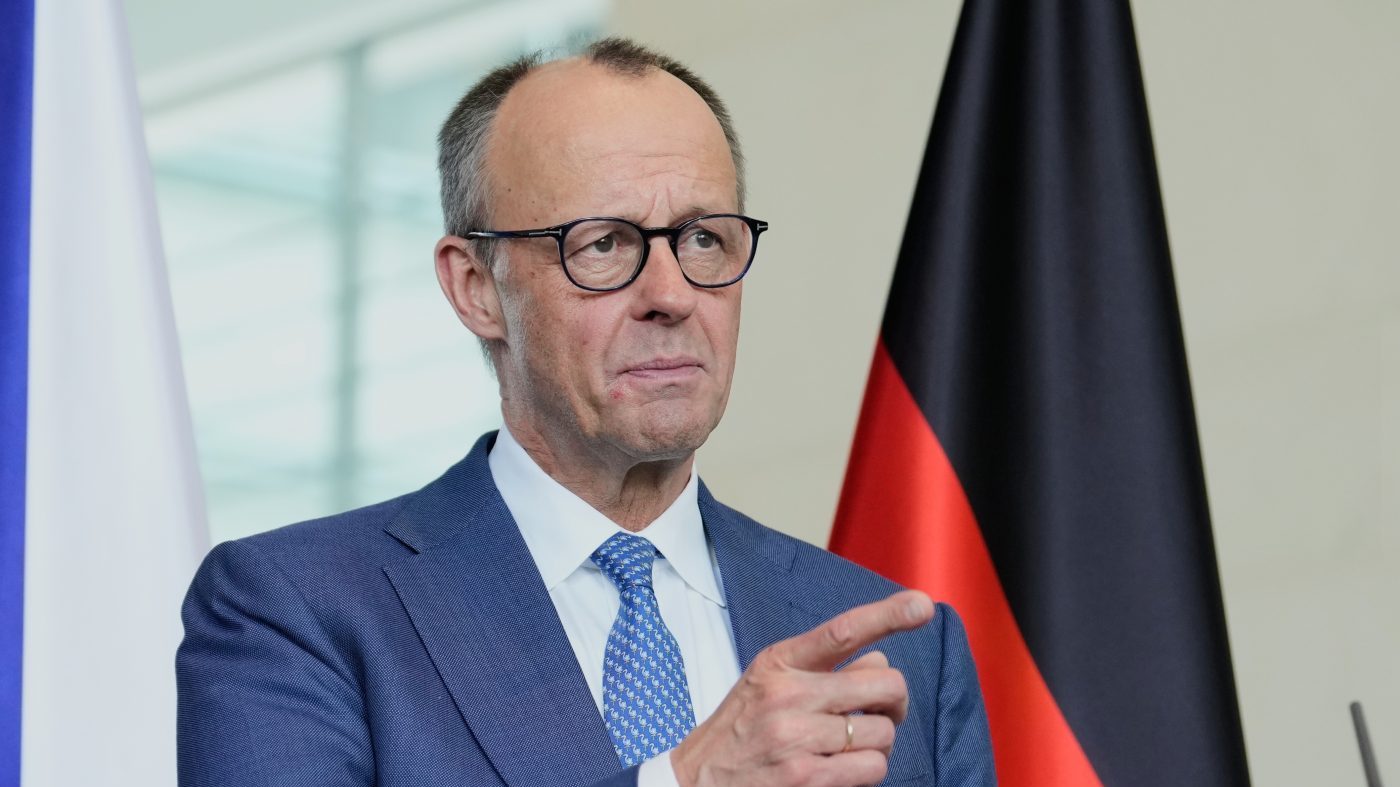
German Chancellor Friedrich Merz on Monday charged that Iran's leadership is humiliating the United States by manipulating President Donald Trump into dispatching and then abruptly canceling travel by his top envoys for negotiations to end the ongoing conflict.
"The Iranians are obviously very skilled at negotiating, or rather, very skillful at not negotiating, letting the Americans travel to Islamabad and then leave again without any result," Merz told students in Marsberg, according to Reuters. "An entire nation is being humiliated by the Iranian leadership, especially by these so-called Revolutionary Guards. And so I hope that this ends as quickly as possible."
Merz's blunt remarks underscore growing European anger over the two-month-old war, which has seen Iran effectively close the Strait of Hormuz, disrupting global energy supplies and hitting Europe especially hard. The chancellor noted that the closure is costing Germany "a lot of money, a lot of taxpayers's money and a lot of economic strength."
Germany is part of a coalition of more than 50 countries, led by France and the United Kingdom, that is crafting an international response to secure the strait once fighting between the U.S. and Iran subsides. Merz revealed that the waterway has been at least partially mined. "We have offered, also as Europeans, to send German minesweepers to clear the strait, which has obviously been mined in part," he said.
The chancellor reiterated that neither Germany nor Europe was consulted before the U.S. and Israel launched the war. He had conveyed his skepticism to Trump in the aftermath. "If I had known that it would continue like this for five or six weeks and get progressively worse, I would have told him even more emphatically," Merz said.
Talks between Tehran and Washington remain deadlocked. Iran recently proposed ending its chokehold on the Strait of Hormuz without addressing its nuclear program, a proposal passed through Pakistan to the U.S., according to Axios. Trump had touted a meeting between U.S. and Iranian officials in Islamabad on Saturday but blocked his top envoys, Steve Witkoff and son-in-law Jared Kushner, from flying to Pakistan after Iranian officials made clear they would not participate.
The crisis has deepened transatlantic tensions, with the German president previously condemning Trump's Iran conflict as illegal and warning of a permanent rupture. Meanwhile, the U.S. Navy is set to enforce a blockade of the Strait of Hormuz starting Monday, a move that could escalate the confrontation further.
Merz's comments reflect a broader European frustration that the war is being waged without allied input, while the economic fallout from the strait's closure continues to mount. The chancellor's call for a swift end to the conflict echoes across the continent, as leaders scramble to mitigate the damage to energy markets and their own economies.