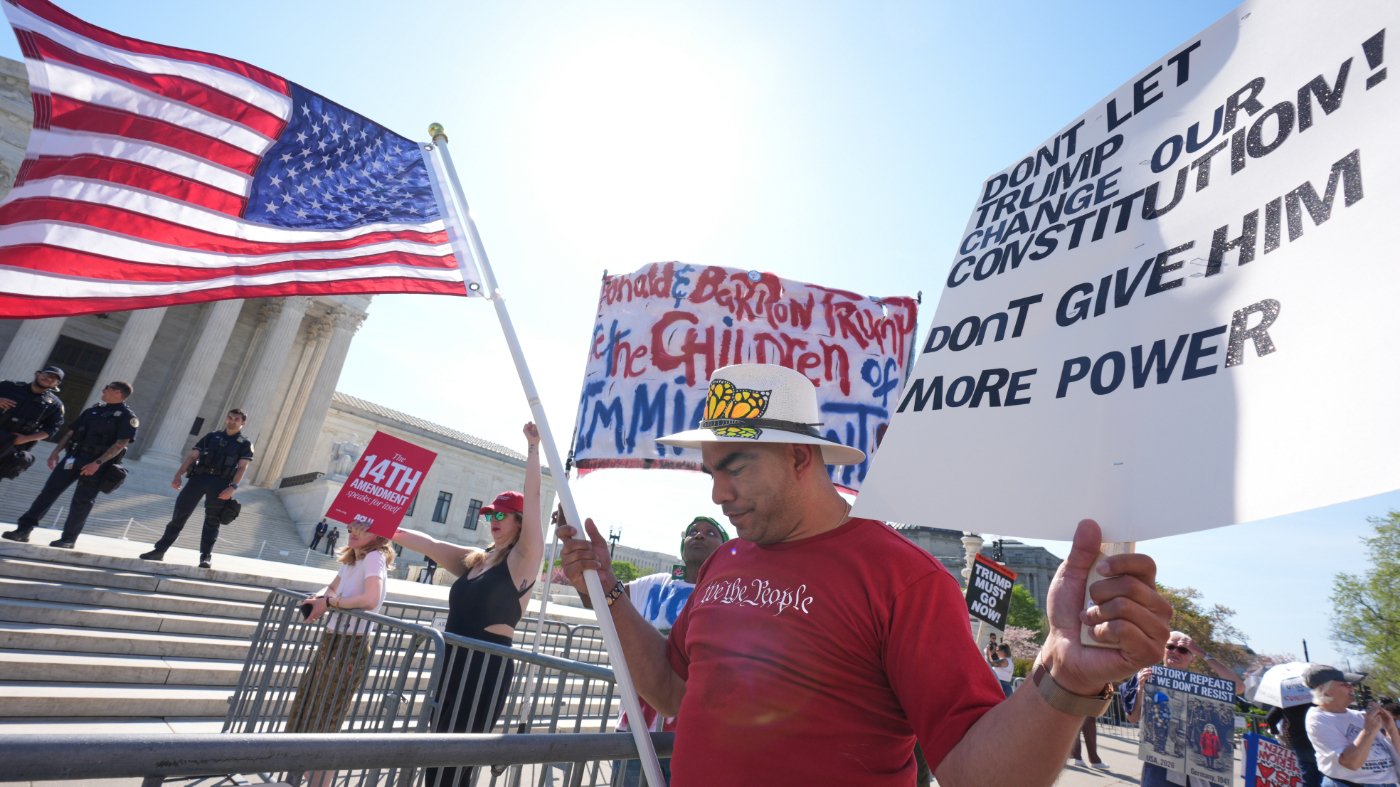
President Trump's two signature voting initiatives are careening toward a catastrophic clash, threatening to strip millions of Americans of their right to vote. The executive order abolishing birthright citizenship, now before the Supreme Court, directly contradicts the SAVE America Act, which demands documentary proof of citizenship for voter registration. Together, they could create a bureaucratic nightmare that disenfranchises a broad swath of the electorate.
The tension is fundamental: the SAVE Act requires official verification of citizenship, while Trump's order would effectively invalidate most standard forms of proof. The executive order, titled “Protecting the Meaning and Value of American Citizenship,” would limit birthright citizenship to children with at least one parent who is a citizen or lawful permanent resident. This flies in the face of the 14th Amendment and the 1898 Supreme Court ruling in United States v. Wong Kim Ark, which affirmed that anyone born on U.S. soil is a citizen. The administration argues that “jurisdiction” implies “allegiance,” a contorted reading that would exclude children of undocumented or temporary residents.
Under this theory, a U.S. birth certificate would no longer suffice as proof of citizenship. Passports, which derive from birth certificates, would also be suspect. Even a parent's birth certificate could be questioned without evidence of a grandparent's citizenship. Only naturalized citizens, whose status doesn't depend on ancestry, would have clear documentation. This echoes the discriminatory voting tests of the Jim Crow era, when literacy tests and grandfather clauses were used to disenfranchise Black voters. The Voting Rights Act of 1965 outlawed those practices, but a new version may be emerging.
The SAVE America Act, which has passed the House and awaits Senate action, would require new voter registration applicants to provide “documentary proof” of citizenship, such as a valid passport, birth certificate, naturalization certificate, or adoption decree, paired with a government-issued photo ID. But if Trump's birthright order stands, those documents—which don't specify parental immigration status—wouldn't prove citizenship under the act. This creates a catch-22: voters would need proof that the order itself renders unreliable.
Over 10 million Americans move each year, and many more change names due to marriage or divorce. The number unable to produce ready proof of citizenship to re-register is unknown, but it would surge under Trump's order. While the order is meant to apply prospectively, Solicitor General John Sauer argued before the Supreme Court that limiting birthright citizenship is the “original public meaning” of the 14th Amendment. If the court agrees, it could retroactively mean millions of American-born children were never citizens, as constitutional original meaning would override executive forbearance.
Because elections are state-run, local officials could selectively accept or reject documentation based on suspicions about an applicant's parents. Those challenged might find it impossible to prove a parent's citizenship or legal status—a burden that could be intentional. Many qualified voters may not risk registering, fearing prosecution for falsely claiming citizenship if they can't document their parents' status.
The Supreme Court is expected to rule on the birthright order by June. The SAVE Act has been blocked by a Democratic filibuster, but Trump is pushing Republicans to eliminate the filibuster and pass it with a simple majority. Either initiative alone would destabilize voting rights for millions; together, they would bring chaos. As Steven Lubet, a Northwestern law professor, notes, some birth certificates may become “more equal than others.”