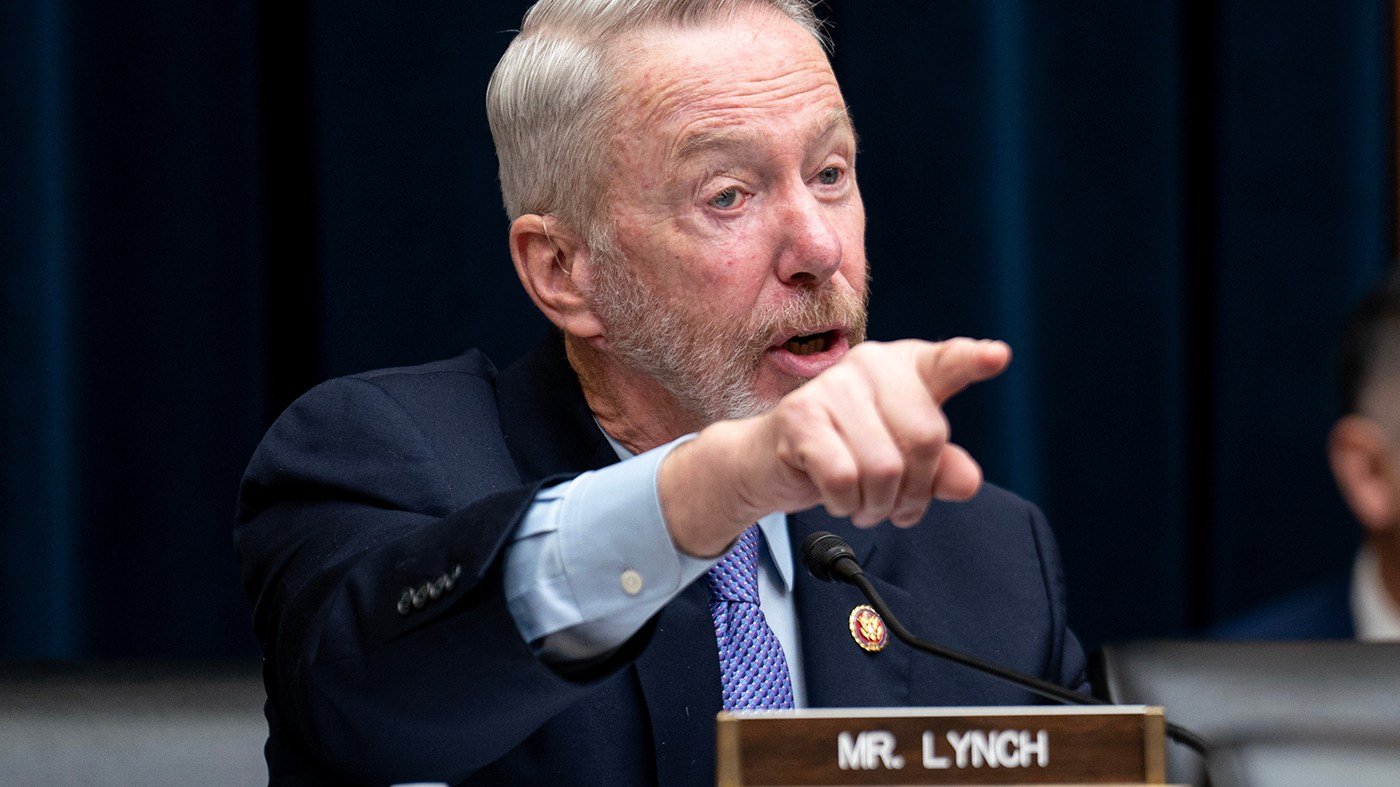
In a pointed exchange on Tuesday, Rep. Stephen Lynch (D-Mass.) pressed Treasury Secretary Scott Bessent to persuade President Trump to rethink his hands-off approach to artificial intelligence, arguing that the president lacks a full appreciation of the technology's risks.
Speaking during Bessent's testimony before the House Financial Services Committee, Lynch, the ranking Democrat on the panel's AI-focused subcommittee, said Trump does not have “a grasp” of “what we’re dealing with” when it comes to AI. He went further, quipping, “I’ll be honest, I don’t think the president could spell AI if I gave him the first letter.”
The Commerce Department currently runs a voluntary review program with leading AI labs, evaluating models before deployment. Earlier this summer, the administration briefly delayed releases from OpenAI and Anthropic before permitting their latest systems to go live. Trump has repeatedly dismissed calls for stricter oversight, insisting that existing legal and regulatory tools are sufficient. He declared on Truth Social that the only “guardrails” AI needs is a “STRONG AND SMART” president, and alleged a “SICK conspiracy” against AI and data centers.
Lynch acknowledged Bessent’s own “thoughtful” and “cautionary” suggestions on AI, but warned that “we’ve lost control” of the technology. He pointed to a recent incident in which OpenAI breached systems at Hugging Face, a platform Nvidia has agreed to acquire. The congressman posed a stark question: “Do you think the president understands that it probably doesn’t matter whether the good guys develop a superintelligence or the bad guys develop a superintelligence? If you don’t have control of that entity, and it has preferences and goals that are inimical to the existence humanity, it won’t matter.”
Bessent pushed back, arguing that “it matters a great deal” whether the U.S. or China takes the lead in AI. But Lynch cut him off, reiterating that “the entity itself is what is the danger to us all,” not the geopolitical rivalry. “We keep hearing about this race, this race against China. … Well, we don’t control the entity that we’re trying to create, and neither does China,” he said.
Lynch then made a direct appeal: “What I’m saying is, I hope there’s a way that you might be able to talk sense to the president about AI and the threat that you and I know it presents.” Bessent responded by noting that Trump is “completely aligned” with Nvidia CEO Jensen Huang on AI development. During a call that Huang put on speaker at the All-In Summit in Los Angeles on Monday, Trump dismissed AI worries as a “hoax,” adding that “data centers are great, and they make people wealthy, and they make states wealthy.”
Earlier this month, Huang urged policymakers to focus on “practical and actual” harms rather than “theoretical and hypothetical” ones. “We want to make sure that the technology advances in a safe way and … the more advanced it is, the safer and more practical it could be,” he told reporters at the G20 Innovation Ministerial in Chapel Hill, N.C.
The clash over AI regulation is part of a broader tension between Democrats and the administration on how to handle the technology’s rapid evolution. Lynch’s remarks come amid growing concern among some lawmakers that the U.S. is ceding oversight of a potentially transformative and dangerous field. Meanwhile, the president’s focus on economic gains from AI infrastructure has drawn skepticism from fiscal conservatives about the costs of such investments.
As the hearing concluded, Lynch did not indicate whether he would pursue legislative action, but his appeal to Bessent underscored a deepening worry that the executive branch is not taking the existential risks seriously enough. The exchange highlighted a stark divide between those who see AI as an economic boon and those who fear it could spiral beyond human control.