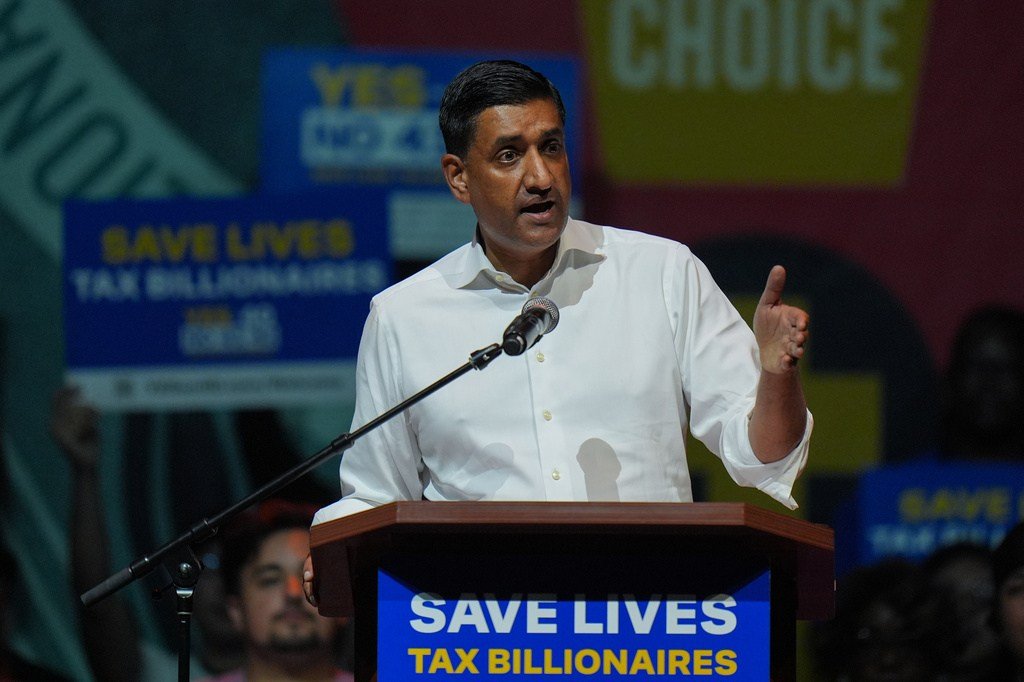
Rep. Ro Khanna (D-Calif.) is making no secret of his ambitions. As he walked across UC Berkeley's campus, he took a swipe at California Gov. Gavin Newsom, saying, "Stop shilling for billionaires." The Silicon Valley congressman has made this critique a central theme, notably clashing with Newsom over Proposition 40, a proposed tax on billionaires that is facing heavy opposition from tech moguls.
At a rally on campus last week, Khanna was greeted like a favorite son. The crowd, a mix of progressive activists and candidates backed by the Working Families Party—including Rep. Aisha Wahab, Jane Kim, and Angela Gonzales-Torres—erupted when someone asked if he would run for president. "Ro for President" signs dotted the audience, underscoring his rising stature in left-wing circles.
Khanna's positioning is clear: he wants to be the standard-bearer for a pragmatic left that embraces markets while taxing the ultra-rich. He describes himself as a "New Deal Democrat," a sharp contrast to Newsom's more centrist approach. On Gaza, Khanna is unambiguous—he opposes military aid to Israel, a stance that sets him apart from many in his party.
But his path to the 2028 Democratic nomination is not without obstacles. On the left, he could face Rep. Alexandria Ocasio-Cortez (D-N.Y.), who has inherited Bernie Sanders' mantle. On the center, he might compete with governors like Josh Shapiro (D-Pa.) and Andy Beshear (D-Ky.).
So what separates Khanna from socialists like Ocasio-Cortez? "Free enterprise means that the government doesn't have control over all of the means of production," he explained. "You wouldn't want Donald Trump controlling everything." He says his goal is a system that rewards "hardworking individuals" rather than those "accumulating wealth in their sleep because of the growth of the stock market."
Pressed for specifics, Khanna pointed to a capital fund to support entrepreneurship and small businesses, along with job-training programs he has launched across the country. "A New Deal," he said, emphasizing a policy agenda that borrows from FDR's legacy.
Khanna's balancing act is delicate. He represents Silicon Valley, a region synonymous with wealth and innovation, yet he has managed to maintain credibility with the left. He has refused to distance himself from socialists, even when it might be politically convenient. When asked about the excesses of the 2020 "woke" era, he offered a nuanced defense: "Woke means being aware of injustices—I think there's nothing wrong with that." He also stood by Francesca Hong, a socialist candidate in Wisconsin, despite her controversial past statements.
His willingness to celebrate American history and support strong borders has earned him some moderate fans. "I've always had a deep love of this country," he said, adding that "we need to celebrate America's history and culture." This has helped him build bridges across the political spectrum, a strategy that could pay off in a crowded primary.
Khanna's ties to Silicon Valley run deep. A former deputy assistant secretary of Commerce under Obama and an intellectual-property lawyer at Wilson Sonsini, he understands the tech world intimately. When Silicon Valley Bank collapsed in 2023, he pushed for federal guarantees on deposits, arguing that letting regional banks fail would only consolidate power in the biggest institutions. It was a stance that served both progressive values and his constituents' interests.
As Democratic infighting heats up ahead of 2028, Khanna is betting that a left tired of losing will embrace a candidate who can appeal to both socialists and moderates. He has already earned goodwill from groups like the Democratic Socialists of America and even some conservatives, who see him as a more principled alternative to figures like Marco Rubio.
But the question remains: Can Khanna maintain this broad appeal without alienating the core progressive base? Unlike Ocasio-Cortez, who has never had to explain her distance from socialism, Khanna must constantly justify his capitalist credentials. It's a tightrope that could define his political future.