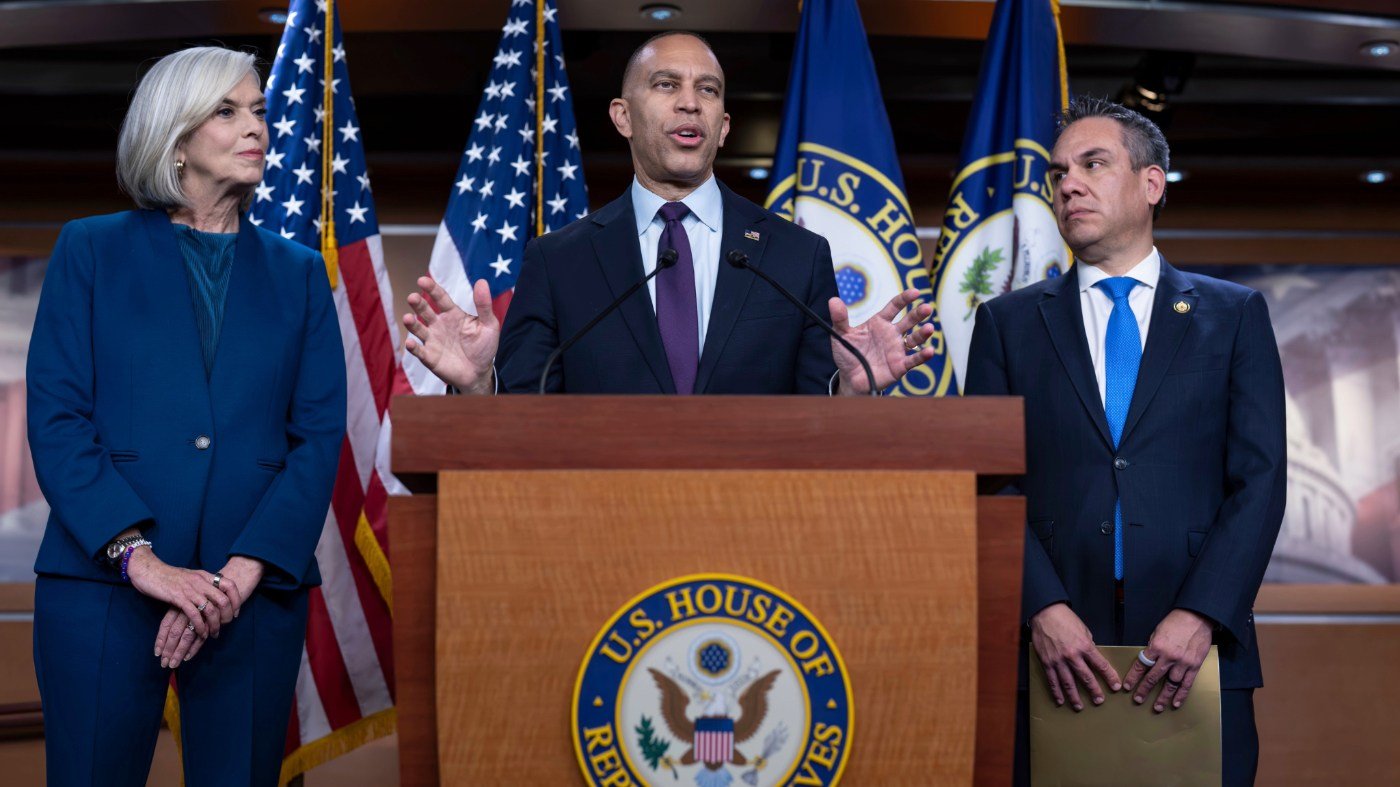
Two weeks after Democrats secured their strongest congressional majorities in decades, the party's internal power struggle has come into sharp focus. The central question: whether the party's direction is set by the moderate candidates who won in swing districts or by the progressive wing that fuels its grassroots energy. The answer is beginning to take shape, but it remains far from settled.
In the House, the decision was relatively straightforward. On Wednesday, Democrats voted 251 to 11 to nominate Rep. Hakeem Jeffries (D-N.Y.) for Speaker, according to House Democrats' leadership vote. Jeffries, who has served as minority leader since 2023, faced a small but vocal contingent of progressive lawmakers demanding more aggressive action on issues like Medicare for All and a tougher stance on the Israel-Hamas conflict. Seven incoming progressive members voted against him, signaling unease within the party's left flank.
Jeffries' victory was not accidental. He met individually with incoming members and sat down with the Congressional Progressive Caucus the day before the vote. Rep. Pramila Jayapal (D-Wash.) left the meeting satisfied on key priorities, though she cautioned that Jeffries has a "relatively short rope" to deliver on progressive demands. His agenda includes reinstating expired Affordable Care Act premium subsidies, reversing nearly $1 trillion in Medicaid cuts, and lowering the Medicare eligibility age—a step toward universal coverage but not the full single-payer system progressives want.
The Senate race is a different story. Sen. Chris Van Hollen (D-Md.) is challenging Minority Leader Chuck Schumer (D-N.Y.) in the first formal contest of Schumer's leadership since 2017. Van Hollen, a progressive veteran, is pushing for an end to the filibuster, outright support for Medicare for All, restrictions on U.S. military aid to Israel, and a ban on the Democratic Senatorial Campaign Committee accepting money from AIPAC. Schumer's allies argue that the challenge is fundamentally about the filibuster, which they see as essential to bipartisan governance.
Schumer enters the Dec. 1 secret-ballot vote with more public commitments, but Van Hollen's campaign reflects a broader desire for change. Many Democratic senators believe voters rejected the status quo and want bold action on costs and governance. The race mirrors the ideological tension within the party, much like the Van Hollen's argument that the majority is a mandate.
Progressives, however, cannot claim full credit for the blue wave. Voters in traditionally red states like Iowa, Kansas, and South Carolina elected moderate Democratic candidates. A New York Times analysis found that the swing toward Democrats was broad but strongest where moderates led the ticket, and weakest where progressives did. Polling reinforces this: a Politico poll found 67 percent of voters prioritize the cost of living, versus 24 percent who chose expanding Medicare for All. A Strength in Numbers-Verasight poll found similar results.
Despite their opposition to President Trump, a majority of midterm voters (51 percent) want the new Congress to work with him, even if it requires compromise. This suggests that voters are not endorsing a progressive agenda but rather a pragmatic approach to governance.
The leadership races are the clearest signal of which direction Democrats will take. House Democrats have answered; Senate Democrats will on Dec. 1. Whoever wins inherits the same political reality: majorities built in red territory cannot be governed on an agenda written for safely blue districts. As Pete Buttigieg warned, it is "yet to be written" whether this election is "one more oscillation" or "the beginning of a tectonic movement." Democrats must move early and visibly on costs, as Buttigieg and Pennsylvania Gov. Josh Shapiro urged, and let the ideological argument wait.
Mistaking this election for a mandate from the left would squander the best opening the party has had since 2008. The party's future depends on recognizing that voters chose competent governance over ideological purity, and acting accordingly.