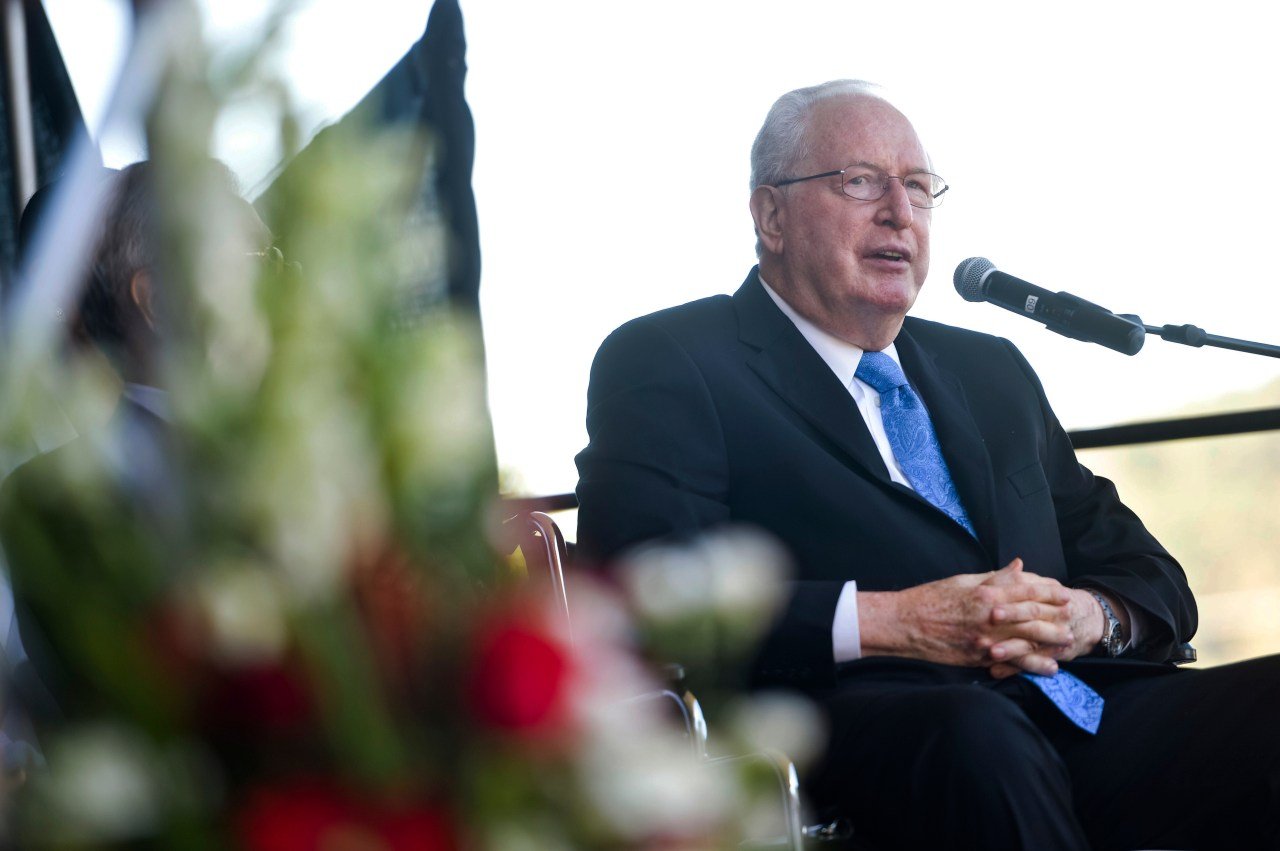
Jay Rockefeller, the last member of the famed Rockefeller political dynasty and the only Democrat among his generation to hold major office, died Thursday night at his home in Washington, D.C. He was 89. His death was confirmed by Mary Stewart, vice president for external affairs at WETA, the public broadcasting station where Rockefeller's wife, Sharon, serves as president and CEO.
Rockefeller's political career spanned half a century, rooted in one of the nation's poorest states despite his family's immense wealth. He arrived in West Virginia in 1964 as a volunteer in an anti-poverty program, was elected governor in 1976, and served two terms before winning a U.S. Senate seat in 1984, which he held for 30 years. "I could not imagine a more rewarding career," he said upon retiring in 2015.
Born John D. Rockefeller IV in New York City, he was the great-grandson of Standard Oil founder John D. Rockefeller, who died a month before his birth. His father, John D. Rockefeller III, was a philanthropist, while his uncles Winthrop and Nelson were Republican governors of Arkansas and New York, respectively. Another uncle, David Rockefeller, led Chase Manhattan Bank.
Rockefeller's path diverged from his family's Republican tradition. At age 27, he moved to the mining community of Emmons, West Virginia, to join the Volunteers in Service to America program, an experience he called transformative. "It explains every policy I pursued and every vote I have cast," he said in his farewell Senate speech in 2014. "It was where my beliefs were bolted down, and where my passions met my principles."
He was elected to the state House of Delegates as a Democrat in 1966, later becoming secretary of state. His only electoral defeat came in the 1972 governor's race against Republican Arch A. Moore Jr., whose daughter, Shelley Moore Capito, would eventually succeed him in the Senate. Capito called Rockefeller "a true gentleman" who treated her with respect and kindness. "We developed a wonderful friendship that transcended politics," she said.
After that loss, Rockefeller stayed in West Virginia, a decision he called the most important of his career. He became president of West Virginia Wesleyan College in 1973, and his popularity, combined with a shift to support strip mining, led to a landslide gubernatorial victory in 1976 over Republican Cecil Underwood. As governor, he focused on infrastructure—roads, sewers, and bridges—calling them "not very sexy things, but very, very necessary."
Current Governor Patrick Morrissey praised Rockefeller's legacy, noting his work in disadvantaged communities, healthcare, coal miners' protections, and veterans' support. "Senator Rockefeller demonstrated a deep commitment to the people of West Virginia," Morrissey said.
In 1980, Rockefeller defeated Arch Moore in a rematch for governor, then won a Senate seat in 1984 after the retirement of Democrat Jennings Randolph. Despite that year's Reagan landslide, Rockefeller won comfortably, aided by his personal fortune—he spent at least $21 million of his own money on campaigns, including $9 million in the 1984 Senate race against Republican John Raese. Bumper stickers in his 1980 gubernatorial race joked, "Make Him Spend It All, Arch."
In the Senate, Rockefeller operated in the shadow of Robert C. Byrd, the longest-serving senator in U.S. history, but carved his own influence. As chair of the Commerce Committee, he championed consumer rights, broadband expansion, and online privacy. He authored the 1997 law creating the Children's Health Insurance Program, which helps families too wealthy for Medicaid. He also led the Veterans' Affairs and Intelligence committees, clashing with President George W. Bush over foreign policy and expressing regret for his 2002 vote authorizing the Iraq War.
Rockefeller also differed with President Obama on mining regulations, reflecting his state's coal economy. His death marks the end of an era for a family that shaped American politics and industry. He is survived by his wife, Sharon, and their children.