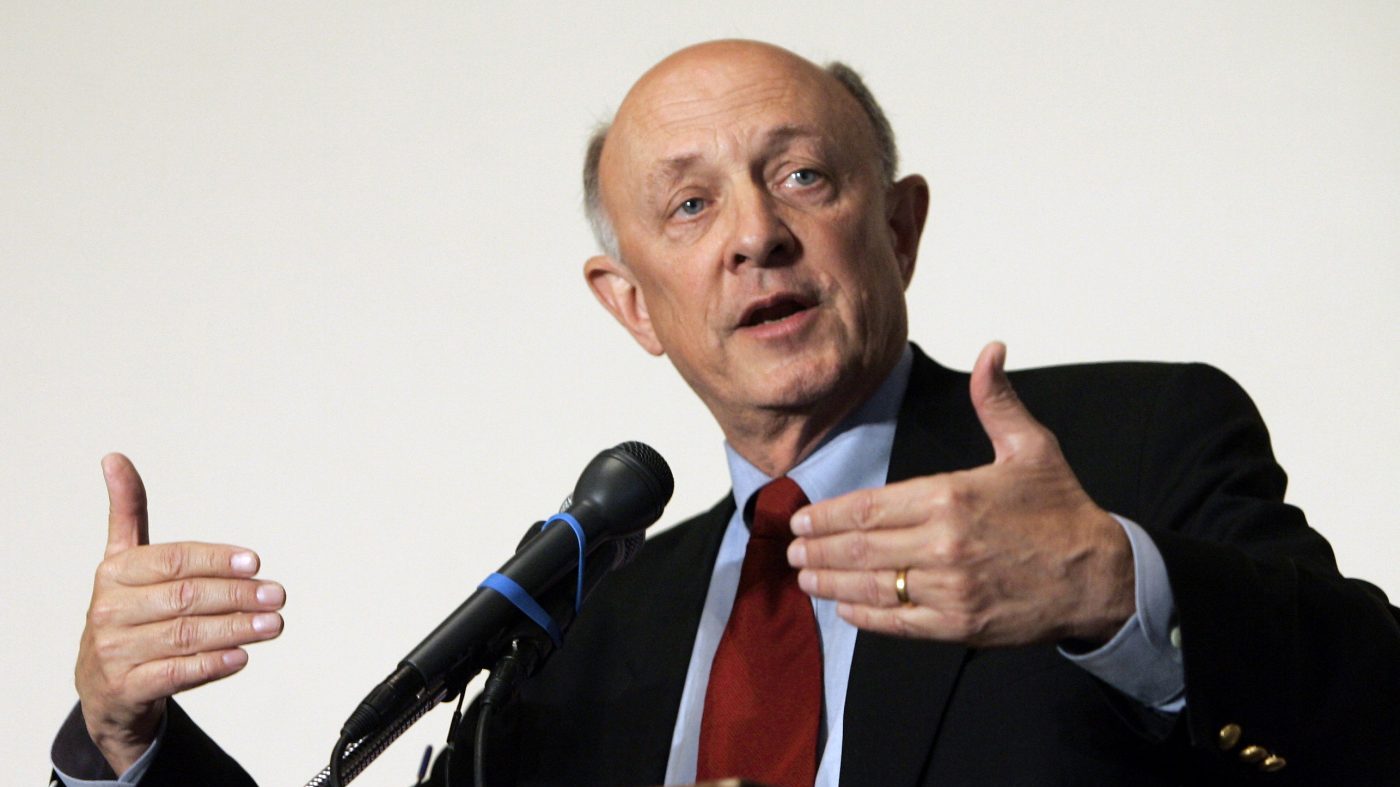
R. James Woolsey, who served as CIA director during the early Clinton administration and later emerged as a leading neoconservative voice pushing for the Iraq War, died Wednesday at his Washington, D.C., home. He was 84.
His wife, Conchita Sarnoff Woolsey, confirmed to The New York Times that he suffered a fatal stroke. She also told The Washington Post that Woolsey died of so-called Havana syndrome, a mysterious ailment first reported among U.S. diplomats in Cuba in 2016 that has since affected other government personnel.

The CIA issued a statement on X, saying: “CIA extends our condolences to the family and loved ones of former Director James Woolsey. He was a great patriot who served his country as Director of Central Intelligence, Undersecretary of the Navy, Ambassador, and attorney.”
Clinton tapped Woolsey to lead the intelligence agency in 1993, a tenure that quickly became fraught. He grappled with the first World Trade Center bombing, the aftermath of the Soviet collapse, and the arrest of CIA mole Aldrich Ames, who had been feeding secrets to Moscow for nearly a decade. Amid mounting criticism and scant backing from Washington, Woolsey resigned in December 1994 after just 18 months on the job.
That bitter departure, former New York Times reporter James Risen told the outlet, “made him much more conservative over time. His bitterness led him to be anti-Clinton. And then that led him to become more Republican in the late ’90s. And then Iraq brought him completely into the Bush, Cheney, neocon orbit, and he became a real pro-Iraq War hawk.”
Woolsey became a vocal champion of the Bush administration’s 2003 invasion of Iraq, arguing for the removal of Saddam Hussein. More than a decade later, he signed on as a senior adviser to Donald Trump’s 2016 presidential campaign, having grown sharply critical of former President Barack Obama. Despite being considered for a national security role, Woolsey never received a post in the Trump administration, according to The New York Times.
Born in Tulsa, Oklahoma, on September 21, 1941, Woolsey graduated from Stanford University, studied as a Rhodes Scholar, and earned a law degree from Yale. He entered government service in 1970 as a staff member on the National Security Council.
Woolsey’s ideological journey from Clinton appointee to neoconservative interventionist mirrors the broader shifts in U.S. foreign policy after the Cold War. His advocacy for the Iraq War placed him at the center of the most consequential and controversial intelligence-driven conflict of the early 21st century. In recent years, the mystery surrounding Havana syndrome has drawn renewed attention to unexplained health incidents among U.S. officials, though the condition remains poorly understood.