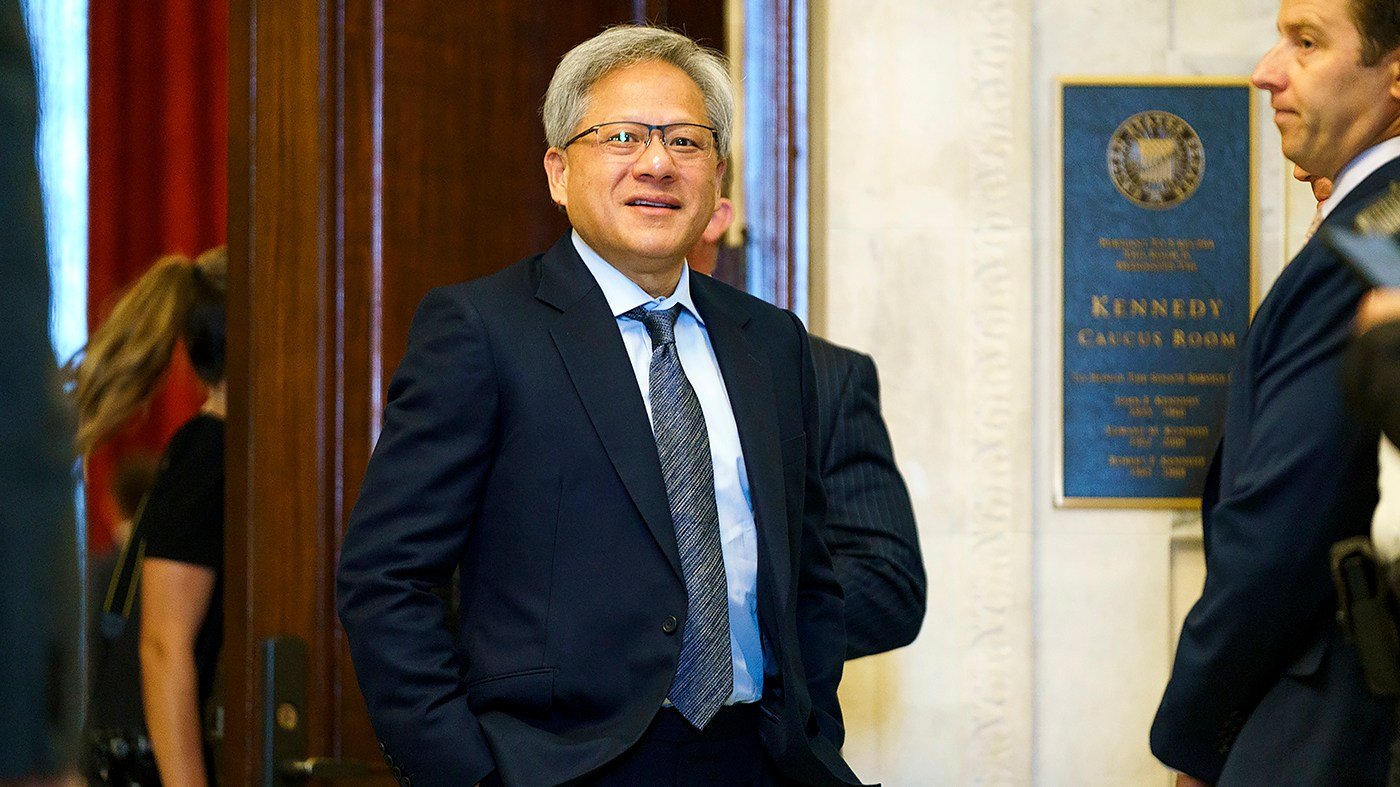
Nvidia CEO Jensen Huang's carefully planned trip to Washington this week has been thrown into disarray by a national security scandal, forcing him to trade the spotlight of his company's flagship conference for the grim setting of congressional hearing rooms.
Huang was originally scheduled to deliver the keynote address at Nvidia's second annual Washington conference on Tuesday, a moment designed to showcase the chipmaker's latest innovations. Instead, he will face lawmakers across four separate panels, who are expected to press him on his admitted affair with a businesswoman suspected of funneling sensitive information to China.
The dramatic pivot comes after a turbulent month for Huang, who abruptly resigned amid a series of affair allegations only to be reinstated less than two weeks later. His return has drawn sharp bipartisan criticism, with lawmakers questioning whether his personal conduct and potential security lapses have compromised U.S. national security.
“He’s got his work cut out for him,” said Cayce Myers, a public relations professor at Virginia Tech. “He has got to do a lot of things that are, in many ways, contradictory to each other. He’s going to face, I think with some Republicans and many Democrats, a hostile audience for that.”
Huang's testimony is scheduled for Tuesday before the House Foreign Affairs Committee, the House Intelligence Committee, and the House Select Committee on the Chinese Communist Party in a closed-door, transcribed briefing. On Thursday, he is set to appear in a public hearing before the Senate Banking Committee.
While Huang is on Capitol Hill, Nvidia executives will be presenting the company's products and projects just over a mile away at its GTC event. The CEO was removed from the agenda following his resignation and was not re-added after his return. Instead, Ian Buck, Nvidia's vice president of hyperscale and high-performance computing, and Justin Boitano, vice president of enterprise AI products, are slated to speak in his former slot.
“The last thing you want to do is cancel that,” said Columbia Business School professor Shiva Rajgopal. “That would be absolutely horrible and terrible … that would be very embarrassing. You just live in a parallel universe, the show goes on, right? And then Congress does what Congress does.”
Lawmakers have shown no signs of easing their scrutiny. In a joint statement, Reps. Brian Mast (R-Fla.), John Moolenaar (R-Mich.), and Rick Crawford (R-Ark.), who chair the House Foreign Affairs Committee, the House Select Committee on the CCP, and the House Intelligence Committee respectively, said: “The NVIDIA board’s brief internal investigation and reinstatement of Jensen Huang do not erase the national security threats and questions that must be addressed.” They added that they remain committed to getting answers on the “mass smuggling of NVIDIA products, their diversion for Chinese military purposes, and their key role in advancing our foremost adversary’s AI capabilities.”
The Republican chairs were among the first to request Huang's appearance after The New York Times reported on his close relationship with Alice Huang, a businesswoman previously linked to Megaspeed, a Singapore-based data center company under investigation for allegedly smuggling Nvidia chips to China. Jensen Huang admitted to the affair, and the board launched an investigation. Days later, following reports of a second affair with a Nvidia executive, he resigned.
Sen. Todd Young (R-Ind.), a member of the Senate Intelligence Committee, laid out the key questions in a post on X: “1. Why didn’t Jensen Huang receive a defensive counterintelligence briefing? 2. Does he still have a security clearance? 3. How are we mitigating the risk from this situation moving forward?”
The AI safety group Americans for Responsible Innovation has also urged Congress to probe Nvidia's compliance with export controls and the potential national security risks posed by Huang's conduct. The hearings come amid broader bipartisan concerns over Nvidia's chip exports to China-linked firms and the Trump administration's handling of such issues.
Huang's dual role as a tech titan and a political lightning rod underscores the complicated path ahead. He retains support from President Trump and Silicon Valley leaders, but his credibility on Capitol Hill has been severely damaged. As Myers noted, “I think the best hope that he can have is to get through it as unscathed as possible. He is going to have some tough questions and he’s going to have some hostile questions and I anticipate that he is going to have to provide some very difficult answers.”
With the GTC event proceeding without its CEO and congressional hearings dominating the week, Huang's split-screen moment is a stark reminder of the intersection of business, politics, and national security. The outcome of these hearings could have lasting implications for Nvidia's operations and U.S. technology policy.