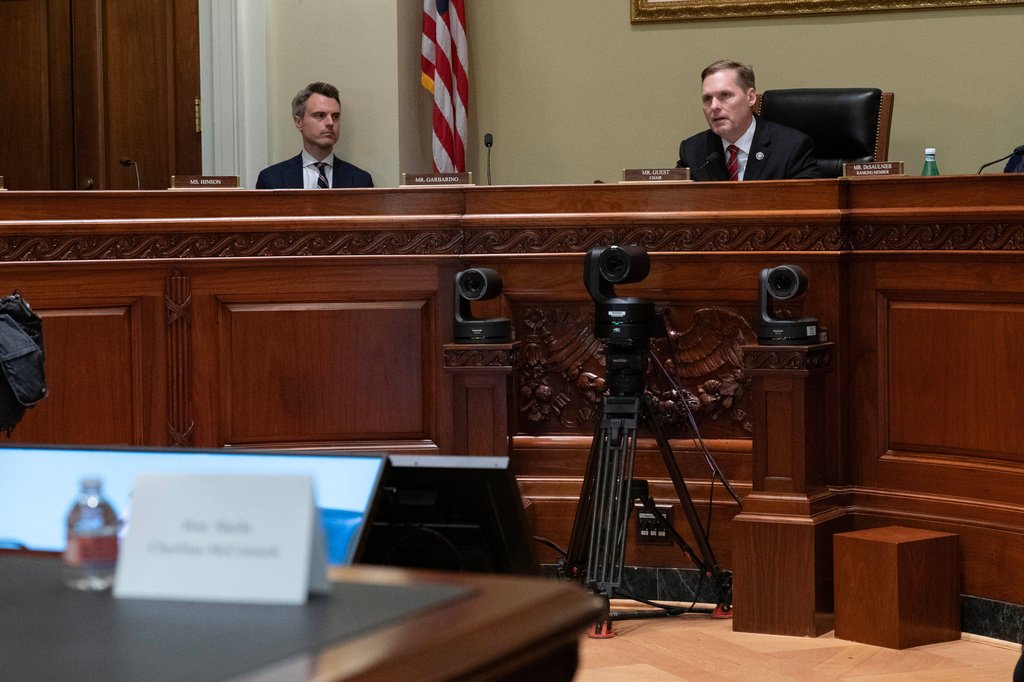
The House Ethics Committee is engulfed in a crisis of its own making, as it increasingly functions as a political weapon rather than a neutral arbiter. Current allegations against former Reps. Eric Swalwell (D-Calif.), Tony Gonzales (R-Texas), and Sheila Cherfilus-McCormick (D-Fla.) have led to resignations, while Rep. Cory Mills (R-Fla.) faces ongoing investigations. Speaker Mike Johnson (R-La.) has vowed to exact punishment on what he calls 'predators' in Congress.
Lawmakers from both parties describe the situation as a crisis, but this is not the first time the Ethics Committee has been used to shield high-ranking members. In 1987, I was a 23-year-old press secretary for Rep. Austin Murphy (D-Pa.) when the committee voted to reprimand him for diverting congressional property, allowing proxy votes, and employing a no-show staffer. The timing and targeting were politically motivated, designed to protect then-Speaker Jim Wright from a looming scandal fueled by then-Rep. Newt Gingrich's relentless campaign.
The committee's decision to make an example of Murphy was a calculated move. A leak to the Washington Times and a story by a reporter known for covering the Kennedy assassination suddenly made Murphy the face of congressional corruption. Our chief of staff and I drafted a statement asserting the committee had 'one agenda from the start, to simply make an example of someone.' History proved us right when Gingrich's ethics complaint against Wright led to his resignation the following year.
Today's crisis mirrors that pattern. The current allegations against Swalwell, Cherfilus-McCormick, and Mills are far more serious than a ghost employee or proxy vote, but the institutional response remains disturbingly similar. Lawmakers are racing to pair expulsion votes, with Republicans refusing to move on Gonzales unless Democrats act on Swalwell, and vice versa. This partisan standoff is driven by a razor-thin majority and deep mutual distrust.
What history teaches is that the Ethics Committee becomes most dangerous when it is deployed as a political cudgel. Lawmakers in both parties express frustration, with one House Democrat privately saying, 'These jerks are destroying Congress.' But the solution is not a synchronized purge engineered to avoid partisan embarrassment. It requires an Ethics Committee that functions independently of leadership pressure and investigates based on evidence, not on who needs protection upstairs.
The recent wave of resignations has sparked a bipartisan push to overhaul House ethics, but meaningful reform remains elusive. The committee's credibility is at stake, and its ability to serve as a neutral arbiter is critical to restoring public trust. Without fundamental changes, the institution risks repeating the mistakes of the past.
I learned from my experience with Murphy that the process matters as much as the outcome. Congress has survived these moments before, but not if the Ethics Committee remains a weapon for whoever is clever enough to pick it up first. The current crisis demands a reckoning, not just with individual misconduct, but with the systemic failures that allow power to corrupt the very mechanisms of accountability.