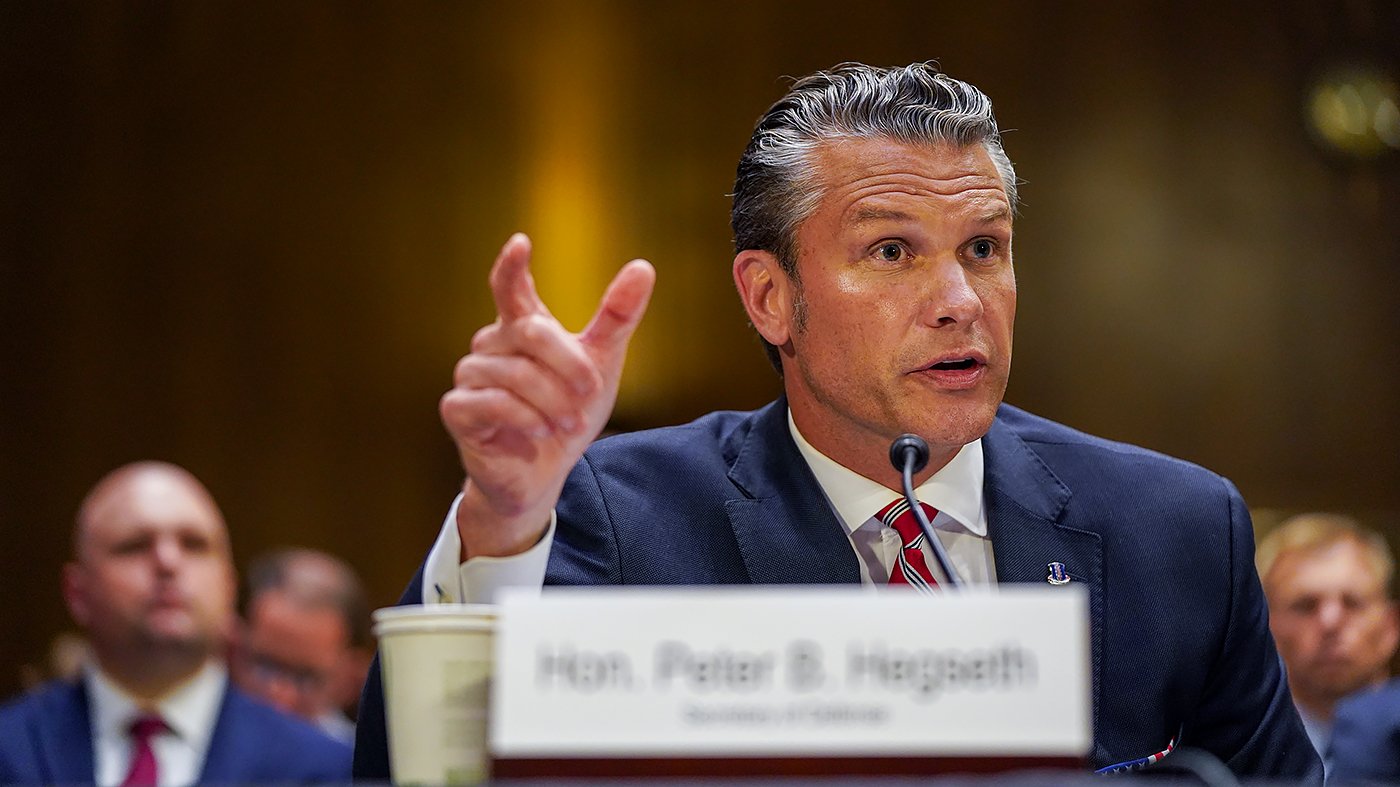
Defense Secretary Pete Hegseth has yet to secure significant Republican backing for the Trump administration's request for tens of billions of dollars to sustain the Iran conflict, a campaign that has rapidly drained U.S. munitions and Pentagon budgets. The effort is further hampered by eroding GOP confidence in Hegseth's stewardship of the military as the war enters its sixth month with no clear endpoint.
Several Republican senators emerged from a closed-door meeting with Hegseth on Wednesday evening still uncommitted or silent on whether they would support a $95 billion reconciliation package that includes $73 billion for the Pentagon and intelligence agencies. The session, part of a series of summer briefings, underscores the administration's difficulty in rallying lawmakers behind an unpopular war and a separate reconciliation bill for broader military priorities.
Sen. Lisa Murkowski (R-Alaska) described the meeting as an opportunity for Hegseth to outline his defense vision but stressed that such briefings should be bipartisan, given the stakes for national security. When asked if she was convinced of the need for the requested spending, she said, "That has yet to be determined."
Sen. Joni Ernst (R-Iowa) echoed that uncertainty, noting that despite Hegseth's July 21 testimony before the Senate Appropriations Committee, "I still don't know that there's a lot of clarity on that. I think that's what a lot of people are concerned about."
Senate Appropriations Committee Chair Susan Collins (R-Maine), who has clashed with Trump over spending authority, declined to comment on the meeting due to its classified nature. Collins, facing a tough reelection, has long opposed using reconciliation to bypass the regular appropriations process, which requires bipartisan input.
The administration's ask comes amid independent estimates that the war's cost has reached at least $132 billion, far exceeding Hegseth's July figure of $37.5 billion. Meanwhile, the White House is also seeking an $87.6 billion supplemental package, primarily to replenish Pentagon stocks as strikes on Egypt, Saudi Arabia, and Jordan resumed this week.
President Trump, during a Camp David cabinet meeting, touted a historic $1.5 trillion defense budget for fiscal 2027, including a $1.15 trillion top line and a $350 billion reconciliation bill. "People see now how important it is," Trump said. "We want to keep a safe country."
But the price tag has proven a hard sell, prompting Hegseth to engage in repeated meetings with GOP lawmakers. Earlier Wednesday, White House budget director Russell Vought and legislative aide James Braid also met with Senate Republicans at a lunch.
Sen. Rick Scott (R-Fla.) said the Hegseth meeting yielded "a lot of work," but he doubted Congress would exceed the House's funding level, suggesting any additional money might wait until after the midterms. Sen. John Curtis (R-Utah) said he would not support Iran war funding without congressional authorization, telling The Hill, "I have zero information about what's in it."
The impasse comes as Senate Majority Leader John Thune (R-S.D.) hopes to schedule a vote on government funding before the August recess, though the path forward remains uncertain amid GOP divisions over spending and the war's trajectory.