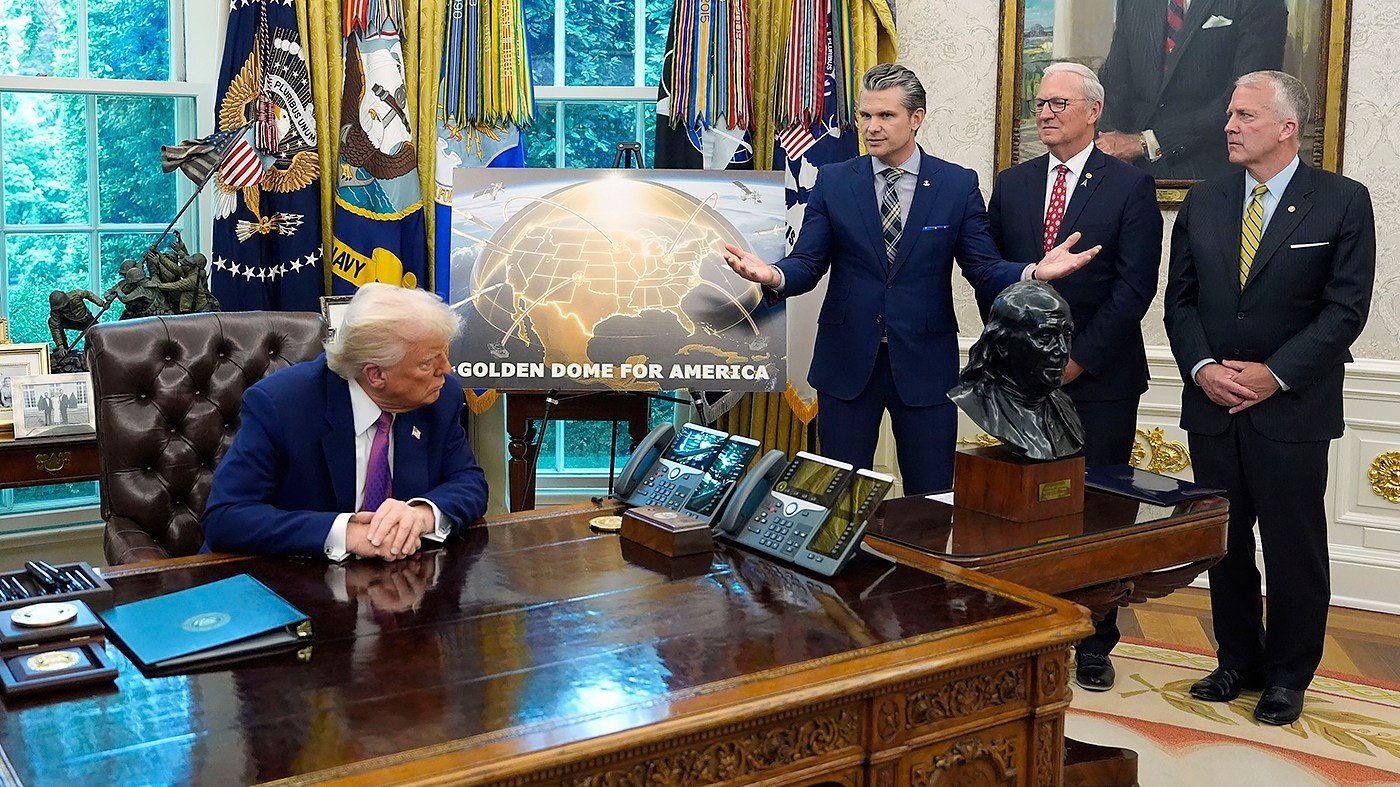
President Trump's ambitious Golden Dome missile defense initiative is entering the new fiscal year with no appropriated funds, as a politically fraught budget strategy and unresolved questions about its scope threaten to stall the program before it truly begins.
The program, which aims to shield the continental U.S. from ballistic, hypersonic, and advanced cruise missiles using a space-based intercept layer, carries an estimated price tag of $1.2 trillion over two decades. But as of October 1, the start of fiscal year 2027, the Pentagon has no money to move forward, according to Thomas Karako, director of the Missile Defense Project at the Center for Strategic and International Studies.
“The program has no money,” Karako told The Hill. “This stands or falls with FY-27 appropriations. It is life and death from that standpoint. Without money there's no program, it's just PowerPoint slides.”
The funding crunch stems from the Pentagon's decision to place the bulk of Golden Dome's initial funding inside a $350 billion reconciliation package, rather than the traditional appropriations process. The base budget request includes only $400 million for the program, while the reconciliation bill would provide $17 billion. But with Congress showing little appetite for another party-line spending bill, and the government operating under a continuing resolution that freezes spending at prior-year levels, the program's immediate future is uncertain.
Sen. Mike Rounds (R-S.D.), who chairs the Senate Armed Services subcommittee that oversees missile defense, expressed frustration at a September 29 hearing. “Should it have been necessary to go to a reconciliation to get this started? I would say no. This should have been on a bipartisan basis,” he said. “I won't lay fault for why that isn't happening, I'm just simply saying we need to get back to a bipartisan approach to this as soon as possible.”
Sen. Angus King (I-Maine), the subcommittee's ranking member, called Golden Dome “one of the most expensive and largest projects ever undertaken by the United States government,” and said it was “very bothersome” that the administration bypassed the regular appropriations route.
The program has already consumed significant funds: Congress provided $22.5 billion in a March reconciliation bill, and Space Force Gen. Michael Guetlein, who oversees the program, said this summer that 90 percent of that money was obligated in under six months. Guetlein has also warned that a continuing resolution hampers his ability to manage the program because there's no clear topline to work from.
Beyond the funding fight, lawmakers are pressing for clarity on what Golden Dome would actually deliver. Karako testified that the program “suffers from a serious lack of strategic messaging and explanation of what it is and what it's trying to do,” and that without it, the concept “conjure up fanciful ideas and memes. Critics and cheerleaders project onto it their fears or fantasies, and political polarization doesn't help.”
King pressed the point, asking: “Who decides who is protected and who isn't?” Karako suggested the shield would likely prioritize major cities and critical infrastructure rather than blanket the entire country—a nuance that has been lost in public debate.
As the White House and Pentagon push forward, the immediate fate of Golden Dome rests on whether Congress can find a bipartisan path to fund it. Without that, as Guetlein put it, “there is no Golden Dome because there is no funding.”