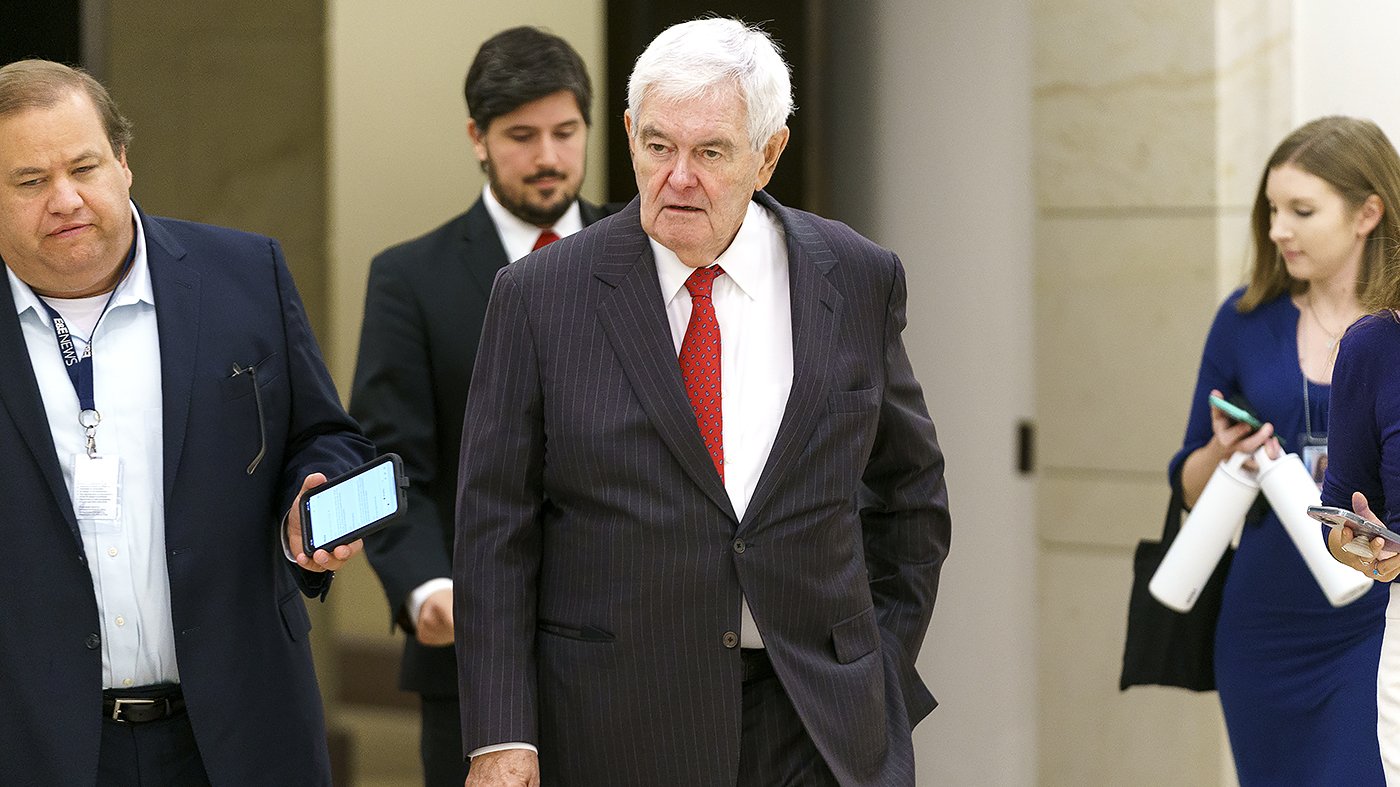
Former House Speaker Newt Gingrich (R-Ga.) acknowledged on Wednesday that the impeachment of President Bill Clinton was a strategic error, arguing that the controversy over the Lewinsky affair obscured what he sees as the true offense: perjury in a sexual harassment lawsuit.
In an appearance on the New York Post's "Pod Force One" podcast, Gingrich said, "I think it was a mistake, because the real problem wasn't Lewinsky. The real problem was he committed perjury in a case involving sexual harassment when he was governor. And perjury's a felony."
Clinton was impeached by the House in 1998 on charges of perjury and obstruction of justice, stemming from his denials under oath about his relationship with White House intern Monica Lewinsky. The Senate later acquitted him, allowing him to finish his second term.
Gingrich, who led the Republican charge for impeachment, now says the case was mishandled. "I always argued the question, 'Is he allowed to commit felonies?' But by allowing it to be about sex, it trivialized it," he said.
He noted that Clinton was later stripped of his law license in Arkansas and barred from practicing for five years after leaving office, a consequence of his false testimony in the Paula Jones sexual harassment case. Jones had accused Clinton of making unwanted advances while he was governor, a claim Clinton initially denied before settling out of court in 1998.
The former speaker said his perspective shifted during a conversation with his daughters. "I realized that we were really off course in August of that year, when I was at the OK Cafe in Atlanta with my two daughters... and they both said to me, 'If our friends lose money on their 401(k) because of some stupid intern, we are going to be mad at you,'" Gingrich recalled. "And I realized at that point I had completely misunderstood how the culture was evolving."
Gingrich also suggested that the impeachment saga contributed to Al Gore's loss in the 2000 presidential election. Gore, he argued, made a mistake by distancing himself from Clinton, whose popularity remained high. "He consciously wanted to be a step away from Clinton," Gingrich said, adding that "Gore was, frankly, not popular enough to be a step away from Clinton."
The remarks come amid ongoing debates about the use of impeachment as a political tool. In a related development, former President Donald Trump has called for the impeachment of House Minority Leader Hakeem Jeffries over comments about the Supreme Court. Gingrich's retrospective critique adds a layer of complexity to the current discourse on accountability and partisanship.
Gingrich's admission is likely to fuel discussion among political analysts about the long-term consequences of the Clinton impeachment. While some see it as a necessary check on executive misconduct, others view it as a politically motivated overreach that ultimately backfired.