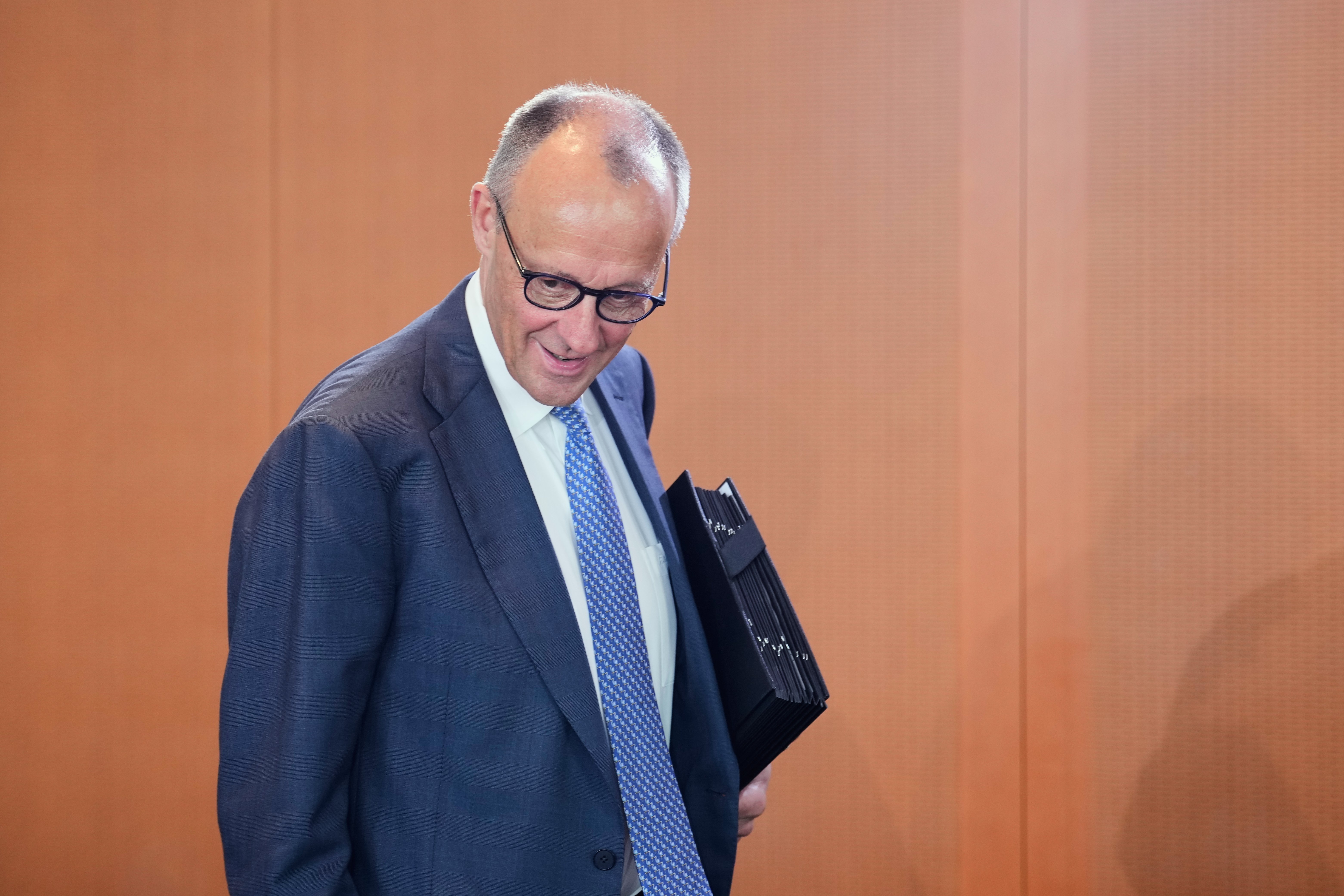
Germany is dramatically reversing decades of post-Cold War military restraint, hiking defense spending to levels not seen since reunification. Berlin has allocated $114 billion for defense in 2025, equivalent to 2.3 percent of its GDP—a 24 percent jump from the previous year. Chancellor Friedrich Merz, who took office last year, has staked his leadership on a pledge that the country's security posture now demands 'whatever it takes.'
The spending surge marks a historic pivot for a nation that once symbolized the peace dividend. During the Cold War, West Germany fielded NATO's second-most capable land force, trailing only the United States, while East Germany's army ranked second in the Warsaw Pact after the Soviet Union. That military prowess fueled anxiety among European leaders like Margaret Thatcher and Francois Mitterrand, who initially opposed German reunification, fearing a return to the aggression of World War II.
Thatcher, in a 1989 conversation with Soviet Premier Mikhail Gorbachev, warned that unification could destabilize the entire international order and threaten European security. But the Germany that emerged after the Berlin Wall's fall chose a different path: it slashed its military, with defense spending declining steadily from 1991 to 2007, and only modest upticks afterward. By 2014, Berlin allocated just 1.15 percent of GDP to defense, even as Russia invaded Georgia in 2008 and seized Crimea in 2014. It took Russia's full-scale invasion of Ukraine in 2022 for then-Chancellor Olaf Scholz to raise spending to 1.52 percent of GDP.
Now, under Merz, Germany is not only spending more but also setting ambitious targets. He has committed to reaching 3.5 percent of GDP—roughly $189 billion—by 2029. That would make Germany the world's fourth-largest defense spender and a dominant force within NATO. This shift comes as the U.S. weighs troop reductions in Europe, with some experts warning that such a move could undermine American power and alliance cohesion.
Blueprint for European Defense Autonomy
A new report from a consortium of five leading German think tanks, former officials, and business leaders, titled 'Achieving European Defense Autonomy: A Roadmap for Overcoming Critical Deficiencies,' lays out a detailed path for Berlin to lead Europe away from reliance on the United States. Though the report addresses Europe broadly, its prescriptions are heavily focused on Germany, which it calls 'the holder of the largest European defense budget' and thus bearing 'particular responsibility' for the continent's security.
The report identifies ten critical capability gaps where Europe cannot currently function without U.S. support. It sets specific timelines and spending targets to close each gap, with Germany playing a lead role in nearly all. For instance, it notes that Europe lacks a command-and-control system capable of operating in denied environments, but points to Ukraine's Delta system—already integrated with NATO—as a model. 'Germany's access to Delta data since April 2026 provides a valid starting point,' the report states.
On unmanned ground vehicles, the report argues that Germany, as the world's leading automotive manufacturer, should be able to mass-produce them quickly. It also calls for Berlin to take a 'driving role' in developing sixth-generation air combat systems that blend manned and unmanned platforms. For satellite communications, it recommends scaling up German reconnaissance constellations to serve as European reference projects, effectively creating a 'European Starlink equivalent.'
If Germany follows through, it will become the undisputed military heavyweight of Europe—a prospect that might revive the fears Thatcher expressed in 1989. But the report's authors and many analysts argue that the Germany of 2026 is not the Germany of 1936. Instead, they see a robust German military as essential to countering Russian revanchism and building a credible European deterrent. As the U.S. signals a potential withdrawal of troops from Germany, the pressure on Berlin to assume greater responsibility has intensified.
The question now is whether Europe's other capitals will follow Berlin's lead. The report urges them to accelerate their own defense spending timelines and invest in the technological advances needed to achieve true autonomy. For now, Germany is setting the pace—and betting that its military renaissance will strengthen, not fracture, the alliance.