Democrats’ surprising Senate victories in deep-red states like Kansas, Texas, and Iowa were fueled in part by rural voters frustrated with soaring diesel and beef prices. Now that Democrats are poised to control both chambers of Congress, those same farmers are expecting concrete results—not just campaign rhetoric.
“There’s a lot of pressure,” said Democratic strategist Maria Cardona. “But Democrats are looking at it as a tremendous opportunity to show the country not just what they can do, but to contrast it with what Republicans have done.”

The most immediate lever Democrats have to lower diesel and fertilizer costs is to force President Trump to wind down the Iran conflict. Since the war began in late February, fuel prices have spiked: a gallon of gas is about $1.02 more expensive than a year ago, and diesel is up roughly $2.56, according to AAA. That hits farmers hard, since diesel powers tractors, combines, and other heavy machinery.
Cardona argued Democrats should “take away funding for the war, and push on a war powers act,” which would pressure the administration to end the conflict and stop spending $2 billion a day. “That will start to relieve pressure on gas and diesel,” she added.
Beef prices have also climbed during Trump’s second term, as the national herd shrinks and tariffs hurt ranchers. Before the election, cattle producers criticized the president for lowering tariffs on imported beef. Brendan Steinhauser, a Texas-based GOP strategist, called diesel and beef prices a “complicated, entangled issue,” but said the next Congress can rein in tariffs and push to end the eight-month war. “Those are probably the first two things that they can do,” he said.
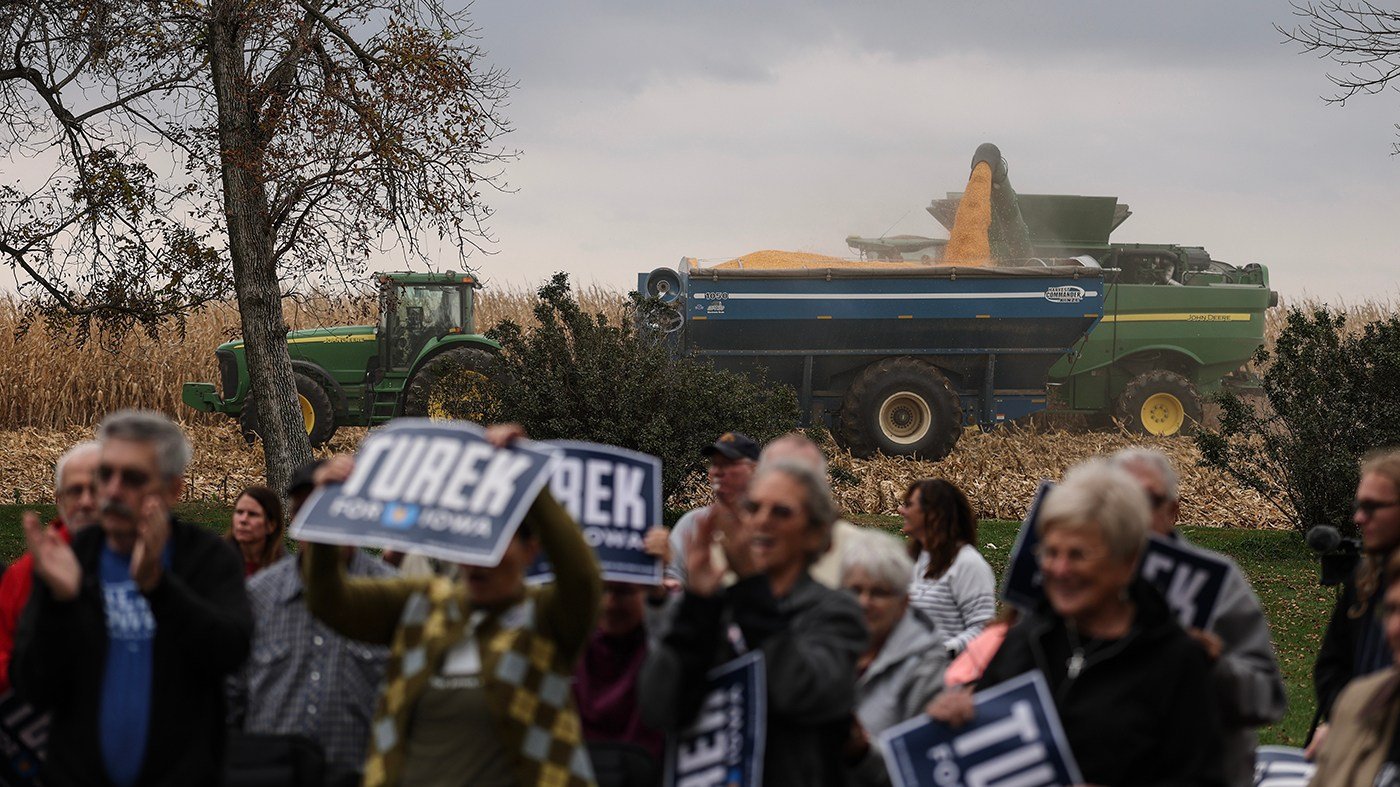
The economic squeeze was decisive in farm country. Kansas elected a Democrat to the Senate for the first time since 1934, Texas for the first time since 1988, and Iowa sent Democrat Josh Turek to the upper chamber—a seat the party hadn’t won since 2008. David Kochel, a longtime Iowa Republican strategist, said high diesel prices were “very consequential” to Turek’s victory, noting the Democrat didn’t have to do “anything” to capitalize. “It didn’t require any strategy on his part,” Kochel added.
Even in Mississippi, where Democrat Scott Colom was narrowly leading Republican Sen. Cindy Hyde-Smith with most votes counted, beef prices moved voters. Colom’s ad targeted Hyde-Smith for saying Mississippians “have so many proteins to choose from,” with Colom arguing the state should “pick another senator.”
Once the 120th Congress convenes in January, Democrats will face pressure to deliver relief. Beyond ending the war and curbing tariffs, experts point to deeper structural fixes. Charlie Decker of the National Farmers Union has urged the EPA to stop exempting large oil refineries from biodiesel and renewable diesel production requirements. “Currently, the only alternatives to petroleum-based fuels available to American farmers and consumers are biodiesel and renewable diesel,” he wrote. He also backs federal investment in low-carbon fuels and permanent authorization for year-round E15 sales.
Dr. Faith Parum of the American Farm Bureau Federation supports changes to renewable fuel standards to benefit domestic feedstocks like corn, soybeans, and canola oil. She also highlighted the farm bill, which the House passed and the Senate Agriculture Committee advanced, noting it would raise the credit limit for the first time since 2018 if the Senate passes it.
On beef, analysts at Farm Action have called for restoring mandatory country-of-origin labeling for meatpackers, creating a heifer retention tax credit, and expanding independent processing capacity. They also suggested giving Congress authority to address price gouging in concentrated food markets during emergencies.
Whether such proposals can survive a Democratic Congress with diverse ideologies—and a president who could veto them—remains uncertain. But the party’s midterm wins were earned, and farmers are now watching to see if Democrats turn promises into policy. As Democrats map a multifront strategy to curb Trump’s agenda, rural voters who helped flip those seats will be a key test of whether the party can deliver.