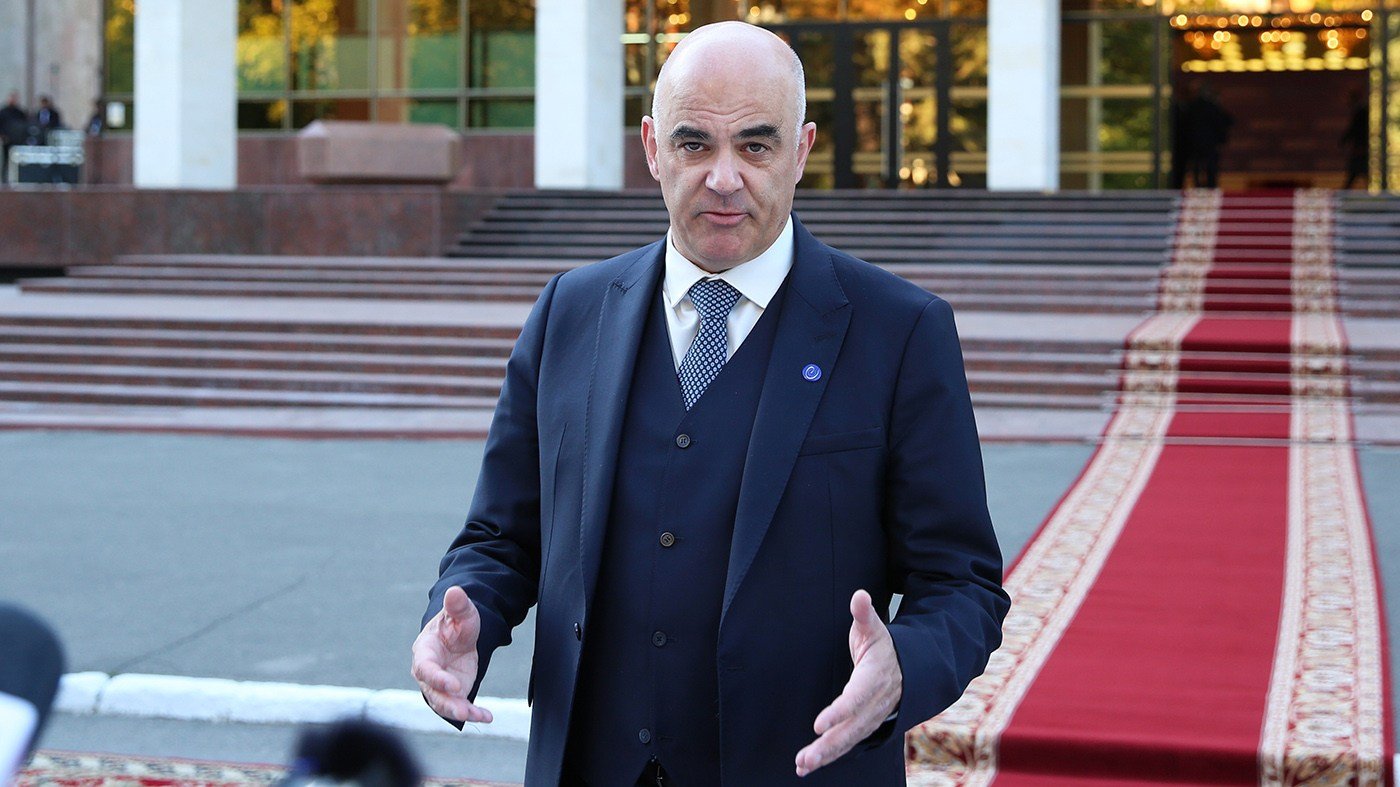
The Council of Europe's secretary-general, Alain Berset, made his inaugural visit to Washington last week, aiming to raise the profile of a human-rights-centered AI framework that has gained little traction beyond the organization's own membership. The treaty, known as the Framework Convention on Artificial Intelligence, was finalized in September 2024 and signed by the Biden administration along with more than 20 other countries, including Japan and Israel. Yet it remains largely obscure outside the Strasbourg-based body, which counts 46 member states across Europe.
Berset, a former Swiss president, met with lawmakers, think tanks, and journalists during his trip, pressing the case for international rules on AI that respect human rights, democracy, and the rule of law. The framework is legally binding, but so far only the European Union has ratified it, doing so in May 2026. The slow pace of adoption underscores the challenge of building global consensus on AI governance, especially as the Trump administration has rejected most regulatory efforts.

Speaking with The Hill, Berset acknowledged the difficulty of rallying cooperation in what many view as a technological arms race. "I do not see any alternative to a strong, I would say, involvement of states," he said, arguing that the framework provides a starting point despite its limited uptake. He pointed to warnings from tech leaders about AI's potential to cause catastrophic harm, saying, "For the first time, we have specialists telling us that this revolution could destroy humanity in a few years. This should be a quite hard wake up call for all of us."
The visit came after Berset opened a permanent observer office for the Council of Europe at the United Nations in New York, a move intended to amplify the organization's work on human rights and democracy. At the U.N., he highlighted the AI framework as a concrete tool for global governance, saying, "Our task is to connect these strengths." The council's expansion into U.N. circles follows recent warnings from AI executives urging the Security Council to impose restraints on their own industry.
The Council of Europe, founded in 1949 in the aftermath of World War II, is one of the continent's oldest human rights bodies. Its European Convention on Human Rights, enforced by the European Court of Human Rights, has produced roughly one million decisions, according to Berset. The organization has drafted around 200 treaties, giving it a track record in international law that Berset argues is relevant to AI regulation.
Unlike the European Union, the Council of Europe includes non-EU members such as Turkey, Ukraine, and observer states like the U.S., Canada, and Japan. "We have created the biggest common legal space that exists in the world," Berset said in a speech at the Hudson Institute. "It's not that visible but it's extremely important for having this convergence, year after year, between the 46 members."
Critics of the AI framework may question its effectiveness, but Berset insists it offers a viable path forward. "I would be more than happy if you bring a better answer. We have at least one answer, we have one element," he said. The push comes as partisan gridlock in Congress continues to stall broader AI legislation, and as international panels warn that current safety measures are inadequate.
Berset's advocacy highlights a growing divide between the United States and Europe over how to handle AI's risks. While the Biden administration had signed onto the Council's framework, the Trump White House has shown little interest in international agreements, preferring a hands-off approach. That stance has frustrated lawmakers who want more oversight, but it also reflects a broader debate over innovation versus safety.
For now, the Council of Europe's AI treaty remains a symbolic gesture for many, but Berset sees it as a foundation for future cooperation. "It is one contribution. It is not the only one, it will not be the only one, but it is one concrete contribution," he told The Hill. Whether other nations follow the EU's lead remains uncertain, but the council is betting that its legal expertise and broad membership can help shape the global conversation on AI.