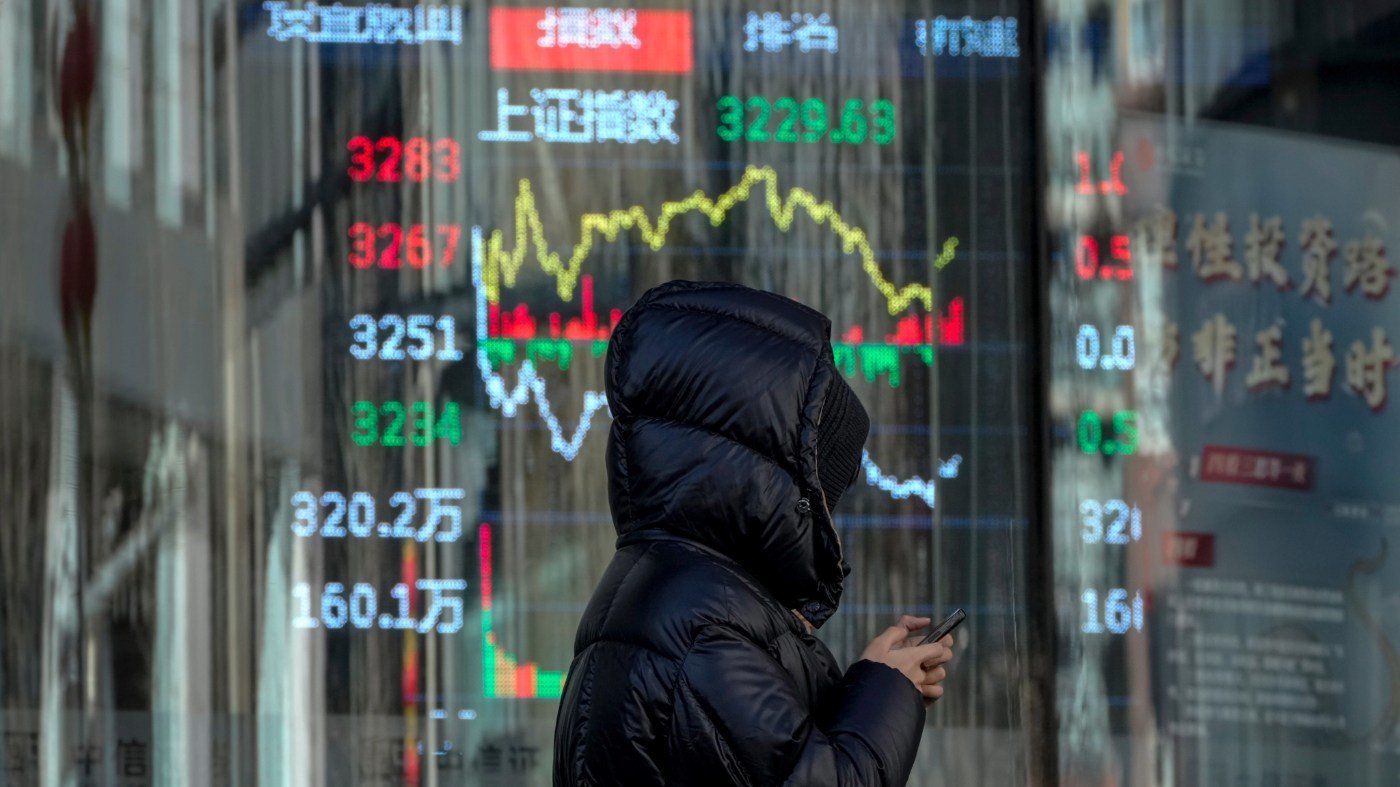
China's benchmark CSI 300 index has tumbled 20% from its June peak, formally entering bear-market territory. The sell-off has erased more than $3.5 trillion in market value since mid-year, and analysts like Morgan Stanley warn of another 15% downside.
The divergence from global markets is stark: the S&P 500 has surged 53% over five years, and Europe's FTSE 500 is up 45%, while the CSI 300 has lost 18.5% in the same period. As The Economist asks, if China is winning the future, why are its investors so glum?
Two fundamental forces are at play. First, Xi Jinping's economic blueprint is failing to deliver broad-based growth. Second, his policy interventions are squeezing corporate profits, driving investors—especially domestic ones—away.
Tech shine masks broader rot
Outwardly, China's tech leadership looks impressive. The Nvidia subpoena over China AI chip sales underscores the sector's strategic importance. High-tech manufacturing profits jumped 52% in the first nine months of the year, but that segment accounts for only about 6% of the economy.
Andrew Collier, a research fellow at Harvard's Mossavar-Rahmani Center, notes that "the country's technology companies are forging ahead," but he warns that "China's split economy—booming in tech and slowing in everything else—is coming apart."
Exports are another apparent bright spot, with the trade surplus hitting a record $1.04 trillion in October. Yet many export factories operate on razor-thin margins, and Beijing's currency interventions to keep the renminbi weak have drawn criticism from trading partners.
Property and consumption slump
The property sector, once a quarter of GDP, is mired in oversupply—there are more vacant homes than China's 1.4 billion people could fill. Falling prices have created a negative wealth effect, dampening consumption, which now accounts for just 38% of GDP, one of the lowest rates globally.
Urban unemployment, officially 5.2% in September, is likely closer to 20% overall, with youth unemployment far higher. Many recent graduates are taking menial jobs, and gig work now employs 44% of the workforce. Xi's relentless push for automation has worsened joblessness.
Government stimulus efforts have been sporadic and ineffective—one-off programs with no lasting impact. Structural reforms to empower consumers at the expense of state enterprises and banks remain absent. Real GDP growth is almost certainly below the reported 4.5% for Q3.
Investors lose faith
Domestic investors increasingly realize that Xi's policies prioritize state goals over shareholder returns. He is commoditizing tech products, flooding global markets, but this slashes corporate profitability. The July IPO of memory chip maker CXMT, which became China's most valuable public company on day one, was seen by investors as just another subsidized entrant racing into a price war.
As Alicia Garcia-Herrero of The Wire China observed, investors view such companies as "heavily subsidized entrants" that will add capacity into an already oversupplied market. They know Xi controls company decisions, not them.
Government rescue efforts, like the "national team" buying $8.9 billion in shares in July, have been ignored. The recent ban on IPOs and large stock sales is, as the Wall Street Journal's Lingling Wei put it, "a Band-Aid, not a cure."
With no end in sight, Chinese equities remain a grim outlier. As the debate over oversight of China policy intensifies, the market's message is clear: Xi's economic plans are not working, and investors are voting with their feet.