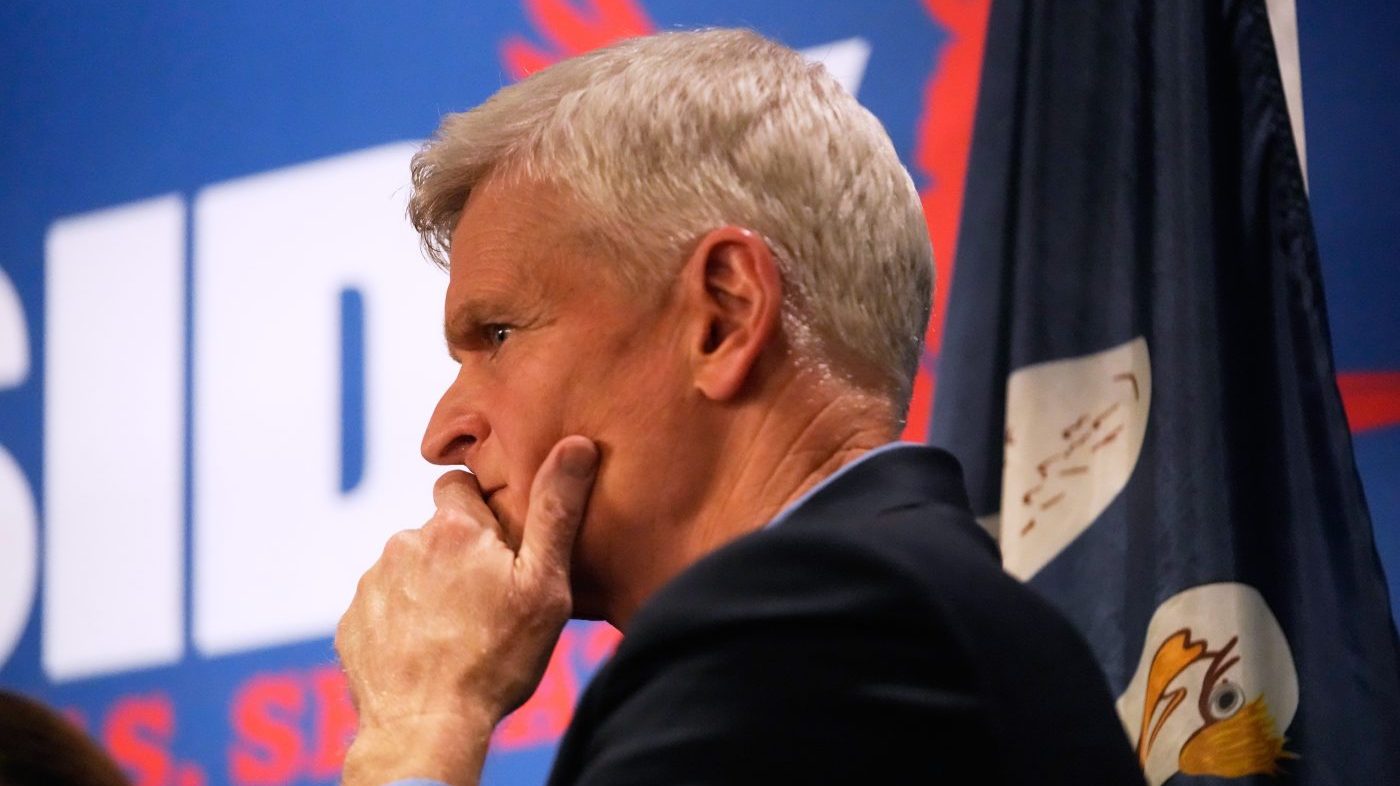
Sen. Bill Cassidy (R-La.) is locked in the most precarious political battle of his career. The two-term senator, a frequent target of former President Trump since voting to convict him in his second impeachment trial, now faces a crowded primary field led by Trump-endorsed Rep. Julia Letlow and state Treasurer John Fleming. Saturday's closed-party primary will test whether Trump's enduring influence can topple an incumbent who has often clashed with the MAGA wing.
Cassidy's troubles stem largely from his February 2021 vote to convict Trump for inciting the January 6 insurrection. That decision earned him a censure from the Louisiana Republican Party and has become a central attack line for his opponents. "Trump's definitely on the ballot. There's no doubt about it," said Pearson Cross, a political science professor at the University of Louisiana. "It's having a bad effect, potentially, on Cassidy, a good effect on Letlow, and it's unclear with Fleming."
Despite his conservative voting record on most issues, Cassidy has struggled to shake the perception that he is insufficiently loyal to Trump. The senator has tried to emphasize his work advancing Trump's priorities on healthcare affordability and other policy areas, but his impeachment vote continues to haunt him. "What has happened is the party has had a lurch to the right," said Robert Hogan, a political science professor at Louisiana State University. "It has really overcome his campaign to the point that he is not considered MAGA enough."
The primary has also been shaped by Cassidy's role in blocking Trump's nominee for surgeon general, Casey Means. Trump publicly blamed Cassidy for the nomination's collapse, writing on Truth Social in late April that the senator is "a very disloyal person" who has "stood in the way" of Health and Human Services Secretary Robert F. Kennedy Jr.'s pick. Cassidy, who chairs the Senate Committee on Health, Education, Labor and Pensions, had wavered over whether to support Kennedy's own confirmation before casting the deciding vote in his favor.
Recent polls show Cassidy trailing both Letlow and Fleming. An Emerson College Polling/KLFY News 10 survey released last month found Fleming at 28 percent, Letlow at 27 percent, and Cassidy at 21 percent, with 22 percent undecided. A Quantus Insights poll from last week showed Letlow leading with 42 percent, followed by Fleming at 30 percent and Cassidy at 20 percent. If no candidate reaches 50 percent on Saturday, the race will head to a June 27 runoff.
Cassidy's campaign manager, Katie Larkin, insisted the senator is "campaigning hard and we feel confident heading into Election Day," while casting Letlow as a liberal and touting Cassidy's record of delivering for Louisiana. The National Republican Senatorial Committee endorsed Cassidy last year, but the incumbent's standing has eroded significantly since then.
This is the first Louisiana Senate race held under the state's new closed-party primary system, which restricts voting to registered party members. The change could benefit Letlow and Fleming, as nearly 30 percent of the state's registered voters who are unaffiliated must now choose a party to participate. The primary is also being watched as a broader test of Trump's influence after his endorsed candidates ousted incumbents in Indiana state Senate primaries earlier this month.
Cassidy's path to victory remains uncertain. "He's pitching himself as the person who's worked with Trump, who's actually been productive, who, despite that vote — which he kind of evades a bit — is saying essentially: 'You have to look past that. That was something that happened a while back,'" Cross said. Trump, however, has made clear he has not moved on.