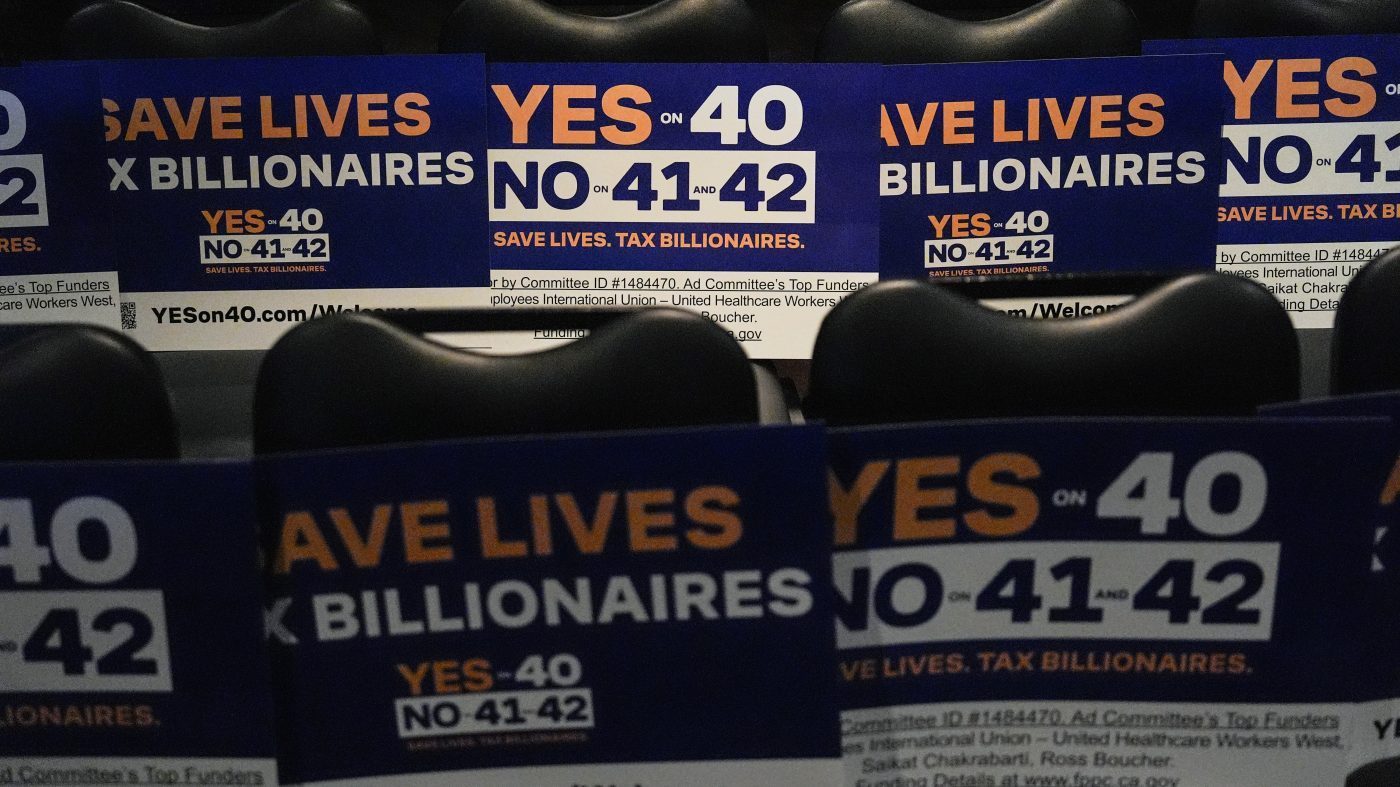
California voters are set to decide this November on a novel proposal to tax billionaire wealth, a measure that has exposed divisions among Democrats and triggered a massive opposition campaign funded by some of the state's richest residents.
Proposition 40 would impose a one-time 5% tax on the net worth of California's roughly 200 billionaires, a first-in-the-nation levy that could generate tens of billions of dollars for healthcare, food assistance, and education programs. The nonpartisan Legislative Analyst's Office (LAO) projects the tax would bring in significant revenue over several years, though it also warns of potential legal and economic fallout.
Supporters, including the labor union United Healthcare Workers West and anti-poverty groups, argue the tax is essential to offset anticipated cuts in federal funding under the One Big Beautiful Bill Act signed by President Trump in July 2025. That law could strip California of up to $30 billion annually, according to an analysis by the state Assembly's Health Committee.
"California faces a fundamental fiscal challenge: How do we protect essential services when the federal government is withdrawing billions of dollars in support?" said Sam Wilkinson, a senior policy associate at End Child Poverty California, on a press call. He added that the tax "would provide critical resources to help California" cope with the funding reductions.
However, Governor Gavin Newsom, a Democrat, has come out against the measure. In a June Substack post, he expressed support for a federal wealth tax but criticized Proposition 40 for dedicating nearly all revenue to healthcare, leaving nothing for housing, childcare, public safety, or universities. "This is not how we should set California's budget priorities," he wrote.
The opposition includes a coalition of billionaires organized under the nonprofit Building a Better California, which has raised over $333 million since January, including $102 million from Google co-founder Sergey Brin, who recently moved his primary residence to Nevada. Tracy Gordon, director of the Urban-Brookings Tax Policy Center, noted that wealthy entrepreneurs and scientists often relocate based on tax policy, which could erode the state's income tax base.
The LAO, however, estimates that billionaires fleeing the state would reduce government revenues by less than $1 billion annually, a relatively small impact compared to the expected tax proceeds. Still, the measure faces an uphill battle at the ballot box. A recent UC Berkeley-Los Angeles Times poll found 50% of likely voters opposed, 42% in favor, and 8% undecided, with the opposition lead outside the margin of error.
Even if Proposition 40 passes, voters could nullify it by approving Proposition 41 or 42, with the latter backed by Newsom and Building a Better California, which would bar new taxes on financial assets or personal property. Legal challenges are also expected, as the tax would apply retroactively to billionaires who were residents on January 1 of this year, a provision that experts say is untested and constitutionally questionable.
The outcome will hinge on voter turnout and messaging in the coming weeks, with Democrats divided and the state's fiscal future at stake. As midterm dynamics play out, the measure's fate could signal broader attitudes toward taxing wealth in an era of federal retrenchment.