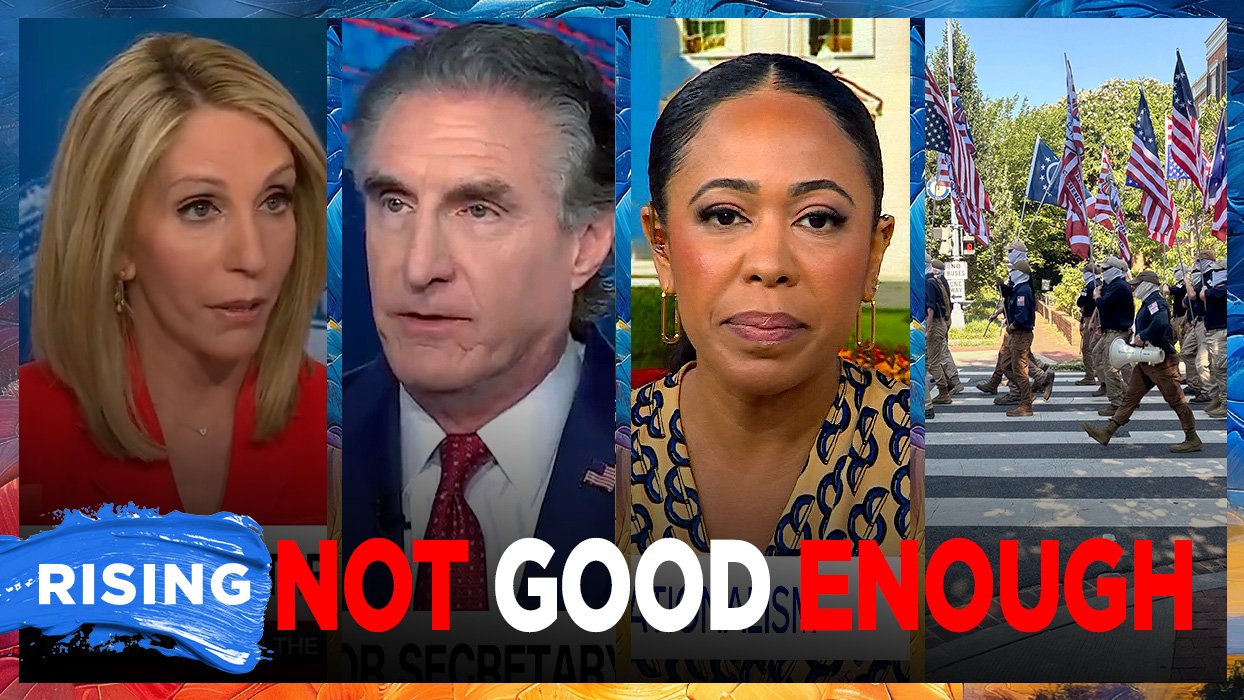
Interior Secretary Doug Burgum, a member of President Trump's Cabinet, had multiple chances to unequivocally denounce a white nationalist group that paraded through the nation's capital on the Fourth of July. Instead of offering a straightforward rebuke, he delivered evasive responses that frustrated critics and raised questions about the administration's stance on extremism.
During a CNN interview, Dana Bash pressed Burgum on a widely circulated Reuters photograph showing a Black woman on a Metro train surrounded by masked members of the Patriot Front. “Are you concerned about this?” she asked. Burgum replied with a rambling historical reference: “Well, I think we obviously, when we’re celebrating America, we’ve had an incredible celebration… but we know from our very founding that this was something that divided our nation.” He went on to mention the Civil War and Abraham Lincoln, avoiding any direct condemnation.
Bash followed up more pointedly: “Do you condemn this group? And what they were doing, and most importantly what do they stand for?” Burgum responded, “Well, I think what they stand for is nothing that I could possibly agree with, but one of the foundational principles of the United States that makes democracy messy is free speech.” The deflection was clear: no one questioned the group’s constitutional right to march; the issue was whether a top official would plainly reject their ideology.
Secretary Burgum also declined to say whether President Trump should condemn the group. The march, which drew an estimated 400 masked participants carrying Patriot Front flags alongside Confederate flags, occurred during America’s 250th Independence Day celebration. The image of a lone Black woman on the Metro surrounded by these marchers has become a stark symbol of the moment.
This is not a difficult call. History shows that presidents and officials who confront racism with moral clarity are remembered far better than those who equivocate. President John F. Kennedy called racial discrimination a moral issue; President Lyndon B. Johnson urged eliminating “the last vestiges of injustice” when signing the Civil Rights Act. Those were politically risky stands, but they defined leadership.
Some online have dismissed the marchers as “paid actors,” a narrative that avoids the uncomfortable truth: the Patriot Front is a white nationalist organization that promotes the idea that America belongs primarily to people of European descent. This is not patriotism; it is racism. And the refusal of officials like Burgum to say so plainly is deeply disappointing.
The moment is defining not just because extremists showed up, but because history remembers how leaders responded. Burgum’s invocation of the First Amendment, as reported in a related article, sidesteps the moral imperative. Meanwhile, some lawmakers are demanding a probe into the group’s activities. For those who believe in a more perfect union, this silence is a stain on the holiday.