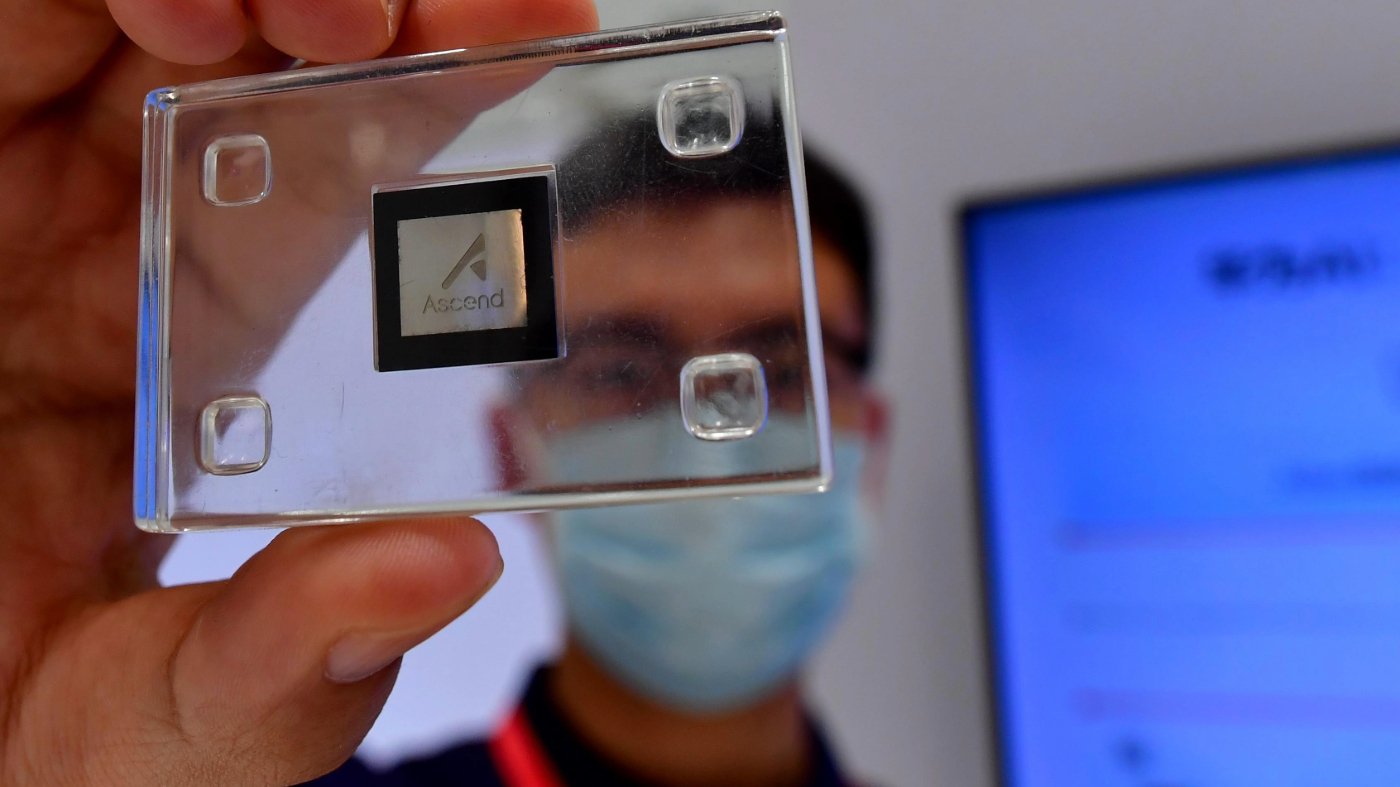
Two years ago, I warned that President Biden's export controls on cutting-edge microchips would backfire. That prediction has now materialized. Instead of crippling Huawei, the restrictions have inadvertently strengthened the Chinese tech giant, allowing it to dominate its domestic market and expand aggressively overseas.
Trade restrictionists long argued that denying China access to America's best chips would prevent it from catching up. They claimed the sacrifice of global market share and revenue for U.S. chipmakers was worth it, because Chinese firms could never develop competitive technology without stealing it. As recently as December, the Council on Foreign Relations called it “virtually impossible” for Huawei to close the gap.
But a new report from the American Enterprise Institute reveals that Huawei has essentially done just that. While export controls blocked access to top-tier chips, the company is now fabricating “near-frontier” semiconductors using older lithography machines. Without tighter restrictions on imports of lithography equipment from allies like the Netherlands, Huawei could soon mass-produce chips capable of challenging U.S. leadership in artificial intelligence.
The implications are stark. Huawei already commands one-third of the global telecom market and over 40 percent outside North America. Producing chips slightly behind Nvidia's best at massive scale would let it dominate the tech stack worldwide. This month, Huawei Cloud launched its Model-as-a-Service platform in nine countries—including Mexico, Brazil, Turkey, and Indonesia—with a combined population exceeding 900 million. These nations are now running Chinese open-source AI models on Huawei's global cloud network, a long-term infrastructure commitment that is difficult and costly to reverse.
Far from isolating Huawei, export controls have shielded it from foreign competition. When the restrictions took effect, Huawei was behind global peers in semiconductor technology. Since then, it has enjoyed an unchallenged domestic market generating over 70 percent of its revenue. That captive base, combined with $150 billion in Chinese government subsidies, has fueled a massive R&D push. As one analyst noted, “Export controls did not constrain Huawei; they concentrated its market.”
The AI race isn't just about the most advanced chips; it's about deploying and scaling systems globally. Huawei doesn't need to beat American companies on every benchmark. It needs “good enough” chips, a protected home market for funding, and access to regions where U.S. firms are absent or restricted. Export controls provided all three. While insulation from competition typically breeds inefficiency, Huawei's monopoly at home has funded fierce competition abroad.
President Trump has rolled back some of Biden's most restrictive measures, including the AI diffusion rule and permitting sales of Nvidia's H200 chips to China for a fee. He has also favored a light-touch regulatory approach over expensive subsidies. These moves are steps in the right direction, but not all export controls should be eliminated. The West's most advanced chips shouldn't end up in the People's Liberation Army.
What policymakers must recognize is that leaving Huawei unchallenged in its domestic market and ceding the international playing field to its cheap-but-good-enough exports has not worked. As a minority of us have argued, we cannot beat China by mimicking its protectionist playbook. We must unleash our innovators and their superior products upon the world. Only by offering the better product can we dominate the global tech economy.
For context, the broader economic landscape shows how policy missteps can ripple across sectors. The housing market, for instance, has seen sales hit a 2025 low amid the Iran conflict, while Redfin reveals that Florida and the Midwest lead as 2026's hottest housing markets. Meanwhile, the collapse of Spirit Airlines has been blamed on Warren and Biden for blocking a merger. These stories underscore the unintended consequences of government intervention.