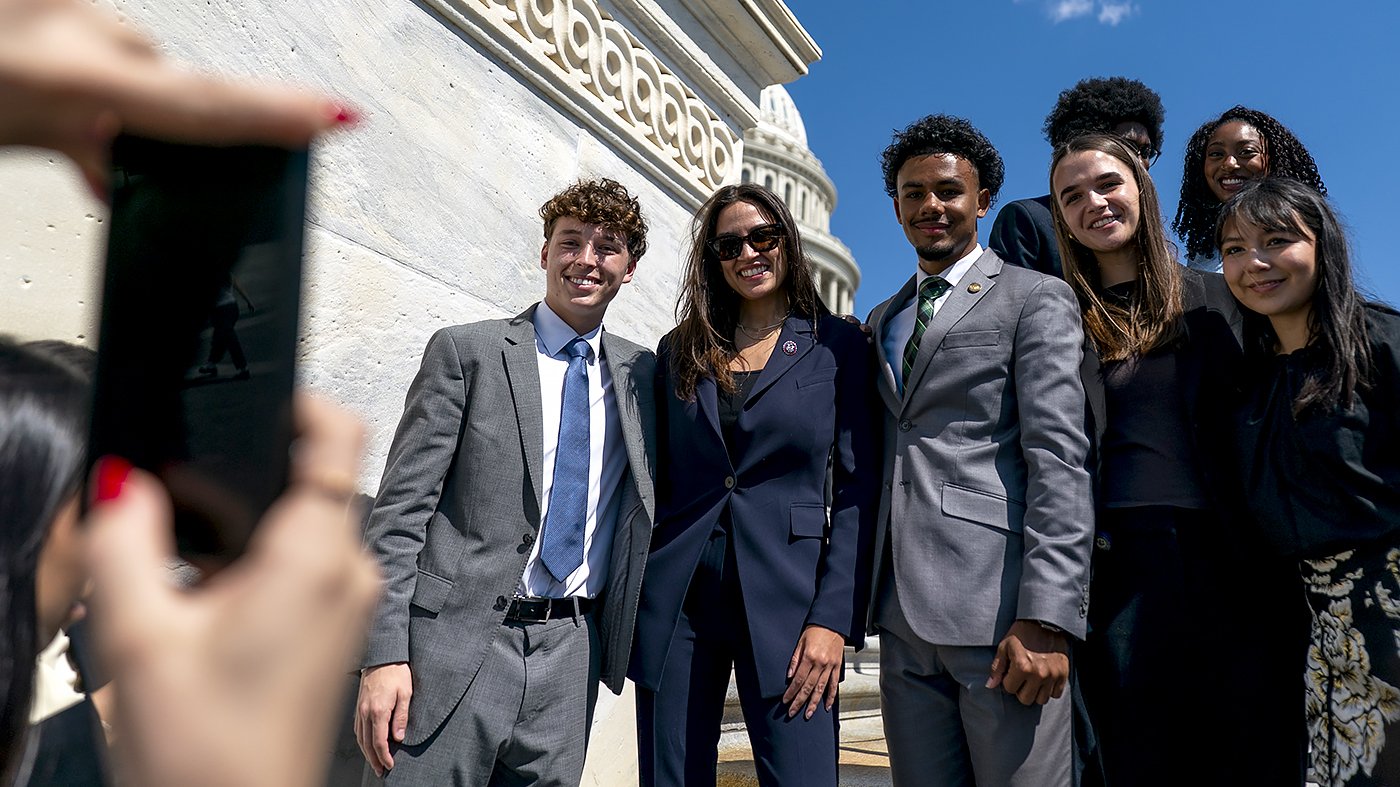
Speculation about a potential presidential bid by Rep. Alexandria Ocasio-Cortez (D-N.Y.) has reached a fever pitch, with betting markets now placing her at the front of the Democratic field for 2028. On Kalshi and Polymarket, the 36-year-old progressive icon leads all potential contenders, even as most public polls still show her trailing former Vice President Kamala Harris and California Gov. Gavin Newsom.
During an appearance on ABC's "This Week" last Sunday, Ocasio-Cortez declined to rule out a run, saying she is "very humbled by the tremendous amount of support out there." Her comments come amid a string of progressive primary victories, including Abdul El-Sayed in Michigan and Peggy Flanagan in Minnesota, which have fueled a sense that the party's left wing is surging.
Ocasio-Cortez's political brand is unmatched among her potential rivals. She commands a devoted following among younger progressives, has a proven ability to raise money, and is arguably the most effective social media communicator in American politics. But the new dynamic, observers say, is that the left's recent wins suggest her ideological lane may be widening beyond coastal strongholds.
Even some conservatives are taking her chances seriously. Writing in National Review, Jim Geraghty argued that Ocasio-Cortez has "about as good a shot as any Democrat has" in 2028, while a Washington Post op-ed by Henry Olsen declared that "AOC may never get a better shot at being president than this."
Yet skepticism remains deep within the party's establishment. Veteran strategist James Carville dismissed the idea on Newsmax, insisting she would not run because she would have "no chance" and noting Democrats "never nominate the most liberal candidate." Others worry that while she might win the primary, her appeal in blue-collar battlegrounds like Pennsylvania and Michigan would falter, echoing the losses of Harris in 2024 and Hillary Clinton in 2016.
New York-based Democratic strategist Hank Sheinkopf cautioned that progressive primary wins don't necessarily translate to general election success. "The question is, first of all are there enough voters who want AOC to be president of the United States, and then in particular are there enough people in the heartland?" he said.
Ocasio-Cortez has appeared to take steps to soften her image. In her ABC interview, she approvingly quoted a New York City Council member who said "Woke 1.0 was crazy," a remark widely interpreted as an attempt to distance herself from more fringe elements of the left. The recent Wisconsin gubernatorial primary, where DSA candidate Francesca Hong lost after controversial statements like wanting to "Cancel Thanksgiving," underscored the risks of far-left positioning.
Her decision to begin freezing her eggs, announced in candid Instagram posts, has also generated significant media attention. She has framed the move as an exercise in bodily autonomy, a pointed contrast to conservative policies on reproductive rights. The story has dominated political discourse at a time when the news cycle might otherwise be quiet.
For some on the left, the prospect of an Ocasio-Cortez run is complicated. Progressive strategist Jonathan Tasini called her "a fantastic president" but suggested that a 2028 bid might be premature, arguing that her energy could be better spent boosting other candidates. As the pivotal moment approaches, the debate over her future is only intensifying.
Meanwhile, the political landscape remains fluid. With Trump acknowledging the hurdles to a third term, the 2028 race is already taking shape. And while early betting markets favor AOC, the path to the White House is anything but certain.