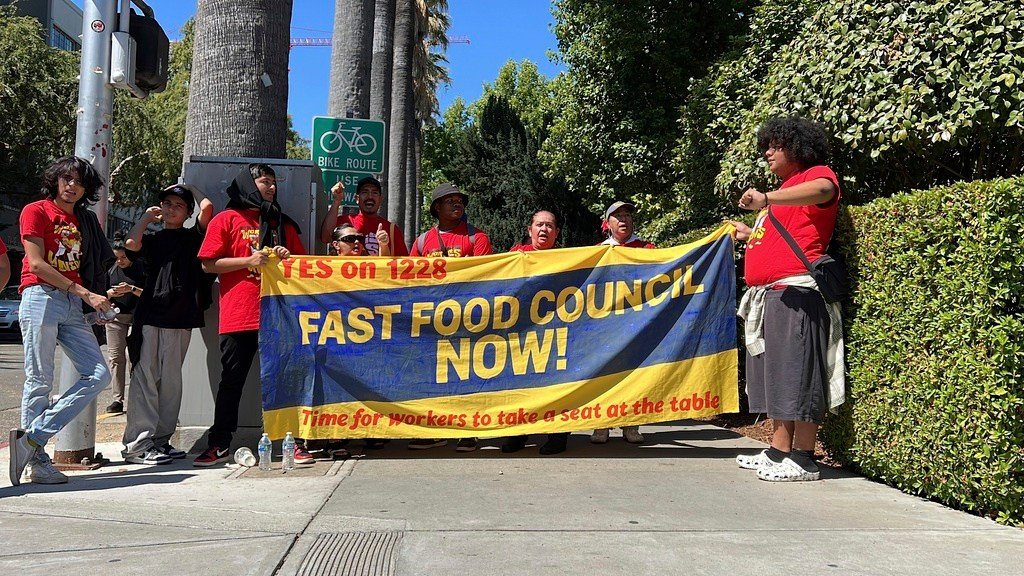
When Angelica Hernandez joined a union, her McDonald's manager warned her that the company had an army of lawyers, that the union would rob her, and that she'd end up living under a bridge. For three years, she resisted, fearing retaliation or losing her job. What finally pushed her to sign on was the intimidation itself. "If I end up living under a bridge," she recalled thinking, "I'm going to fight to make sure it doesn't happen to others."
Her story captures the missing half of America's affordability debate. Politicians talk about making rent, groceries, health care, and child care cheaper. They talk much less about whether workers earn enough to keep pace.
With the midterms approaching, affordability has become the defining economic issue of American politics. But it's too often framed as a crisis of prices alone, as if paychecks were fixed and the only solution was to make things cheaper. Prices and wages come down to the same question: Does a job pay enough to live?
The Fight for $15's legacy
The Fight for $15 forced that question onto the national agenda. When roughly 200 fast-food workers walked off their jobs in New York City in November 2012, they sought more than double the federal minimum wage. The demand was dismissed as unserious. President Obama was calling for a $9 minimum wage; leading Democrats considered $10.10 ambitious. Yet workers chose a number that reflected what survival required rather than what Washington considered plausible.
By the end of 2026, 79 jurisdictions will have reached or exceeded a $15 minimum wage. The National Employment Law Project estimates that the movement helped produce $150 billion in raises for 26 million workers. It also widened the fight to include predictable schedules, paid sick leave, and a voice in setting standards.
The movement taught the country that a winning wage demand cannot remain frozen in time. Adjusted for inflation, the $15 workers demanded in 2012 would be worth about $21.65 today. Yet the federal minimum remains at $7.25, where it has been since 2009, even as roughly 14 million workers still earn less than $15 an hour.
Setbacks and the power gap
In June 2026, 55 percent of Oklahoma voters rejected a ballot measure that would have raised the state minimum wage to $15 by 2029 and indexed it to the cost of living thereafter. Opponents argued that the increase would destroy jobs and raise prices. The defeat showed how easily the language of affordability can be turned against higher wages.
The Fight for $15 also fell short of its full promise. It won enormous wage gains without winning widespread collective-bargaining rights for fast-food workers. Workers who became public faces of the campaign did not always gain a permanent role in the institutions making decisions about their lives. During the 2024 presidential campaign, I organized across Arizona, including Native communities that national politicians often visit when electoral margins are close and leave once votes are counted. On a trip to Havasupai, the tribal chairwoman described years of underinvestment. As we prepared to leave, she took my hand and told me something I have not forgotten: "When you are in a room with power, bring us into it."
I had understood her words as a charge to carry a community's concerns into powerful rooms. Listening later to worker leaders from the Fight for $15 describe what happened after the strikes ended and the cameras disappeared, I understood them differently. Being heard by those with power is different from possessing power yourself.
A credible agenda needs both wages and power
A credible affordability agenda must address both wages and the power workers need to secure them. Congress should set a meaningful national wage floor and index it to inflation or the national median wage. States should retain the ability to set higher standards where living costs demand them. But wage laws alone are not enough. Workers need institutions that give them an enduring voice.
California's Fast-Food Council, which brings workers, employers, and public officials into the process of setting industry standards, offers one model. Stronger unions, sector-wide bargaining, worker standards boards, and enforceable protections against retaliation offer others.
This is where the affordability agenda has been thinnest. A tax credit can deliver relief. A price cap can reduce a bill. A minimum-wage law can increase a paycheck. Yet none of those policies gives working people the collective power to shape the next decision, enforce the last one, or prevent their gains from being eroded.
Candidates running on affordability this fall should answer three questions: What wage should a full-time job pay? What mechanism will keep that wage from losing value? And what institutions will give workers the power to defend it after Election Day?
The Fight for $15 supplied the missing logic in today's affordability debate. Its central insight is that economic security depends on what people earn as well as what they pay. The danger is that politicians will embrace that insight while leaving behind the workers who gave it meaning.
Hernandez learned that asking for more became less frightening once she no longer had to ask alone. A true affordability agenda would carry that lesson forward. A job should pay enough to build a life, and workers should possess enough power to defend what they build.