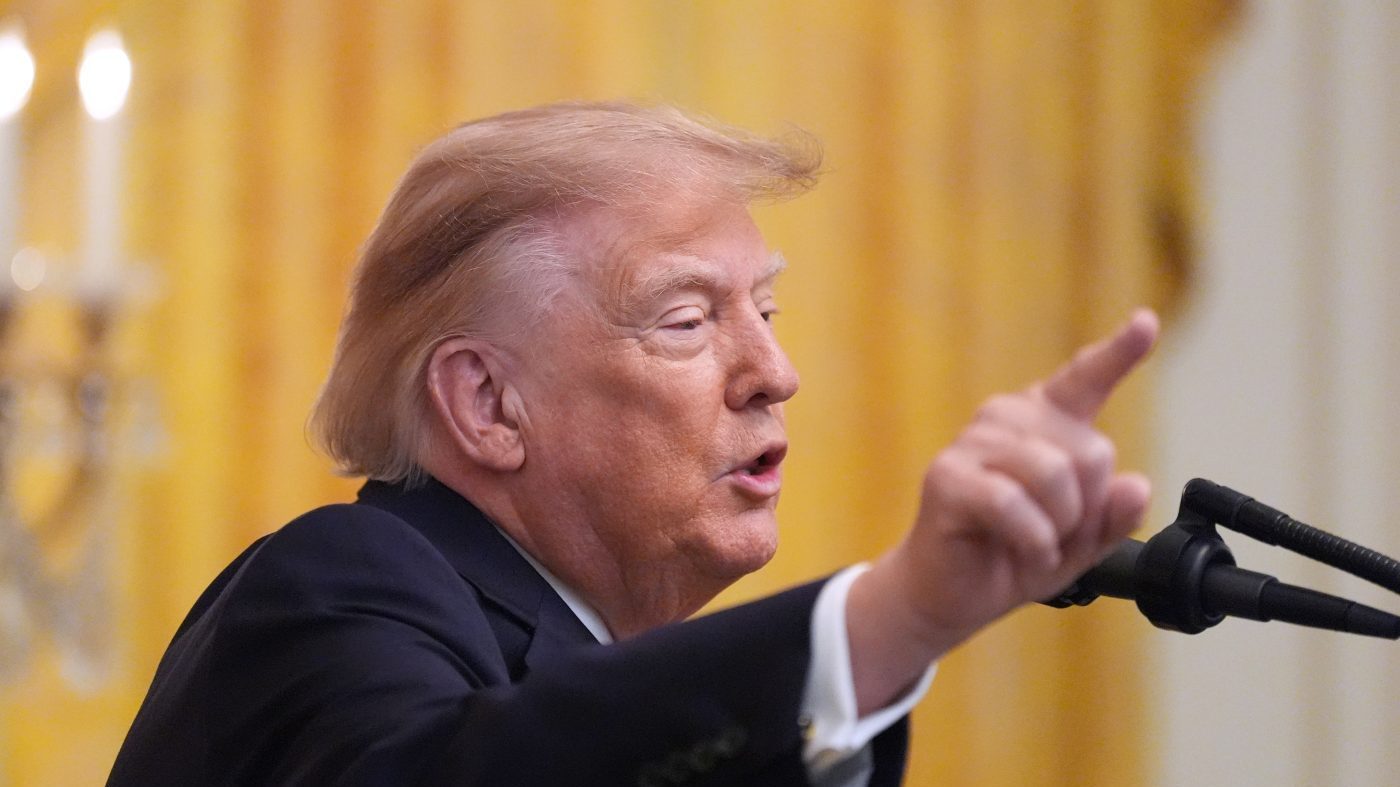
President Trump has not ruled out invoking the Insurrection Act or declaring a national emergency in connection with November's midterm elections, he said in an interview published Thursday by Time magazine.
Asked about the boundaries of his presidential authority, Trump declined to set any limits. "I'm not committing to anything," he told the outlet. "We're going to see how it plays out in court."
The comments come as the White House weighs how to respond if Democrats capture one or both chambers of Congress. According to Time, administration officials have already begun discussing the possibility. One official said the White House would "be forced to think more bipartisan" in that scenario, adding that the past two years of governing on a strictly partisan basis is not something to look back on with pride, even if it worked.
Trump, for his part, has warned that a Democratic takeover of either the House or Senate would trigger a third impeachment effort against him. He has also dismissed polling that shows him and other Republicans trailing as fabricated, a posture that has unsettled some in his party as the midterm map widens. Trump's red-state rally tour has already raised alarms among Republicans who fear it could cost them seats.
The Insurrection Act of 1807 grants the president broad power to deploy military forces or federalize state National Guard units to suppress an insurrection or obstruction of the law. Trump has repeatedly flirted with using it. In January, after an Immigration and Customs Enforcement officer shot and killed U.S. citizen Renee Good in Minneapolis, he threatened to send troops there before backing off and saying there was no reason to invoke the law.
In June 2025, he said he would "certainly" invoke the act in response to anti-ICE demonstrations in Los Angeles, and again in October regarding similar protests in Portland, Oregon. He characterized both situations as "insurrections." He also said he considered deploying troops to Minneapolis late in his first term after protests erupted over the 2020 police murder of George Floyd.
So far, Trump has relied on Title 10, a federal code provision that allows him to deploy the National Guard in a supporting role for local law enforcement, rather than the Insurrection Act itself. The law was last invoked by President George H.W. Bush in May 1992 during the Los Angeles riots that followed the acquittal of four LAPD officers in the beating of Rodney King. Fifteen U.S. presidents have used it.
The statute's origins are tied to a different kind of threat: in 1807, President Thomas Jefferson sought to confront Vice President Aaron Burr's scheme to carve out a new country in the Louisiana Territory. The law was enacted after Burr was arrested in Alabama and charged with treason.
The president's refusal to rule out extraordinary measures comes amid broader political turbulence. Senate Republicans have exited Washington for the midterm campaign, with many in the GOP openly fearing their majority could slip. Senate exits for midterms have left the party's legislative agenda in limbo as members head home to face voters.
Meanwhile, Trump's approval ratings have sagged, with a recent survey showing 73% of respondents disapproving of his economic stewardship. Trump's economic approval plunges to a new low, according to that poll, complicating the party's midterm messaging.
Whether Trump would actually invoke the Insurrection Act or declare a national emergency remains uncertain. But his refusal to take those options off the table ensures the question will hang over the campaign season, raising the stakes for a midterm election already defined by deep partisan divides.