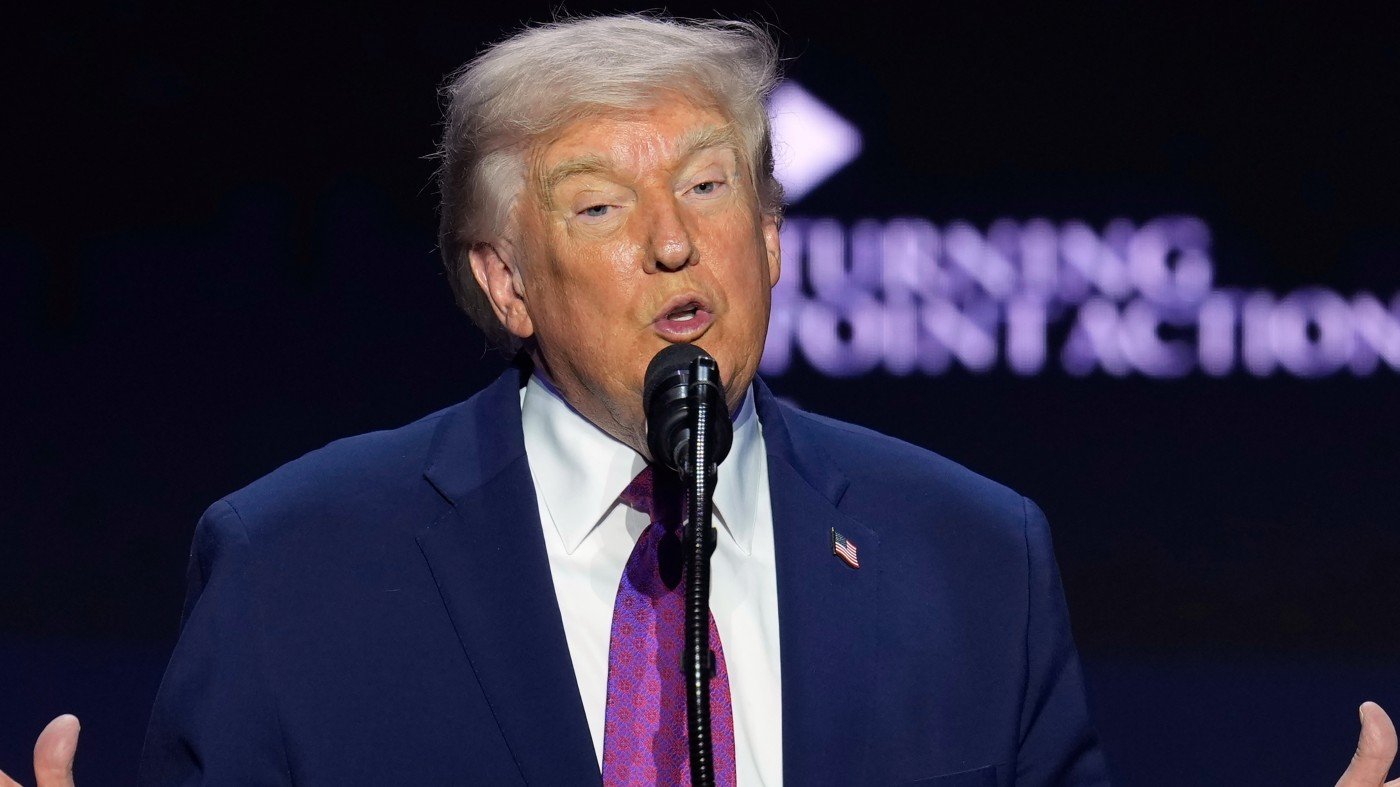
Former President Donald Trump's foreign policy vision for Iran drew fervent support from a crowd of young conservatives at a Turning Point USA event in Arizona on Friday. The rally, part of a "Build the Red Wall" effort to mobilize voters ahead of the midterms, offered a glimpse into how Trump's assertive stance on international conflicts resonates with a key segment of the Republican base.
Trump dedicated a portion of his speech to Iran, asking the audience, "Would anybody like to hear about Iran a little bit?" He asserted that U.S. pressure on Tehran would remain "in full force and effect" until a comprehensive agreement is finalized. "This process should go very quickly and that most of the points are already negotiated and agreed to," Trump claimed, adding, "You'll be very happy."
Central to his remarks was a commitment to nuclear non-proliferation. Trump vowed that the United States would work to secure what he termed "nuclear dust"—a non-technical reference to enriched uranium—and bring it out of Iran. "Iran will never have a nuclear weapon," he declared to applause. This appearance follows other instances where Trump has claimed diplomatic progress with Iran, only to face skepticism from Tehran.
However, Trump's rally remarks were immediately juxtaposed against contradictory signals from Iranian leadership regarding a critical maritime chokepoint. Hours after Trump stated that Iran had said the Strait of Hormuz was "open for business" but that a U.S. naval blockade on Iranian ports would continue, Iran's parliamentary speaker, Mohammad-Bagher Qalibaf, issued a starkly different message on social media.
"With the continuation of the blockade, the Strait of Hormuz will not remain open," Qalibaf wrote. He asserted that passage would require Iranian authorization and be conducted on a "designated route," adding, "Whether the strait is open or closed and the regulations governing it will be determined by the field, not by social media." This statement directly countered an earlier post from Iranian Foreign Minister Abbas Araghchi, who had announced the strait was open for commercial vessels during a ceasefire period.
The mixed messages from Tehran created visible confusion. An Iranian state news agency, Fars, questioned Araghchi's post, characterizing it as an "unexpected tweet" that, following Trump's "nervous saber-rattling," had plunged Iranian society into an "atmosphere of confusion." The financial markets reacted to the initial reports of an opening, with stock prices rallying and oil prices dropping sharply by 12 percent, though the Iranian speaker's post came after global markets had closed for the weekend.
Trump's Arizona speech, which also covered staple campaign themes like immigration, tax cuts, and winning swing states, is part of his broader effort to consolidate support among younger voters amid shifting political dynamics. His focus on Iran underscores the persistent volatility of U.S.-Iran relations, a recurring feature of his political agenda. The episode highlights the fragile nature of any diplomatic communications between the two adversaries, where public statements from one side can be swiftly contradicted by another faction within the other.
The ongoing tension reflects a pattern where Trump's declarations of a conflict winding down are met with ambiguity or silence from Iranian officials, leaving the actual state of negotiations unclear. For investors and geopolitical observers, the incident serves as a reminder of how quickly developments in the Persian Gulf can sway global energy markets and heighten regional security risks.