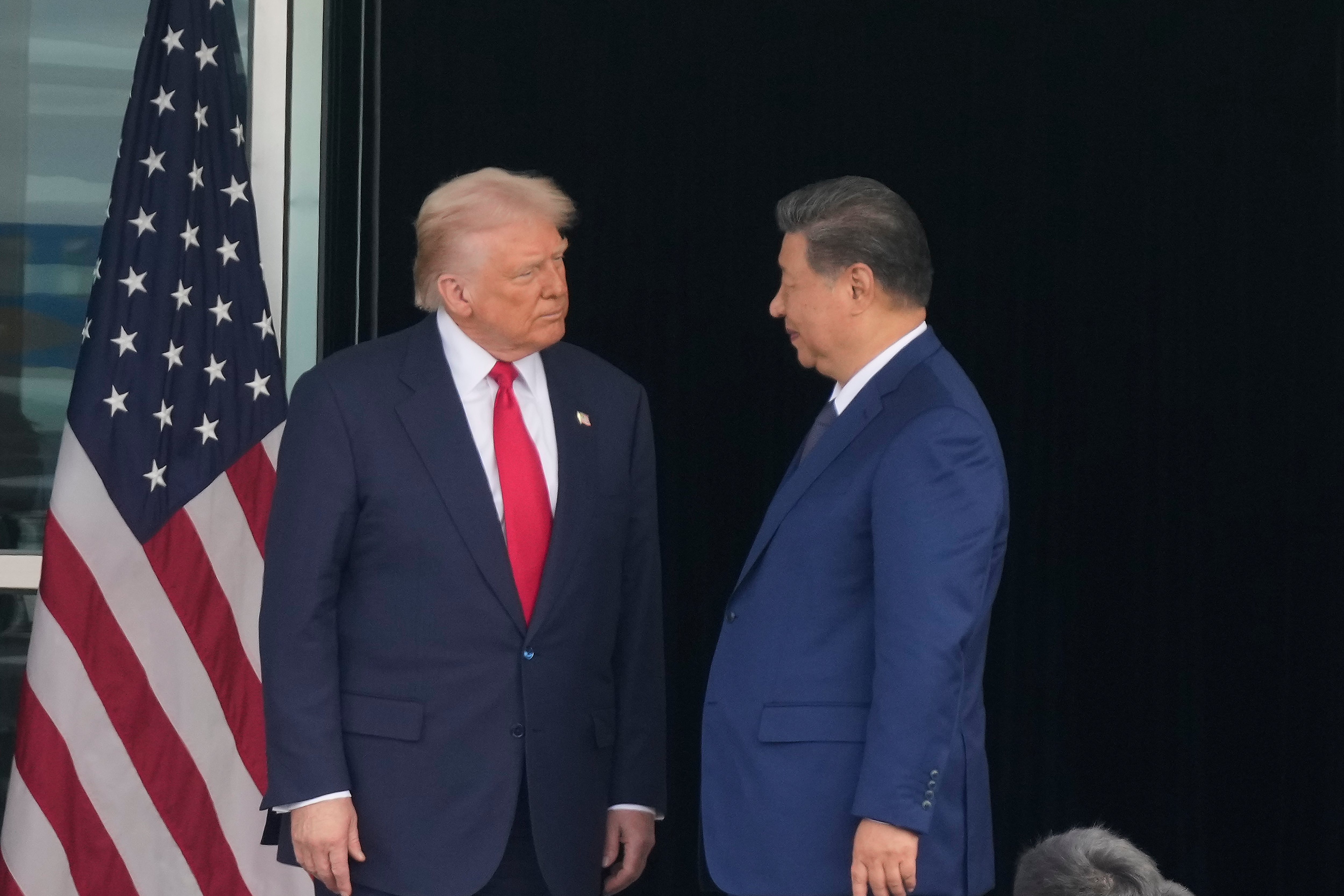
When President Donald Trump meets Chinese President Xi Jinping in Beijing this week, the optics will suggest a meeting of equals. Behind the scenes, the balance of power has shifted sharply—and not in Washington's favor.
Trump arrives with a significantly weakened hand. The Iran conflict, which the administration hoped would be a swift campaign, has instead triggered a global energy shock, depleted critical munitions, and exposed vulnerabilities in America's military posture. The visit, originally scheduled for March but postponed to May as fighting escalated, now looks less like a show of strength and more like damage control.
The geopolitical landscape has transformed since Trump and Xi first agreed to the summit last October. The war with Iran—China's closest Middle Eastern partner—has laid bare systemic flaws in the U.S. way of war. Iranian reprisals degraded American air defenses, blinded early-warning systems, and left many of the 13 U.S. regional bases inoperable. Low-cost drones and missiles inflicted disproportionate damage, turning strategic chokepoints into contested zones.
Perhaps more consequential is the drain on U.S. munitions. Precision interceptors, missiles, and other high-end systems have been consumed at a pace that has forced the Pentagon to divert stockpiles from Asia, thinning deterrence in the Indo-Pacific just as Beijing's coercive power expands. Replenishment will take years, not months, and the war has revealed deeper problems: vulnerable forward bases, the difficulty of countering drone swarms, and how quickly maritime superiority erodes in narrow seas.
These are not abstract lessons for Beijing. They are a playbook. The Iran conflict has shown how asymmetric tools can blunt a superior military and how control of chokepoints can yield leverage without full-scale war. As China plans for contingencies along the First Island Chain—from Japan through Taiwan to the Philippines—it views these vulnerabilities as opportunities.
The economic picture is equally troubling. The war has triggered an energy shock that is feeding inflation and eroding political capital. As March inflation hit 3.5%, gasoline prices now shape the White House's strategic calculus as much as battlefield outcomes. Trump's bargaining position is tied to his need for relief—relief Beijing is uniquely positioned to provide, whether through its leverage over Iran as its main oil customer or its central role in global supply chains.
In April 2025, in response to Trump's tariffs, Beijing effectively pulled a geoeconomic kill switch by halting most exports of rare earth minerals—critical inputs for high-tech production. Washington was forced to climb down and negotiate a truce. That episode set the stage for Trump's broader policy shift from confrontation to accommodation.
In his first term, Trump recast China as a strategic adversary, launched tariffs, and made the Indo-Pacific central to U.S. strategy. He revived the Quad and treated economic interdependence as a vulnerability. In his second term, that posture has softened. Planned tariffs have been paused, punitive measures shelved, and rhetoric cooled. Even baseline steps—such as arms sales to Taiwan—have been delayed. The administration now frames its goal as “stable peace, fair trade, and respectful relations.”
The shift is unmistakable. The U.S. remains deeply reliant on Chinese inputs, especially rare earths, and Beijing has shown it will weaponize that dependence. At a moment of depleted munitions and economic strain, the risk of disruption is a constraint Trump cannot ignore. Trump now needs China—a major financier of U.S. government spending—in ways he did not in his first term. Then, a strong economy allowed escalation. Now, stagflation makes confrontation costly. The White House needs stable supply chains and cannot risk Beijing weaponizing its U.S. Treasury holdings as borrowing rises.
That dependence reframes the summit. Trump is going not to dictate terms but to seek relief—on energy, financial stability, and a political win. Chinese cooperation will not come cheap. Beijing will push to ease export controls on advanced semiconductors and AI, extend the trade truce to lock in its gains, and demand greater ambiguity on Taiwan. As Democrats push for a sixth war powers vote to constrain Trump's Iran actions, the administration's room for maneuver is shrinking.
The likely outcome is a managed detente: a cooling of rhetoric and a symbolic reset. Trump will present it as deal-making prowess; Xi, as proof of China's rise. Both will claim success, but the underlying shift will endure. A rivalry of near-peers is giving way to something closer to a strategic accommodation—on terms that increasingly favor Beijing.