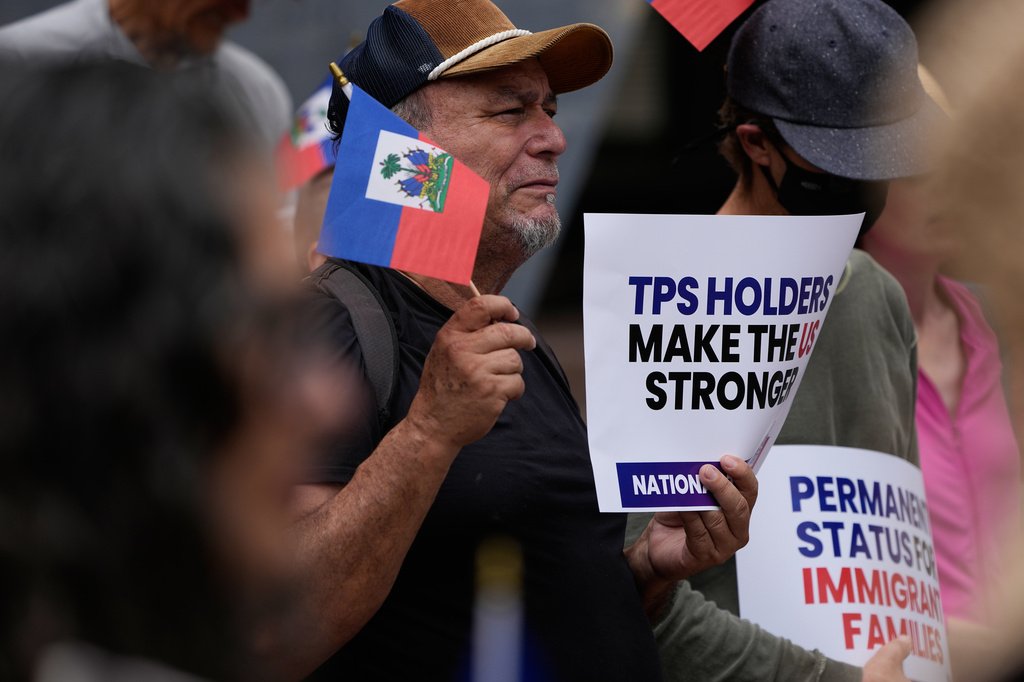
President Trump's latest immigration crackdown is handing a strategic victory to America's adversaries, who would eagerly welcome the removal of hundreds of thousands of essential workers from the U.S. labor force. The administration's decision to revoke Temporary Protected Status (TPS) for more than 300,000 Haitians and roughly 50,000 other immigrants is not just a policy shift—it's a self-inflicted wound on an economy already grappling with inflation and labor shortages.
The move follows a Supreme Court ruling in June that permitted the government to strip work permits from TPS recipients and begin deportation proceedings as of July 27. That decision overturned a lower court's finding that the revocation was "in part" driven by "racial animus." Already, employers have started firing Haitian workers who lost their protected status, according to reports.
Trump has long demonized undocumented immigrants, and on his first day back in office he signed an executive order labeling their presence an "invasion." He has also used inflammatory language, including a remark that immigrants are "poisoning the blood of our country," a phrase he later denied knowing was associated with Adolf Hitler. More recently, he falsely claimed on social media that Democrats want to "allow Criminals, the Mentally Insane, and Lunatics from all over the World to come into our Country, totally unvetted and unchecked."
Data contradicts such fearmongering. A Northwestern University study found that immigrants were less likely than native-born Americans to be incarcerated between 1870 and 2020. TPS itself was created with bipartisan support and signed into law by Republican President George H.W. Bush in 1990, offering refuge to those fleeing natural disasters or armed conflict.
The economic stakes are significant. The U.S. Chamber of Commerce, in a July 10 letter to Senate leadership, urged Congress to preserve TPS "to prevent significant disruption to America's work force and avoid an unnecessary humanitarian crisis." Over 1 million immigrants have used TPS since its inception, and roughly 70% of current recipients are employed, many in low-wage jobs that employers struggle to fill.
These workers are deeply integrated into American society. An estimated 390,000 U.S.-born children and 410,000 adult citizens live with TPS holders. Mass deportations could force American citizens to leave with their parents or partners, and could devastate sectors like agriculture, manufacturing, and healthcare. Crops could rot, factories could close, and hospitals could face severe staffing shortages, leading to higher prices, job losses, and even preventable deaths.
The racial dimension is hard to ignore. Haiti's population is about 95% Black, and many other affected immigrants come from predominantly Black African nations like Ethiopia, Somalia, and South Sudan. Trump's own words have fueled accusations of bias. In 2025, he admitted to asking during his first term, "why is it we only take people from s---hole countries?" and suggested the U.S. should instead accept immigrants from Norway, Sweden, and Denmark—countries he described as having "nice people." He also slashed refugee admissions from over 100,000 in Biden's final year to just 6,700 between October 2025 and May 2026, with nearly all being white South Africans, whom he falsely claims are persecuted.
Critics argue that such policies betray America's identity as a nation of immigrants, a principle enshrined in the poem at the Statue of Liberty. "It's sad that the president embraces 'Make America Great Again' but rejects the immigration that has made our country great," said A. Scott Bolden, a former chair of the D.C. Democratic Party and a NewsNation contributor.
As the administration presses forward, the consequences will ripple through communities and the economy. The decision not only undermines American values but also plays into the hands of those who wish to see the United States weakened. The question is whether Congress will act to reverse course, or let this self-inflicted blow stand.