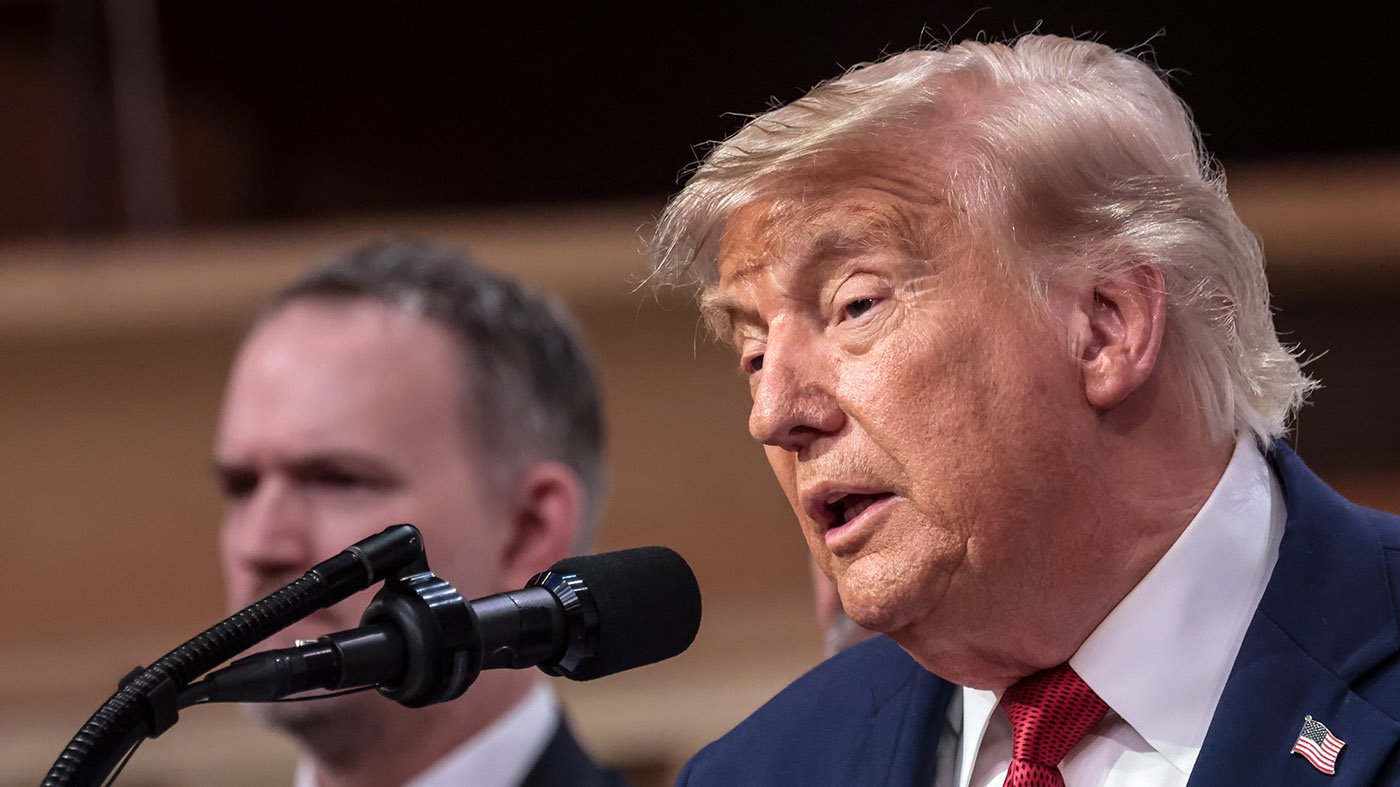
President Trump took to the podium at the G7 summit in France on Wednesday to sell his interim peace deal with Iran, but the lengthy press conference only deepened the chasm between the White House and its critics. Rather than unveiling a last-minute concession to appease skeptics, Trump doubled down on a framework that many hawks are calling a strategic catastrophe.
The most jarring moment came when Trump openly defended Iran's right to maintain ballistic missiles—a capability that the U.S. and Israel had previously demanded be dismantled. “They have to have some because other people have some,” Trump said, likening Tehran's arsenal to that of Gulf Arab states. He dismissed advisors who urged total elimination, asking, “Am I going to let Saudi Arabia have missiles but they can't have them?”
Trump framed the reopening of the Strait of Hormuz as essential to averting an “economic catastrophe,” warning he did not want to be remembered like Herbert Hoover. On Iran's enriched uranium stockpile, the president waved off concerns, saying the material was “not a lot of value” even if the U.S. had the means to seize it.
The memorandum of understanding, expected to be signed in Switzerland on Friday, establishes a $300 billion reconstruction fund for Iran. While not directly funded by Washington, the U.S. will help structure it, likely leaning on Gulf allies to contribute. In return, Iran pledges not to “procure or develop” nuclear weapons—a promise critics note Tehran has made before, including under the 2015 JCPOA that Trump himself trashed.
The MOU also calls for diluting Iran's enriched uranium under IAEA supervision, but the language is vague, punting final enrichment decisions to later negotiations. Skeptics warn this gives Iran ample room to maneuver. Trump has defended the agreement as provisional, but the lack of concrete deadlines has fueled unease.
Conservative commentators erupted. Ben Shapiro labeled the deal a “disaster” on Fox News, while Erick Erickson called it “an American surrender.” Sen. Bill Cassidy (R-La.), fresh off a primary loss after Trump backed his opponent, dubbed it “the worst foreign policy blunder in decades.” Former U.N. Ambassador Nikki Haley warned that any funds flowing to Iran would be used to “further their nuclear ambitions and on terrorist proxies against us.”
Trump further inflamed tensions by criticizing Israeli Prime Minister Benjamin Netanyahu. He called Israel's recent Beirut strike “unnecessary” and argued that its operations in Lebanon were disproportionate. “When two drones are shot into the desert and drop harmlessly, you don't have to knock down buildings in Beirut,” Trump said. The remarks drew rare praise from left-leaning commentators but sparked a firestorm in Israel, with the Jerusalem Post running a front-page op-ed asking, “Why on earth would Trump endorse Iran's ballistic missile program?”
As the administration prepares to ink the deal, bipartisan critics are asking why the war was fought in the first place. Former officials like John Kelly have warned the pact strengthens Tehran and risks a nuclear breakout. Trump's press conference, meant to project control, instead exposed a White House struggling to contain fallout on multiple fronts.