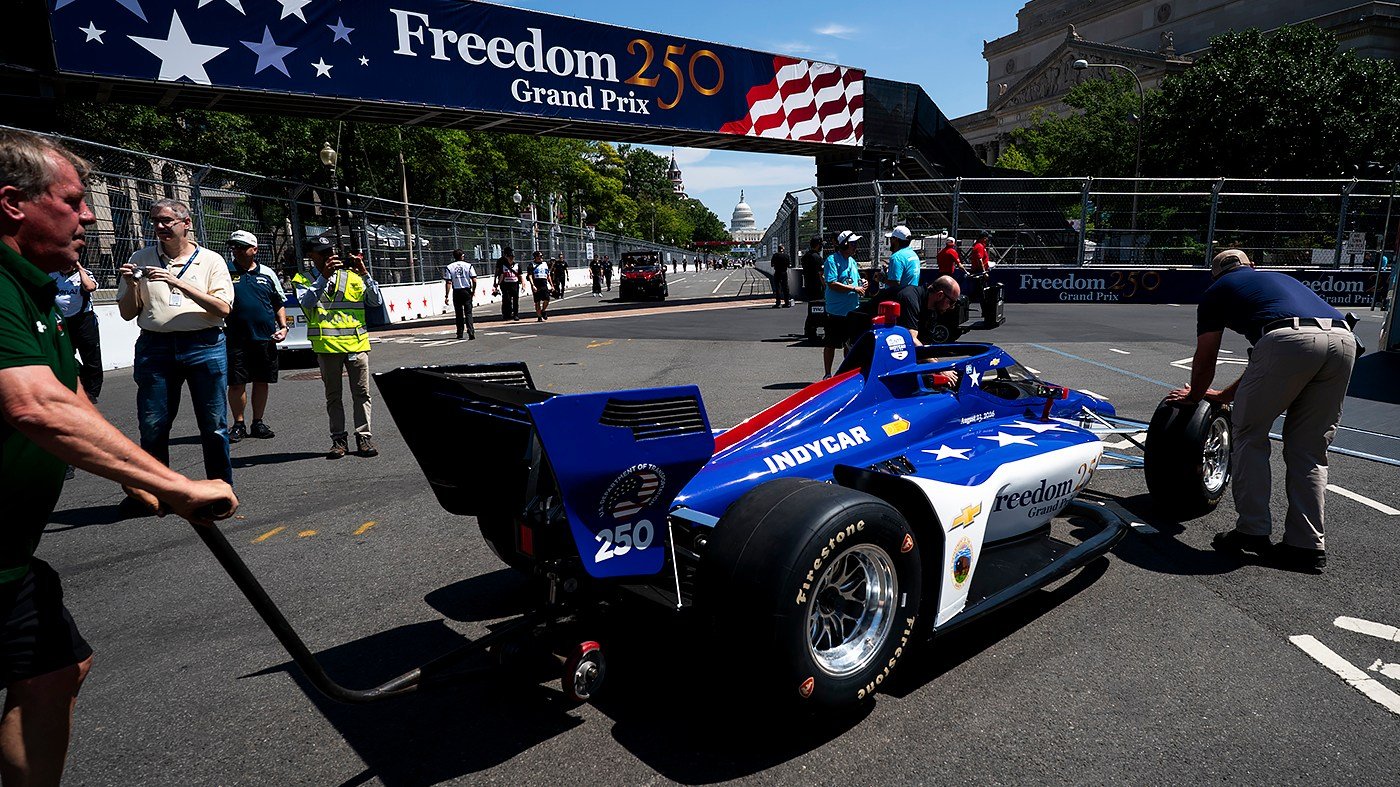
For the first time in its history, the IndyCar Series will bring its high-speed spectacle to the nation's capital this weekend, closing streets around the National Mall and downtown Washington for a two-day event that caps a summer of Trump-administration-led celebrations marking the country's 250th birthday.
The Freedom 250 Grand Prix, set for Sunday, was not on the original 2026 IndyCar calendar. According to reports, President Trump had long mused about a road race on D.C. streets, and in January he directed the Departments of Transportation and the Interior to map out a route through the National Mall. Organizers have called it a likely "one-and-done" event, making it a singular moment for both the city and the racing series.
Transportation Secretary Sean Duffy has framed the race as a unifier. "And I think if you look at the political divide in America, this is an event that brings America together," he told the New York Post. "Cars and racing is freedom and American."
Trump and first lady Melania Trump are expected to take a ceremonial lap in "The Beast" before the green flag, a move that will likely amplify the political and media spotlight on the race. Security details for the president's appearance have been outlined in a separate official security plan.
IndyCar's Bid for Relevance
The race arrives as the IndyCar championship enters its final stretch, with series points leader Álex Palou and top-ranked American Kyle Kirkwood, both driving Honda-powered cars, headlining the field. Saturday features two practice sessions and qualifying, while Sunday's schedule includes a 9 a.m. warmup and a 1 p.m. start, with Trump waving the green flag.
Longtime motor sports journalist Curt Cavin noted the event's significance for a league that has long catered to a niche audience. "It's all about the visual for me," he wrote. "The visuals of the U.S. Capitol, Washington Monument, White House and the rest of the elements that make the city the most recognizable in the world will give the sport much-craved relevance."
Disruption and Complaints
But the spectacle has come at a cost for D.C. residents and commuters. The 1.7-mile, seven-turn track, with 147 laps, has required weeks of street closures, hospitality suites, and fenced-off sidewalks, leaving much of the National Mall impassable during peak tourist season. Local officials have urged non-attendees to avoid the area entirely, while ticket holders are directed to public transit.
"This is worse than cherry blossom," commuter Nancy Marlow told WTOP, referencing the city's famous spring festival. "I've been out here over an hour. This time of year, it normally takes me 20 minutes." Even the Lincoln Memorial area was briefly closed Friday for a promotional shoot.
Noise and Vibration Concerns
The roar of IndyCar engines has raised alarms among nearby museums and historic sites. The nonprofit New Living Deal sent a letter to the National Park Service warning that vibrations from the race "may harm historic properties directly adjacent to the race course," comparing the impact to jackhammers and pile drivers. The National Gallery of Art told WTOP it had conducted a vibration study and implemented mitigation measures.
As the city braces for the spectacle, the race underscores the Trump administration's willingness to use major events to shape the national narrative—even at the cost of disrupting daily life in the capital. Whether it becomes a lasting tradition or a one-off political statement remains to be seen, but for one weekend, Washington will be the center of the motor sports world.