The Trump administration's campaign to stamp the president's name and image onto federal property has reached a new frontier: the U.S. passport. On Tuesday, the State Department unveiled limited-edition passports to mark the nation's 250th birthday, featuring President Trump's inaugural portrait encircled by text from the Declaration of Independence, with his signature beneath his likeness.
White House spokesperson Olivia Wales called the design a "patriotic" way for Americans to join the semiquincentennial celebrations. But the move is the latest in a broader push that has become a hallmark of Trump's second term, far exceeding efforts in his first term to embed his personal brand into government resources.
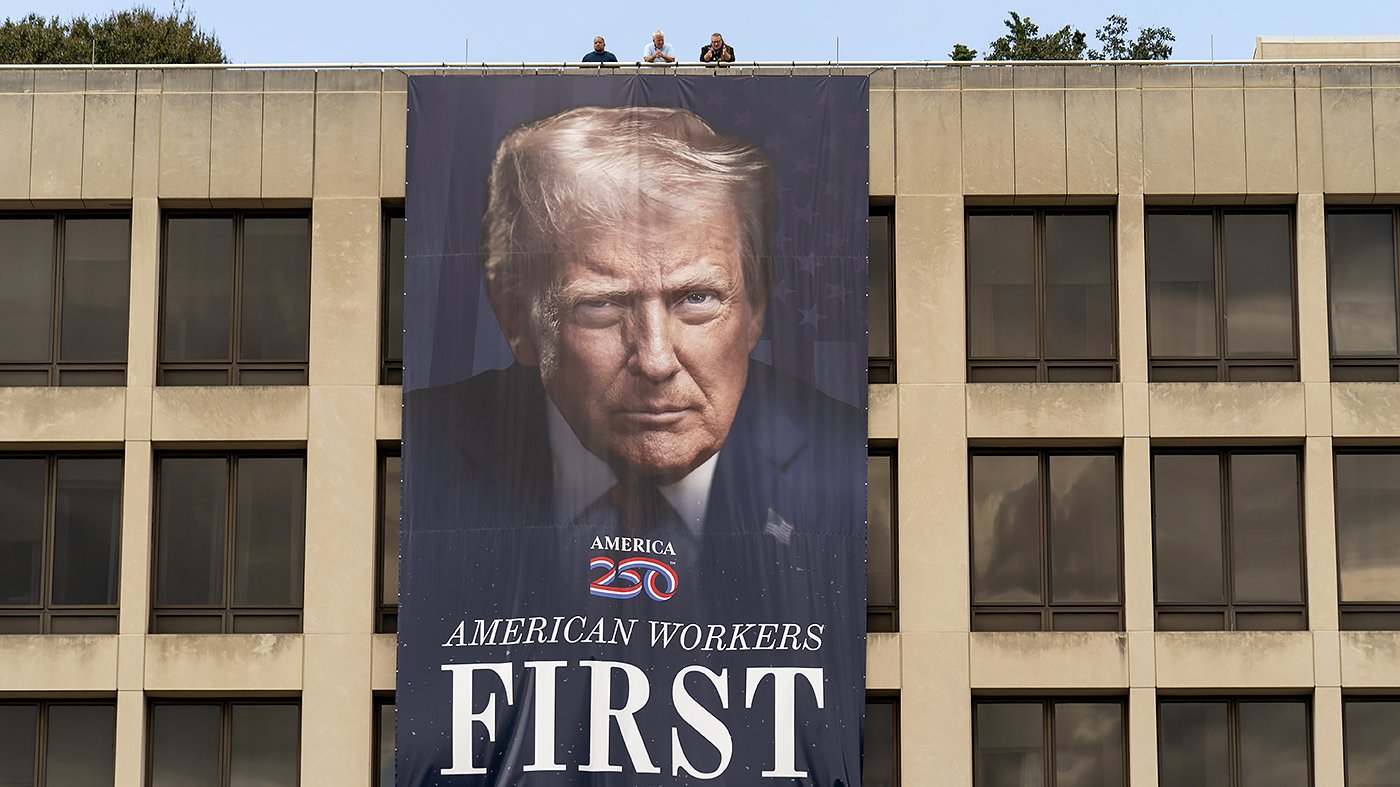
In recent months, Trump's portrait has appeared on banners hanging from the Departments of Labor, Justice, and Agriculture in Washington, D.C. The Justice Department banner reads "Make America Safe Again," while Labor's says "American Workers First" and Agriculture's states "Growing America Since 1862." Placing Trump's face on the Justice Department building breaks with tradition, where past presidents have kept distance to preserve the department's political independence.
Beyond passports, Trump's image has been added to National Park passes and minted coins, despite a federal law prohibiting the likeness of living persons on U.S. currency. In October, the Treasury Department shared draft designs for a $1 commemorative coin featuring Trump with a raised fist and the words "Fight, Fight, Fight"—a phrase he shouted after a bullet grazed his ear during an assassination attempt in July 2024. Another draft shows Trump with his fists on the Resolute Desk, resembling his official portrait, with "Liberty" above and a bald eagle on the reverse. The Commission of Fine Arts, now with Trump-appointed members, approved the gold coins in March.
The Treasury also announced in March that Trump's signature would be the first from a sitting president on U.S. paper currency, again timed to the semiquincentennial. Treasury Secretary Scott Bessent confirmed the plan.
Trump has also pushed to put his name on buildings around the Capitol. In December, his full name was added to the exterior of the U.S. Institute of Peace and the Kennedy Center, renaming it "The Donald J. Trump and the John F. Kennedy Memorial Center for the Performing Arts." The unanimous board approval drew criticism from Kennedy family members and others who said it violates the spirit of a living memorial to the slain president.
A $400 million White House ballroom project, which began after demolishing the East Wing last October, reportedly was to include Trump's name, but he dismissed that as "fake news." Other ventures include the $1 million "Trump Gold Card" visa, a direct-to-consumer drug platform TrumpRx.com, "Trump accounts" for children's savings, and the "Trump-class" Golden Fleet of battleships.
In Palm Beach, Florida, the president attended the renaming of Sunshine Boulevard to President Donald J. Trump Boulevard. Governor Ron DeSantis also signed a bill last month to rename Palm Beach International Airport to "Donald J. Trump International Airport."
These moves come as the administration continues to assert its brand across multiple fronts, from foreign policy engagements to economic strategy, reflecting a presidency that increasingly blurs lines between public service and personal branding.