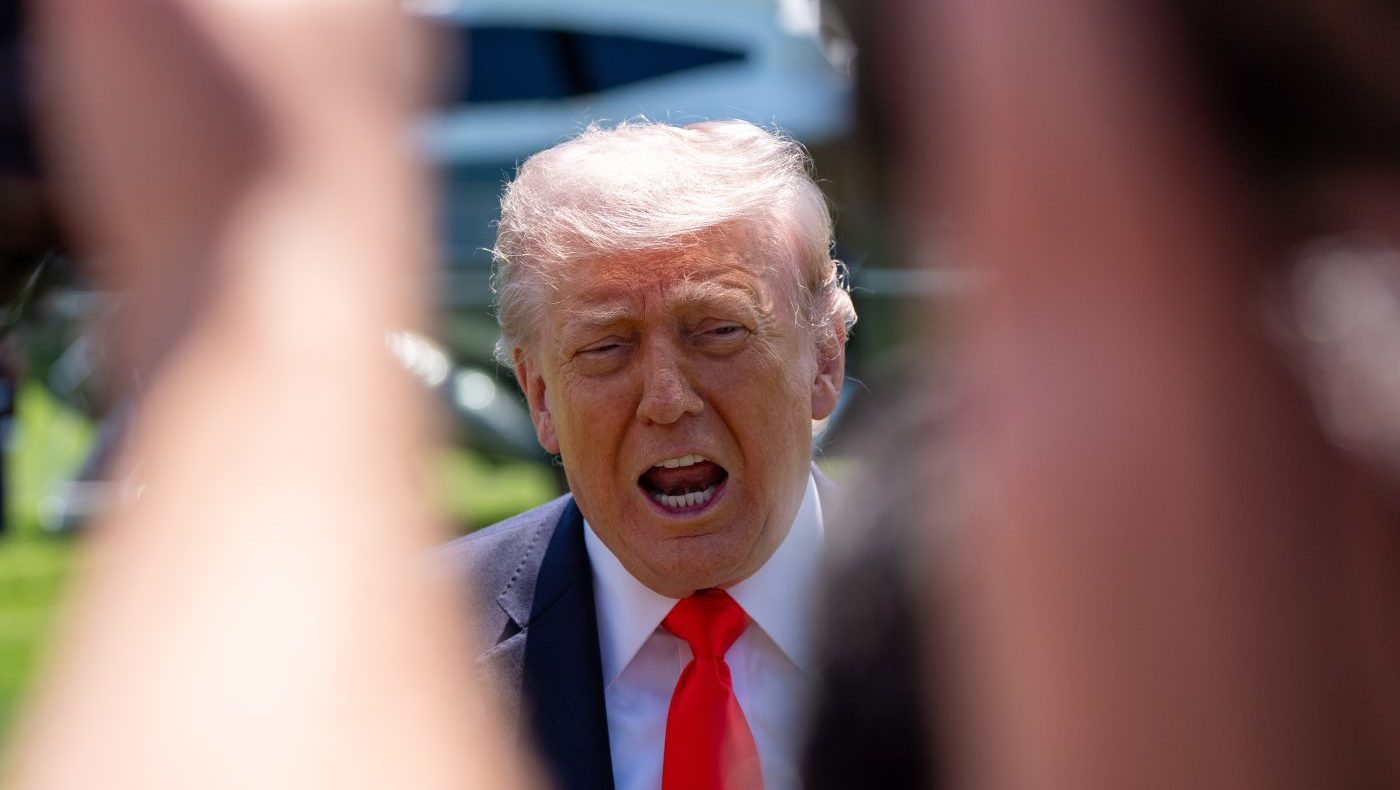
President Trump on Friday escalated his confrontation with Congress over the War Powers Act, suggesting the Vietnam-era law requiring legislative approval for extended military engagements is unconstitutional. His remarks came as the U.S.-led campaign against Iran reached the 60-day threshold, a critical deadline under the statute.
The United States and Israel initiated strikes against Iran on February 28, with Trump formally notifying Congress on March 2. As of Friday, that notification period hit 60 days, triggering a requirement under the War Powers Act for the president either to end hostilities or secure congressional authorization.
Speaking to reporters before departing for a weekend in Florida, Trump dismissed the need to seek approval from lawmakers. “It’s never been sought before, there’s been numerous, many, many times and nobody’s ever gotten it before, they consider it totally unconstitutional,” he said. “But we’re always in touch with Congress. But, nobody’s ever sought it before; nobody’s ever asked for it before; it’s never been used before. Why should we be different?”
The administration’s position marks a notable shift, though it remains unclear to whom Trump was referring with “they.” Defense Secretary Pete Hegseth offered a different rationale during a Senate Armed Services Committee hearing on Thursday. He argued that the 60-day clock effectively paused when Trump announced a ceasefire with Iran in April. “We are in a ceasefire right now, which our understanding means the 60-day clock pauses or stops in a ceasefire,” Hegseth told Senator Tim Kaine (D-Va.).
Kaine pushed back on that interpretation. “I do not believe the statute would support that,” he said. “I think the 60 days runs maybe tomorrow, and it’s going to pose a really important legal question for the administration there.” A senior administration official reiterated Hegseth’s stance in a statement earlier Friday.
The War Powers Act grants presidents 60 days to respond to an imminent threat before requiring congressional authorization or ending operations, with a possible 30-day extension for troop withdrawal. Senate Democrats have attempted six times to pass a war powers resolution to halt U.S. military action against Iran without congressional approval. The most recent vote on Thursday failed 47-50, but marked a shift as Senator Susan Collins (R-Maine) joined Democrats and Senator Rand Paul (R-Ky.) in support. Senator John Curtis (R-Utah), who voted against the resolution, acknowledged the 60-day mark demands joint decision-making.
House Speaker Mike Johnson (R-La.) backed the administration’s view, telling NBC News on Thursday that current operations are not “active, kinetic military bombing” and that he would not interfere with sensitive negotiations. “I would be very reluctant to get in front of the administration in the midst of these very sensitive negotiations,” Johnson said.
Despite a lull in kinetic strikes, the U.S. and Iran remain locked in a tense standoff over the Strait of Hormuz, a critical chokepoint for global energy supplies. Iran has threatened to impose tolls on ships transiting without coordination, while the U.S. maintains a blockade on Iranian oil tankers to pressure Tehran. The crisis has complicated talks over Iran’s nuclear program, with the U.S. demanding Tehran abandon uranium enrichment and hand over its stockpile of highly enriched uranium. Iran denies seeking nuclear weapons but has not agreed to end enrichment.
Trump told reporters Friday he was not “satisfied” with Iran’s latest proposals. “They want to make a deal, but I’m not satisfied with it,” he said, adding that Iran is “asking for things I can’t agree to.” The standoff continues to test the limits of executive war powers and congressional oversight.
For more on the constitutional clash, see our coverage of the Hegseth hearing and the Iran war powers deadline.