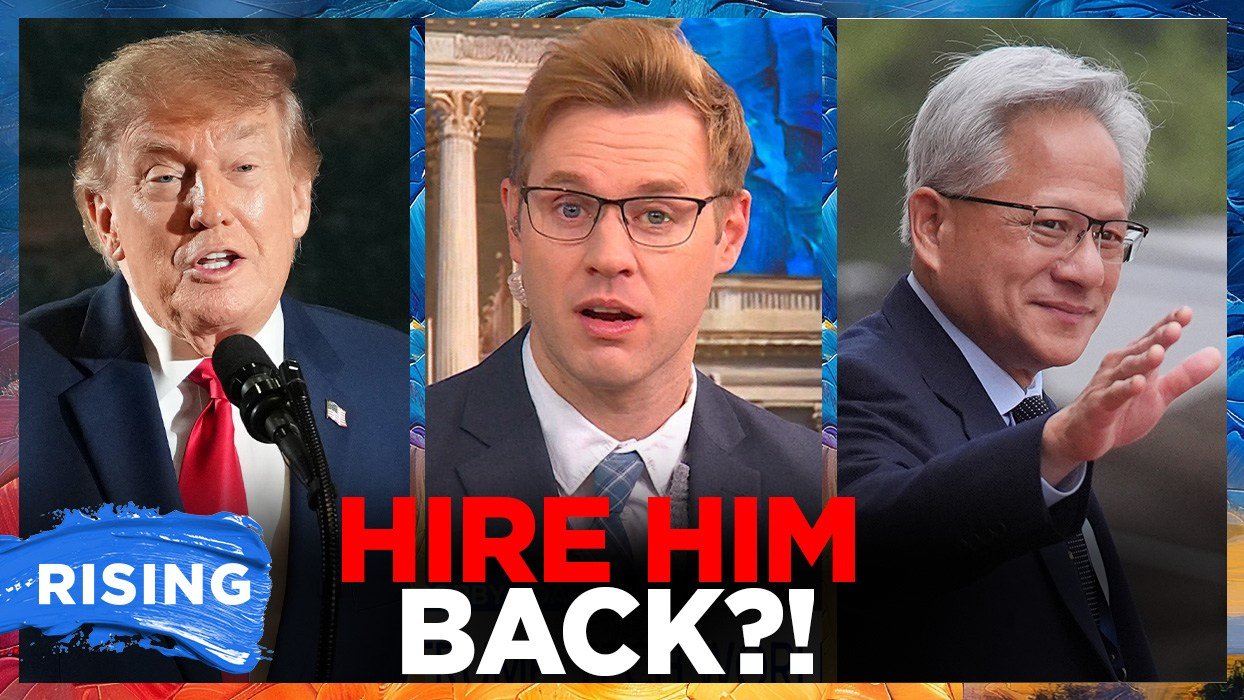
President Trump has thrown a new twist into the Jensen Huang saga, saying he has seen no intelligence suggesting the former Nvidia CEO had a relationship with an actual Chinese spy. Trump also expressed support for Huang returning to the helm of the chipmaker, a position that clashes with some national security officials.
Speaking to reporters, Trump dismissed the allegations that Alice Huang, the woman at the center of the affair, was a Chinese intelligence asset. He argued that given America's reliance on Nvidia's advanced microchips, it might be in the nation's best interest to have Jensen Huang back at work. This aligns with sentiments expressed by former White House crypto and AI adviser David Sacks, who has also advocated for Huang's return. The broader tech community appears to share this view, seeing Huang as essential to Nvidia's continued dominance.
However, national security reporter Josh Rogin offers a more nuanced perspective. He notes that while Alice Huang may not have been a full-time, trained intelligence officer, she could still have been a ‘shady businesswoman’ who reported to China's Ministry of State Security. Rogin describes her as a potential ‘front, bagwoman, cutout, or asset’—all of which would make her a national security risk. ‘That’s a Chinese spy in the common sense understanding of the term,’ he wrote.
Both interpretations could be valid. Perhaps Jensen Huang wasn’t ensnared by a classic honeypot operation, but rather became involved with a businesswoman who used their relationship to shield her company, Megaspeed, from scrutiny over alleged chip exports to China. If true, that would still represent a serious lapse in judgment on Huang’s part, regardless of Alice Huang’s exact role.
This raises a critical question: can Nvidia simply welcome back a CEO who allegedly misled the board about such matters? The board reportedly feels betrayed and is reluctant to reinstate him. If Trump believes Huang’s return is vital for national security and the tech sector, he needs to make that case convincingly—both to the public and to Nvidia’s leadership.
Adding to the chorus, Elon Musk has also voiced support for Huang’s reinstatement. The convergence of tech moguls and political figures suggests a growing faction that prioritizes economic and technological interests over espionage concerns.
My take: if the Chinese spy angle turns out to be overblown, and the intelligence is less solid than initially portrayed, many may come around to Trump and Musk’s position. But until then, the controversy is unlikely to fade, and Nvidia’s board faces a difficult decision with significant implications for U.S. chip supply and global tech competition.