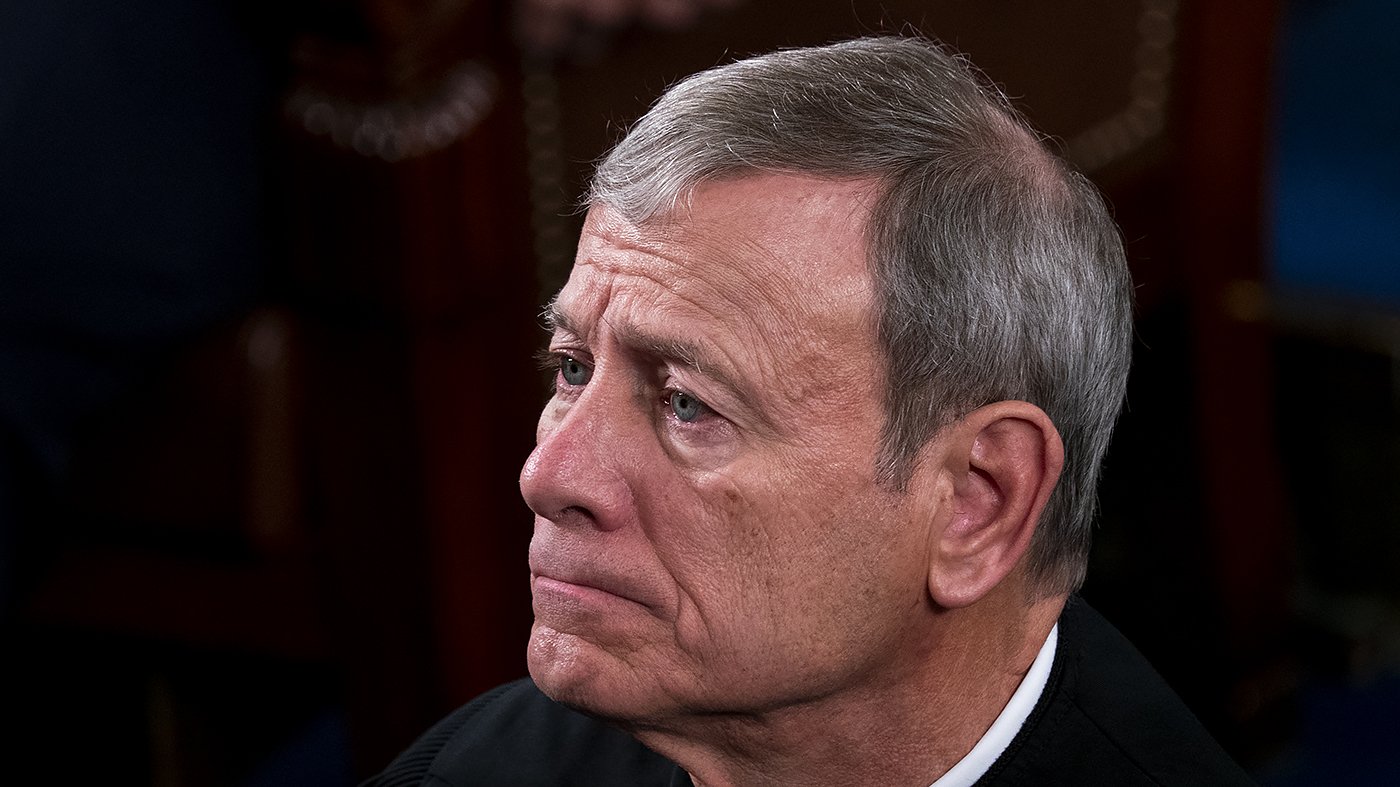
Chief Justice John Roberts pushed back Wednesday against the idea that the Supreme Court has become a political battleground, telling a gathering of federal judges and lawyers that the public's perception of the justices as “purely political actors” is inaccurate.
Speaking at a conference for the 3rd U.S. Circuit Court of Appeals, Roberts acknowledged that many Americans view the court as making policy decisions rather than interpreting the law. “I think, at a very basic level, people think we’re making policy decisions, we’re saying we think this is how things should be, as opposed to what the law provides,” Roberts said, according to the Associated Press.
The chief justice’s remarks come just days after the court’s 6-3 conservative majority struck down Louisiana’s second majority-Black congressional district as an unconstitutional racial gerrymander, a decision that significantly narrowed a central enforcement tool of the Voting Rights Act. The ruling weakened Section 2 of the landmark 1965 law, which has long allowed advocacy groups to push for the creation of additional majority-minority districts.
Justice Samuel Alito, writing for the majority, characterized the decision as an “update” to the legal framework governing Voting Rights Act cases, rather than a wholesale elimination of the provision. But the court’s three liberal justices saw it differently. In a blistering 48-page dissent, Justice Elena Kagan accused the majority of completing a “now-completed demolition” of the Voting Rights Act.
“At this last stage, the Court’s gutting of Section 2 puts that achievement in peril,” Kagan wrote. “I dissent because Congress elected otherwise. I dissent because the Court betrays its duty to faithfully implement the great statute Congress wrote. I dissent because the Court’s decision will set back the foundational right Congress granted of racial equality in electoral opportunity. I dissent.”
The current court, with a 7-3 conservative majority, has taken a sharp rightward turn under Roberts’s tenure, driven by three appointees of former President Donald Trump: Justices Brett Kavanaugh, Neil Gorsuch, and Amy Coney Barrett. Barrett replaced liberal icon Ruth Bader Ginsburg after her death in 2020. The court’s conservative bloc has delivered landmark rulings on issues like abortion—overturning Roe v. Wade in 2022—and now voting rights.
Trump praised the voting rights decision, but he has not been uniformly pleased with the justices he appointed. He recently criticized conservative members who ruled against him on a tariff dispute, accusing them of disloyalty. In that case, Roberts, Barrett, and Gorsuch joined the liberal justices in a 6-3 ruling against Trump’s tariff policy.
The tension between the court’s self-image as apolitical and its increasingly consequential decisions on hot-button issues continues to fuel debate. As former President Barack Obama has warned about the dangers of politicizing the justice system, the Supreme Court’s role in shaping American democracy remains under intense scrutiny.
Some legal scholars suggest that proportional voting systems could offer a way to protect multiracial democracy from hostile court rulings, a topic explored in recent analysis. Meanwhile, the political climate around the judiciary has grown more fraught, with figures like comedian Dave Chappelle recently calling the current atmosphere “insufferable.”