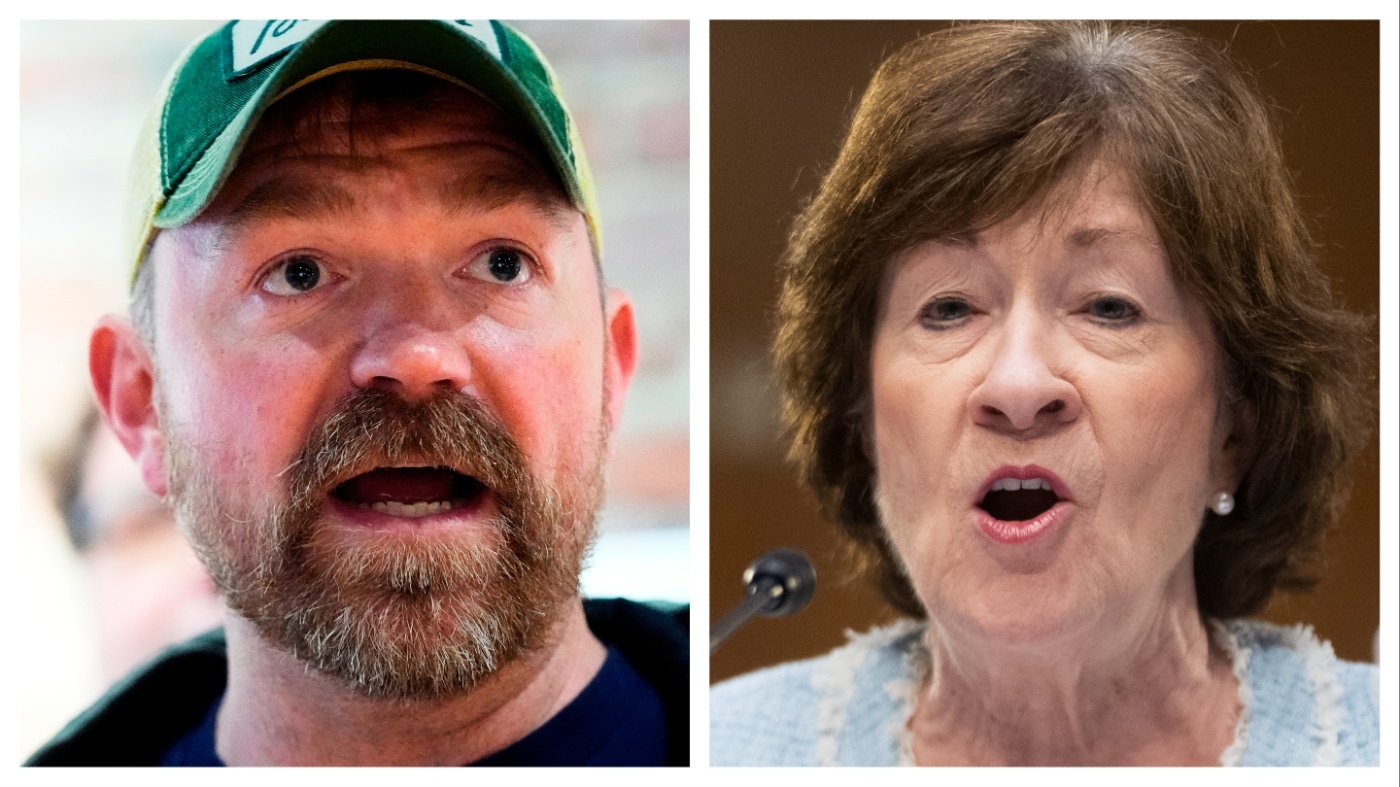
Senator Susan Collins (R-ME) and her Democratic opponent Graham Platner have launched dueling television advertisements this week, marking the first major media salvos since Governor Janet Mills ended her Senate campaign. The shakeup has reshaped the race, leaving Platner as the likely Democratic nominee.
Collins’s ad, which aired Tuesday, leans heavily on her record of delivering federal funding for local infrastructure. It features Chris Gardner, executive director of the Eastport Port Authority, praising Collins for her response after a breakwater collapse in December 2014. No one was injured, but the damage disrupted the economy of Eastport, home to the deepest natural seaport in the continental United States.
“But prior to sunrise, we received a phone call from Sen. Susan Collins, who assured us that she would be there to help see it rebuilt,” Gardner says in the spot. “Just having that assurance meant so much to this community.” Collins had secured a $6 million federal grant for the breakwater in 2013, but the project stalled before the collapse. A $15 million overhaul began in 2017, using state, federal, and city funds to rebuild with more durable composite materials. Gardner concludes: “The breakwater has long been a part of Eastport’s past, and with the help of Susan Collins, it’ll always be a part of our future as well.”
Platner’s ad, released Thursday, takes a sharply different tone. It opens with the line “Susan Collins’s charade is over” and shows him speaking at a campaign rally. He accuses Collins of offering only “symbolic opposition” and “weak condemnation” of the Trump administration’s actions, including the conflict with Iran and restrictions on abortion rights.
“We don’t care that you pretend to be remorseful at the start of a new Forever War that you chose to let happen,” Platner says in the ad. “We don’t care that you are concerned while we go broke as you sell us out to the President and to the Epstein class who are engineering the greatest redistribution of wealth from the working class to the ruling class in this nation’s history.”
Collins recently voted with Democrats and Senator Rand Paul (R-KY) to limit Trump’s authority for military action against Iran, marking her first break with the administration on war powers since the conflict escalated. Platner’s ad dismisses this as too little, too late, calling it “performative politics” that should be disqualifying. “Selling out the same working-class voters who’ve delivered mandate for change after mandate for change is not forgivable,” he says.
Platner, a veteran and oyster farmer, has built his campaign on populist and progressive themes, positioning himself as an outsider. With Mills’s withdrawal, he is now the frontrunner for the Democratic nomination in the June 9 primary. Shortly after Mills dropped out, Platner canceled upcoming primary debates to focus on the general election fight against Collins.
Meanwhile, Collins disclosed to a local news outlet that she has a benign tremor affecting her hands, head, and voice. The 73-year-old senator said she has had the condition throughout her Senate career and is taking medication for it. “It has absolutely no impact on my ability to do my job or how I feel each day,” she told NEWS CENTER Maine. The admission adds a personal dimension to a race already defined by sharp contrasts.
The race in Maine is drawing national attention as a potential bellwether. For more on Platner’s rise and the broader Democratic debate about outsider candidates, see our analysis of Platner’s rise and the Democratic debate on outsider candidates. And for details on Mills’s exit and Platner’s debate pullout, read our coverage of Mills’s exit and Platner’s debate pullout.