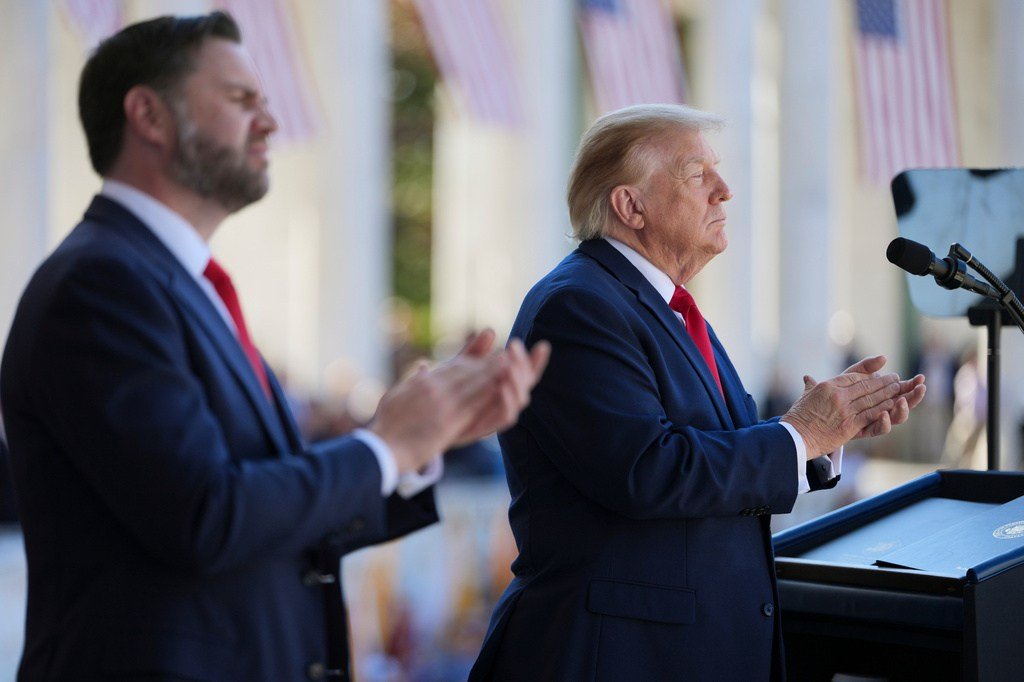
History is not kind to the party holding the White House when the incumbent is not on the ballot. In the eight open-seat presidential elections since World War II, the incumbent party has lost seven times. The lone exception came in 1988, when Vice President George H.W. Bush rode President Ronald Reagan's popularity to victory. That pattern looms over Republicans as they prepare for 2028, when President Trump will be term-limited and unable to seek another term.
The so-called "open-seat phenomenon" has shaped modern American politics. In 1952, President Harry S. Truman's approval rating had cratered to 22 percent, and he chose not to run for a full second term. Republican Dwight D. Eisenhower won in a landslide. In 1960, after Eisenhower's two terms, Democrat John F. Kennedy narrowly defeated Vice President Richard Nixon. Eight years later, Lyndon Johnson's unpopularity over Vietnam led him to bow out, and Nixon won back the White House for the GOP.
1988 was the exception that proved the rule. Reagan's approval averaged 53 percent in the months before Election Day, and the economy was booming with GDP growth near 4.2 percent. Bush capitalized on that to win 53 percent of the popular vote and 426 electoral votes — the last president to top 400. Since then, every open-seat race has gone against the incumbent party: Democrats lost in 2000 and 2016, Republicans lost in 2008 and 2024.
In 2000, Vice President Al Gore won the popular vote but lost the Electoral College to George W. Bush after a Supreme Court decision halted the Florida recount. In 2008, with the Great Recession and two wars weighing on the GOP, Barack Obama defeated John McCain. In 2016, Trump himself was the beneficiary, beating Hillary Clinton despite losing the popular vote. And in 2024, President Biden was forced to withdraw late, leaving Vice President Kamala Harris to lose to Trump.
Now, as Trump's second term winds down, his approval rating sits at a dismal 38 percent on average. Economic growth is sluggish at 1.7 percent, down from the prior year. His tariffs have contributed to an affordability crisis, and the unpopular Iran war has further eroded public confidence. These are not the conditions that allowed Bush to succeed in 1988.
If Republicans are to break the trend again, they would need Trump's approval to climb above 50 percent and the economy to rebound significantly. That seems unlikely given current trajectories. More probable is a scenario where 2028 GOP hopefuls — some openly, some quietly — distance themselves from Trump, sparking internal party warfare and potentially angering the mercurial president.
Democrats, meanwhile, have their own vulnerabilities. They could nominate a weak, out-of-touch liberal, as they did with Michael Dukakis in 1988, handing the GOP an unexpected gift. But with history on their side and the political winds blowing against the incumbent party, Democrats enter 2028 as the clear favorites.
As the race takes shape, both parties will be watching Trump's numbers and the economy closely. If conditions don't improve, the open-seat curse is likely to strike again, delivering the White House to the Democrats. But politics is unpredictable, and the 2028 campaign is still years away.