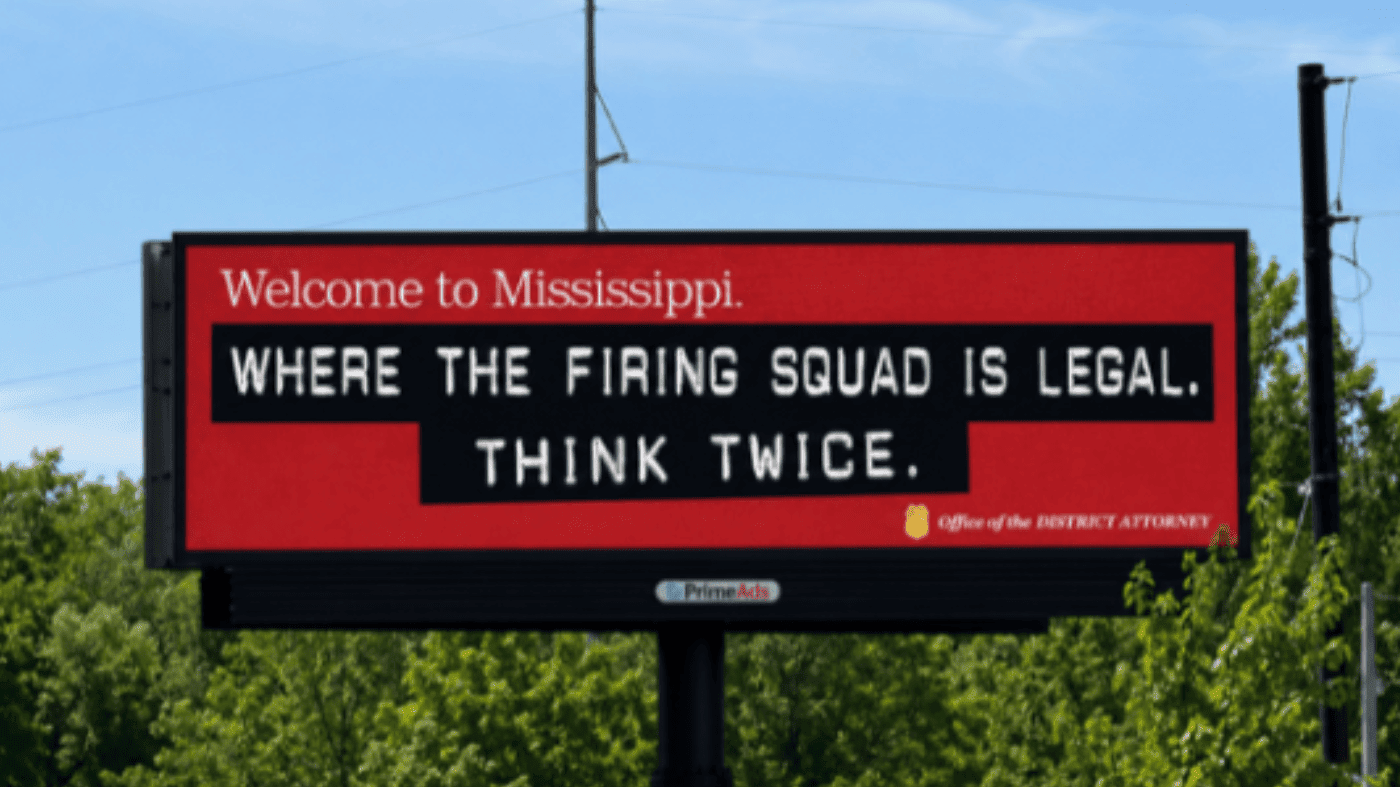
DESOTO COUNTY, Miss. — A stark new billboard on Interstate 55 southbound at the Tennessee line greets travelers with an unmistakable message: “WELCOME TO MISSISSIPPI. WHERE THE FIRING SQUAD IS LEGAL. THINK TWICE.”
DeSoto County District Attorney Matthew Barton unveiled the campaign this week, underscoring the state’s 2017 law that authorizes execution by firing squad for death row inmates when lethal injection drugs are unavailable. The sign, situated just south of Memphis, is aimed squarely at violent criminals crossing into the Magnolia State.
“We are going to be loud and clear that DeSoto County does not coddle violent criminals,” Barton said. “If you bring violence across our state line, we are going to prosecute you aggressively and hold you accountable.”
The district attorney framed the initiative as a direct warning: “People on death row are the losers of life’s lottery. If violent criminals are looking for a state that coddles crime, Mississippi is not it. They’d better think twice before they act here.”
This is not Barton’s first foray into provocative signage. His previous campaign featured billboards reading “TURN BACK NOW,” also targeting would-be offenders. The new sign explicitly ties the threat of capital punishment to the state’s legal framework, which allows firing squads, electrocution, and nitrogen gas as alternatives to lethal injection.
Mississippi is one of only five states where firing squad executions remain legally authorized. The law, sponsored by former state Rep. Robert Foster (R), was enacted in 2017 as part of broader death penalty legislation. Foster argued at the time that the state needed backup methods in case lethal injection drugs became scarce.
The Department of Justice has signaled renewed support for such methods. Last month, the DOJ announced it would resume use of firing squads and electric chairs in certain federal death penalty cases, alongside “readopting” lethal injection. Officials described these methods as “critical to deterring the most barbaric crimes, delivering justice for victims, and providing long-overdue closure to surviving loved ones.”
The billboard campaign has sparked debate about the effectiveness of such messaging. Critics question whether graphic warnings actually deter crime, while supporters argue it sends a clear signal that the state prioritizes law and order. Barton’s office has not released data on the impact of the earlier “TURN BACK NOW” signs.
The move comes amid broader national conversations about capital punishment and its role in criminal justice. As states like Mississippi double down on execution methods, the debate over deterrence, morality, and legality continues to intensify.