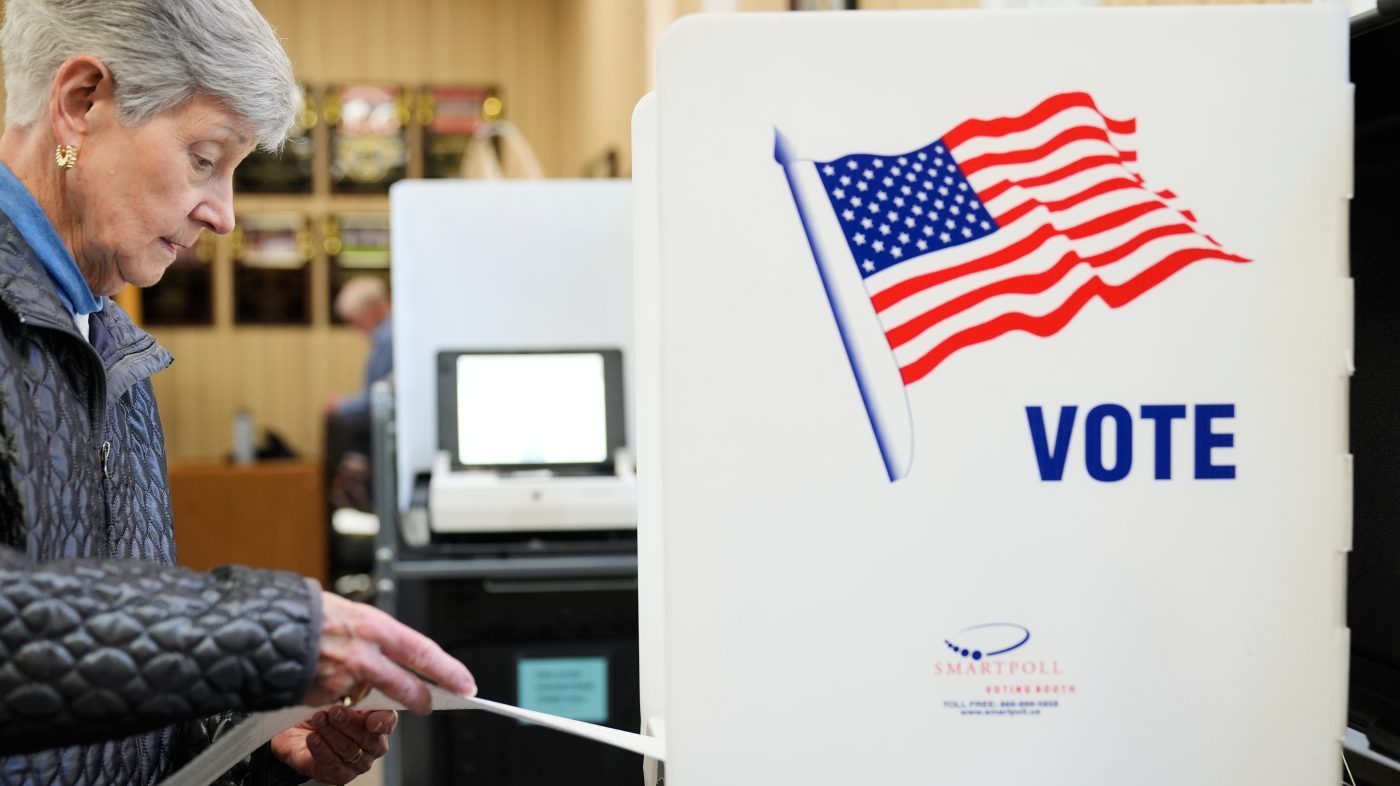
With just one week until the final ballots are cast in the 2026 midterms, tens of millions of Americans have already voted in races that will shape President Trump's legislative agenda and the balance of power in Washington. Control of the Senate, House, and numerous governorships hangs in the balance, and both parties are making their final pitches to voters.
In the Senate, Democrats need to flip four Republican-held seats to win the majority, while in the House, a net gain of just three seats would give them control. According to nonpartisan election forecaster Decision Desk HQ (DDHQ), which partners with The Hill, Democrats have a 57% chance of taking the Senate and an 80% chance of winning the House, as of Tuesday afternoon.

Senate and House Outlook
Public polling shows Democrats leading in several Republican-held Senate seats, though most leads are within the margin of error. Their best pickup opportunity is in North Carolina, but they also lead narrowly in Alaska, Maine, Texas, and Ohio. They trail slightly in Iowa and are tied in Kansas. Democrats are also favored in the states they are defending, including Georgia, Michigan, and Minnesota. On a strong night, the party could also target upset wins in South Carolina, Mississippi, and Nebraska, where an independent candidate is backed by Democrats.
In the House, the Democrats' path is even more favorable, with the generic congressional ballot showing them ahead by 8.1 points. Republican redistricting efforts may offset some gains, but the GOP has already halted spending in several key races, signaling a tough environment for the party. A recent Marist poll confirms the Democrats' lead, and some high-profile Democrats, like actress Sophia Bush, are calling for a 'blue landslide.'
Poll Closing Times
Polls across the country close between 6 p.m. and 1 a.m. ET. The first closures are at 6 p.m. in parts of Kentucky and Indiana, with all polls in those states closed by 7 p.m. At 7 p.m., polls close in Georgia, South Carolina, Vermont, and Virginia, plus most of Florida and New Hampshire. At 7:30 p.m., West Virginia, Ohio, and North Carolina close. At 8 p.m., a large group of states closes, including Alabama, Connecticut, Delaware, Illinois, Maine, Maryland, Massachusetts, Mississippi, Missouri, New Jersey, Oklahoma, Pennsylvania, Rhode Island, Tennessee, and D.C. Texas, Michigan, Kansas, North Dakota, and South Dakota close at 8 p.m. in most areas, with the rest closing at 9 p.m. Arkansas closes at 8:30 p.m. At 9 p.m., Arizona, Colorado, Iowa, Louisiana, Minnesota, Nebraska, New Mexico, New York, Wisconsin, and Wyoming close. At 10 p.m., Montana and Utah close, with Idaho and Oregon closing at 10 or 11 p.m. California and Washington close at 11 p.m., and Hawaii and most of Alaska close at midnight, with some Alaska precincts closing at 1 a.m.
When Will Results Be Known?
The speed of counting varies widely by state. States like Florida, North Carolina, Georgia, and Texas, which rely heavily on early in-person voting, are expected to report results quickly. In contrast, battlegrounds like Michigan, Wisconsin, and Pennsylvania may take longer, especially if races are close. For instance, DDHQ did not project the 2024 presidential winner in Michigan until two days after the election.
Western states, particularly California, conduct elections largely by mail and allow ballots to arrive days after Election Day. This has historically delayed the calling of the House majority, as seen in 2022 and 2024. However, a new congressional map favoring Democrats has reduced the number of competitive races in California, which could expedite the outcome this year.
For those watching the GOP's Michigan rally and other final campaign events, the election night results will be shaped by turnout and the final push from both sides. President Trump has also raised concerns about election integrity, which could influence how results are accepted.
When Do Winners Take Office?
Federal winners are sworn in on Jan. 3, 2027, at noon, per the Constitution. However, special elections for appointed senators in Ohio and Florida could see winners seated before the end of the year, which would immediately reduce the GOP's majority if Democrats win those races. State and local winners take office at varying dates depending on state law.
As the final week unfolds, both parties are focusing on turnout and late-breaking issues, including voters' personal finances and other local concerns that could sway undecided voters.