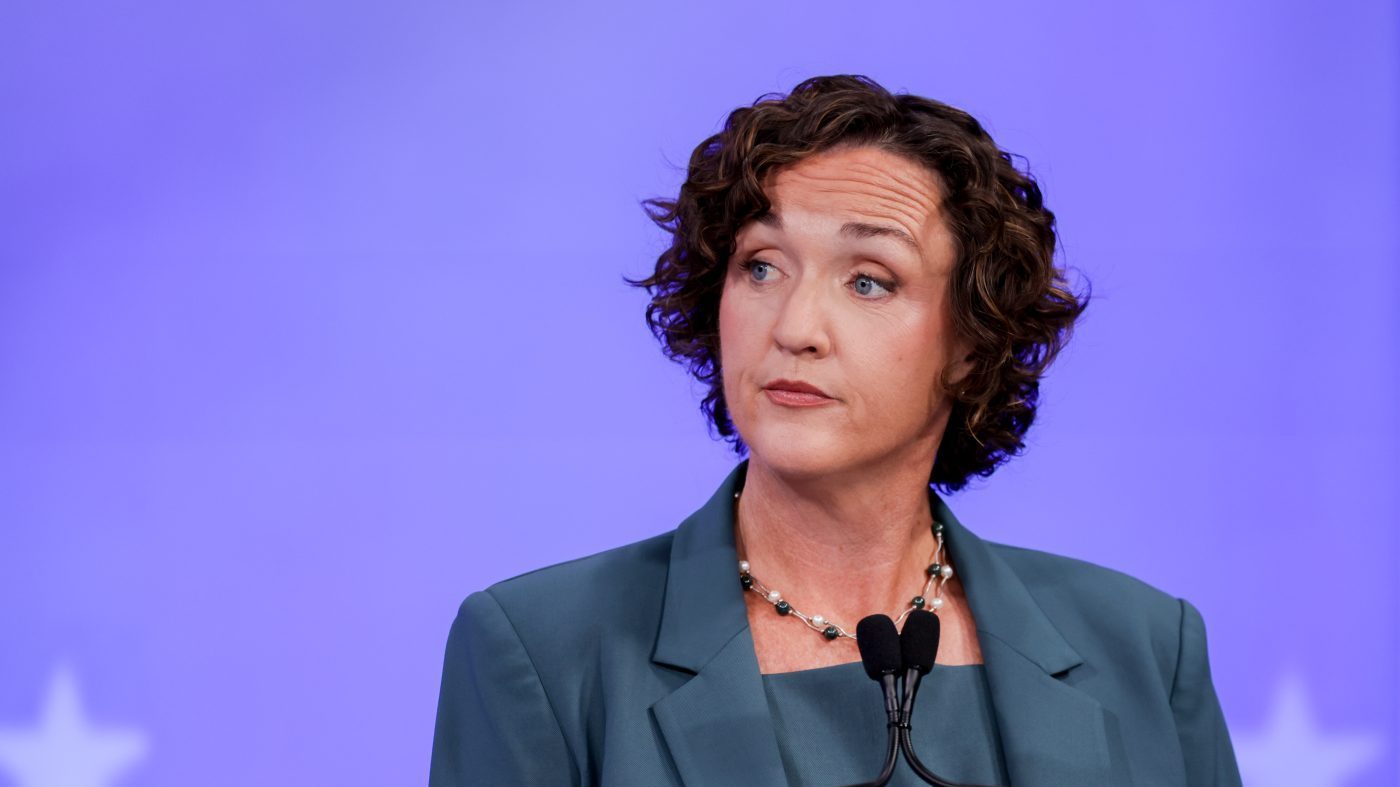
Just two months after declaring she was stepping away from politics, former California gubernatorial candidate Katie Porter has re-entered the fray—this time to oppose a marquee progressive initiative. In an opinion piece published Monday in the San Francisco Chronicle, Porter argued that Proposition 40, the so-called “Billionaire Tax,” would do little to address systemic inequities and could actually backfire on working families.
Porter, who finished a distant fifth in this year's gubernatorial primary, had said in July that she was “done, for now, with politics” and rebranded her social media presence to promote her upcoming book, Katie Porter Turns the Page. But her return to the political arena underscores the deep divisions the ballot measure has created within California's Democratic establishment.

Prop 40 would impose a 1% annual tax on the wealth of billionaires residing in California, with revenue earmarked for healthcare and housing programs. Supporters argue it is a necessary step to make the ultra-wealthy pay their fair share. However, the measure has drawn opposition from Governor Gavin Newsom and former Health and Human Services Secretary Xavier Becerra, the frontrunner to succeed him. Both have cited concerns about its constitutionality and potential economic fallout.
In her op-ed, Porter echoed many of the populist themes she championed in Congress, writing that “working families across California have been shortchanged in an economy shaped by corporate elites and the ultra-wealthy.” Yet she cautioned that supporting the idea of taxing billionaires “doesn't require us to rubber-stamp every poorly drafted policy.” She warned left-leaning voters “not to be fooled” by the measure's progressive veneer.
“Proposition 40 is a prime example of a seemingly progressive-sounding policy solution that ultimately just perpetuates the status quo,” Porter wrote. “It does nothing to reform our healthcare system and would send billions in tax dollars to private health insurance companies and corporations that dominate our healthcare system.”
Her opposition could provide political cover for Newsom, who has faced criticism from the left for his stance. A new poll from the UC Berkeley Citrin Center for Public Opinion Research, conducted with Politico, shows voters are almost evenly split: 46% support the tax, 43% oppose it. The poll also found that 32% of voters believe Newsom is “mainly trying to protect billionaires and other wealthy interests” by opposing Prop 40, while 24% think he is “mainly trying to protect California's economy and tax base.” Another 15% see both motivations equally, 15% neither, and 13% are unsure.
Porter's return to public life was further signaled last Friday when Newsom appointed her to the California Community Colleges Board of Governors, a body overseeing 116 campuses. The position, which requires Senate confirmation, pays $100 per diem. Porter served in the U.S. House from 2019 to 2025, where she gained a national following for her pointed questioning of corporate executives and her advocacy for consumer protections.
The debate over Prop 40 has become a flashpoint in California politics, with progressives split between those who see it as a necessary step and those who worry it could destabilize the state's budget. Porter's intervention adds a prominent voice to the opposition, potentially swaying undecided voters. As the November election approaches, the measure's fate remains uncertain, and the battle lines are being drawn not just between parties but within them.
For now, Porter has made clear that while she may have turned the page on campaigning, she has not turned her back on policy fights. Her critique of Prop 40 echoes broader concerns about the feasibility of wealth taxes, a subject that has also been debated at the national level, as seen in recent discussions about future progressive leadership. Meanwhile, the ongoing legal battles over election rules continue to shape the political landscape, and economic policy remains a central issue for voters nationwide.