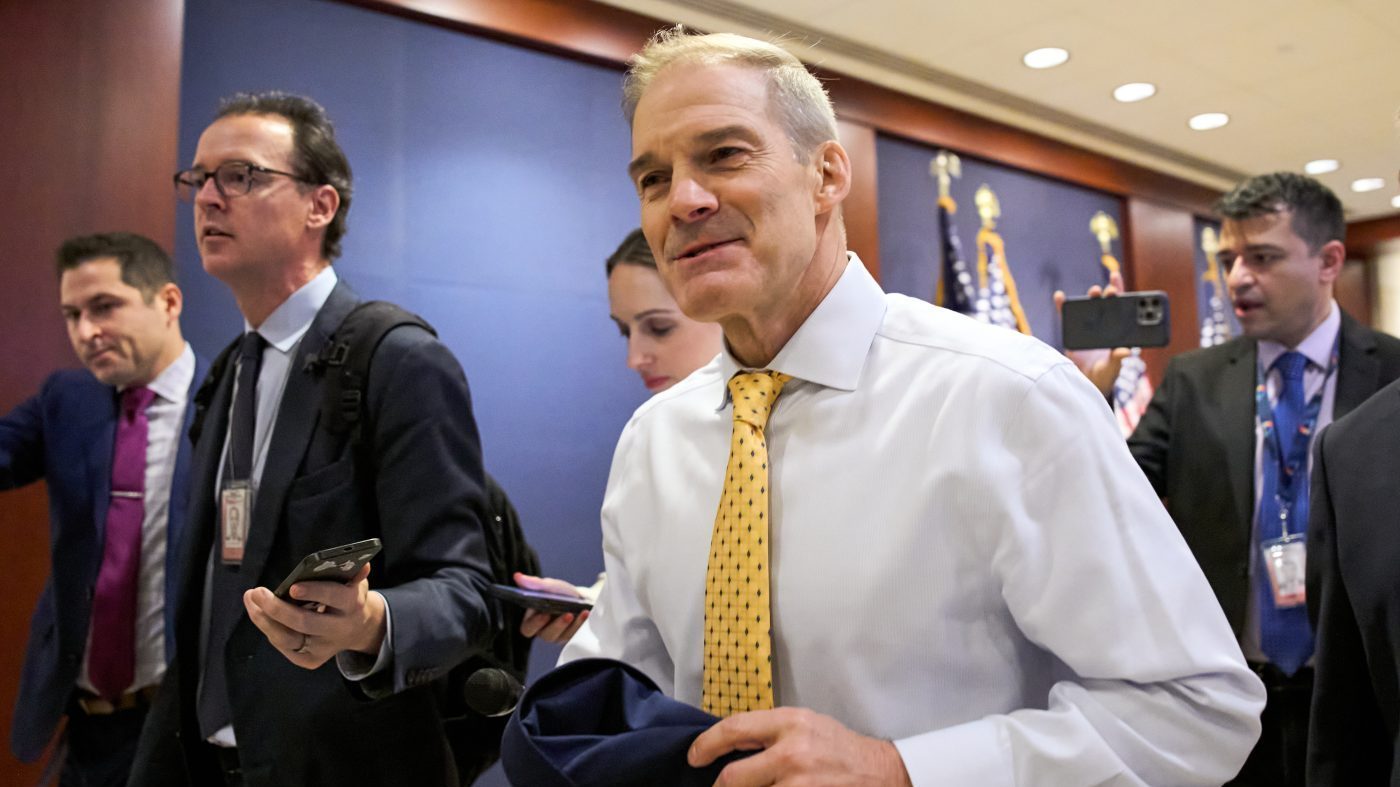
House Republicans on Tuesday chose Rep. Jim Jordan (R-Ohio) to lead their conference in the next Congress, a decisive shift toward a more combative style of leadership after the party's bruising midterm defeats. Jordan, a founding member of the House Freedom Caucus and a staunch ally of President Trump, defeated Rep. Steve Scalise (R-La.) in a secret-ballot vote held in the Capitol Visitor Center, 106-73.
Scalise, who has served as the party's No. 2 in the House since 2019, had argued that his experience in leadership made him the best fit to guide the conference through the minority. But the electoral losses—Democrats are projected to hold a commanding majority of roughly 260 seats—fueled a wave of anger among rank-and-file Republicans, many of whom blamed the current leadership team for the party's poor showing. That sentiment, described by several lawmakers as a desire to "clean house," quickly turned against Scalise and Rep. Tom Emmer (R-Minn.), the outgoing whip, who had been seen as potential contenders.

Jordan, a 20-year veteran of the House, seized on the restless mood, presenting himself as a fresh face and a fighter ready to take on the new Democratic majority and its expected Speaker, Rep. Hakeem Jeffries (D-N.Y.). He had spent the months before the election stumping for GOP candidates across the country, building relationships that paid off in Tuesday's vote, especially among the many newcomers elected in the wave of Republican retirements this cycle.
Jordan's rise marks a remarkable journey for a conservative icon who once made his name by challenging his own party's leaders. As a co-founder and first chairman of the Freedom Caucus, he led the group in relentless attacks on then-Speaker John Boehner (R-Ohio), whom conservatives viewed as too willing to compromise. Boehner eventually resigned in 2015, in part due to the pressure.
In recent years, however, Jordan has moved closer to the establishment. After opposing Kevin McCarthy's 2015 Speaker bid, he later backed him, a shift that helped Jordan secure the chairmanship of the influential House Judiciary Committee. McCarthy, who has long feuded with Scalise, returned the favor by lobbying on Jordan's behalf in this race. Jordan's policy evolution is also notable: once a critic of warrantless surveillance, he has supported President Trump's efforts to expand such authority.
The contest between Jordan and Scalise was a reprise of their 2023 battle for the Speakership, after McCarthy's ouster. Scalise won the nomination then but withdrew when he could not secure the 218 votes needed on the floor. Jordan's subsequent nomination also failed, and Mike Johnson eventually took the gavel.
In his letter to colleagues, Jordan argued that Republicans have "operated without a clear plan" and need a leadership team that is "active and engaged, forward-thinking and straight-shooting." He emphasized his experience in oversight and his knowledge of the Democrats' playbook, vowing to keep the conference unified in the minority.
Jordan's new role will be tested immediately. Democrats are promising exhaustive investigations into Trump, his family, and his administration, and Jordan will be the first line of defense for his ally in the White House. He also faces the challenge of managing a conference that is ideologically diverse and increasingly fractious. The selection of Jordan signals that House Republicans are ready for a more aggressive posture, but whether he can deliver results remains to be seen.
Meanwhile, Senate Republicans are delaying their own leadership vote as conservatives press for a strategy that aligns with the new political reality. The coming weeks will reveal whether Jordan can unite his party or whether the internal divisions that have plagued the GOP will deepen.