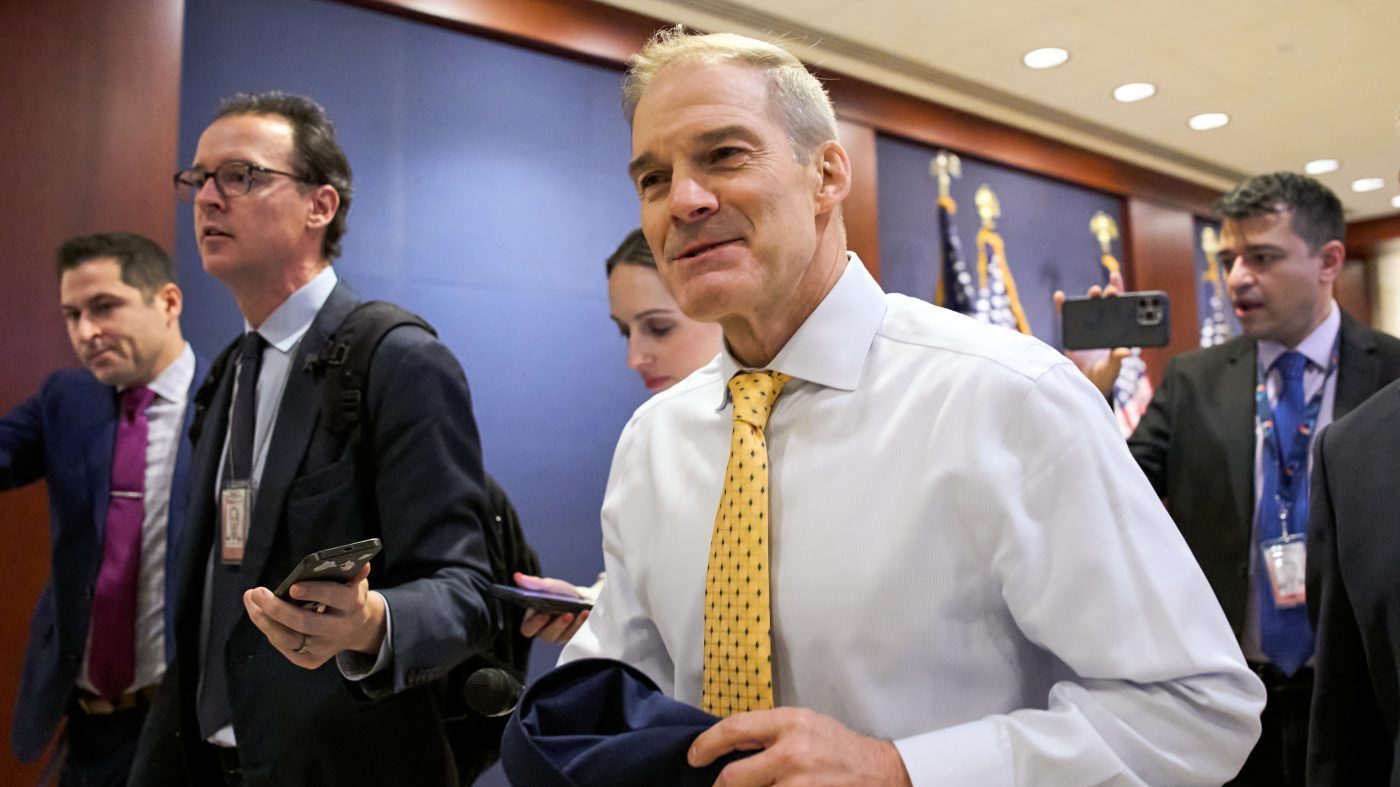
House Republicans on Tuesday selected Rep. Jim Jordan of Ohio to serve as their minority leader in the next Congress, a decisive shift toward the party's conservative wing after a bruising midterm election that cost the GOP its majority.
Jordan defeated outgoing House Majority Leader Steve Scalise of Louisiana by a tally of 106-73 in a secret-ballot election held in the Capitol Visitor Center. Scalise had been the No. 2 Republican since 2019, and his backers argued that his experience made him the natural choice to steer the conference through the minority. But the scale of last week's losses—Democrats are on track to control roughly 260 seats—fueled a wave of anger directed at the party's establishment, and many rank-and-file members demanded a change at the top.

That frustration was particularly acute toward Speaker Mike Johnson, who is stepping down from leadership at the end of the term. With Johnson out of the picture, Scalise and GOP Whip Tom Emmer of Minnesota became the targets of a "clean house" sentiment that swept through the conference. Jordan, a 20-year House veteran and co-founder of the House Freedom Caucus, positioned himself as the antidote, promising a more combative approach against the incoming Democratic majority and its likely Speaker, Hakeem Jeffries of New York.
Jordan's victory also reflects the shifting composition of the GOP conference. He spent months on the campaign trail this year stumping for Republican candidates, building goodwill among the many newcomers who entered the House after a wave of retirements. Those freshmen, less tied to the old leadership structure, proved pivotal in Tuesday's vote.
Jordan has long been a polarizing figure in the party. As the first chairman of the Freedom Caucus, he built a reputation for attacking Republican leaders, most notably then-Speaker John Boehner, whom conservatives saw as too willing to compromise. Boehner resigned in 2015 under relentless pressure from the group. But in recent years, Jordan has moved closer to the establishment, backing Kevin McCarthy's speakership bid in 2023 even as other conservatives tried to block it. That shift helped him secure the chairmanship of the House Judiciary Committee, a position he has held throughout the 119th Congress.
McCarthy, who has long been at odds with Scalise, repaid Jordan by lobbying on his behalf in the leadership contest. Jordan's evolution is also visible in his policy stances—once a vocal opponent of warrantless surveillance, he has more recently supported President Trump's efforts to expand those powers.
The Scalise-Jordan rematch echoed their 2023 battle for the Speakership, which Scalise initially won in a party vote but then abandoned after failing to secure the 218 votes needed on the floor. Jordan later became the nominee but also fell short, and Johnson ultimately stepped in. This time, Jordan's allies argue, his outsider credibility and close ties to Trump make him the right person to lead the GOP's oversight efforts against the Democratic majority.
In his letter to colleagues last week, Jordan wrote that Republicans have "operated without a clear plan to survive the hour or the day in front of us," adding that such an approach "will not cut it against an emboldened and energetic Democratic majority." He described himself as "battle-tested on the oversight front" and familiar with "the Democrats' playbook," vowing to keep the conference unified and disciplined.
The road ahead is steep. Democrats are preparing exhaustive investigations into Trump, his family, and his administration, and Jordan will be the first line of defense for his ally in the White House. He also faces the challenge of managing a diverse and often restive conference that includes both staunch conservatives and moderates who lost their seats in the blue wave.
Jordan's election is a signal that the GOP is ready to embrace a more confrontational style in the minority, but whether that strategy will pay off politically remains an open question. For now, the former wrestler has won his toughest match yet—but the next Congress will present even greater challenges.