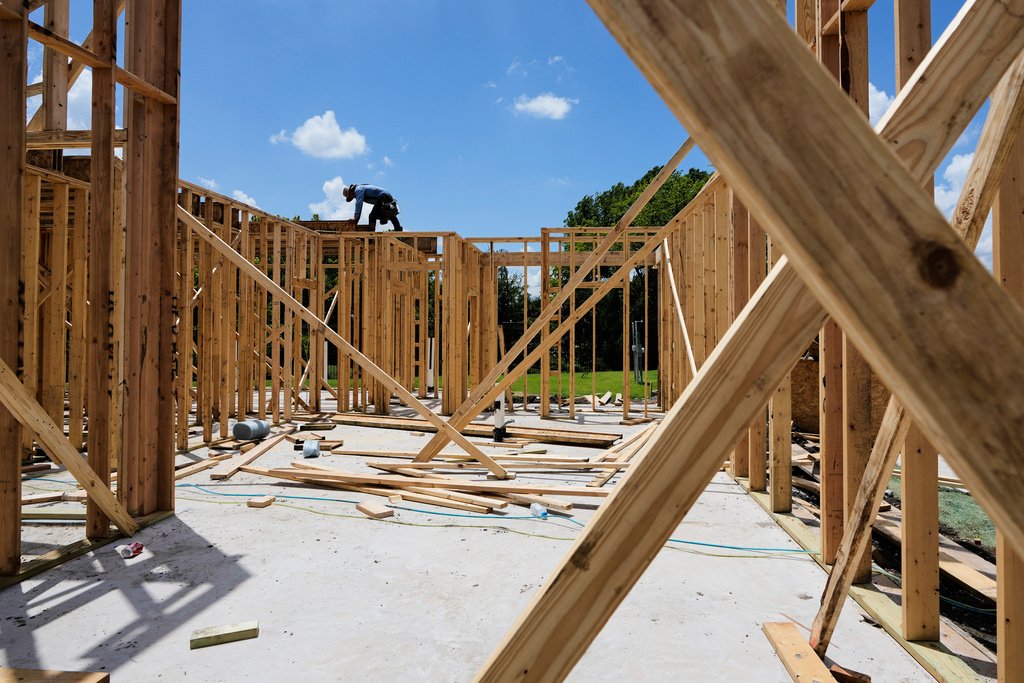
The House of Representatives passed legislation Wednesday that would limit institutional investors to owning no more than 350 single-family homes per entity, alongside measures to boost new housing construction. The vote signals a rare bipartisan consensus that large-scale corporate ownership is distorting the housing market and that more building is needed to tackle the supply shortage.
But the bill, while acknowledging two real problems, has drawn sharp criticism for its approach to the investor issue. Representative Adam Smith (D-Wash.), author of a more aggressive alternative, argues the cap is fundamentally flawed. 'A 350-home cap accepts the premise that institutional investors belong in the single-family market and tries to manage the harm,' Smith wrote. 'But the harm is not primarily a function of scale. It is a function of the nature of institutional ownership itself.'

Smith points to a House Financial Services Committee investigation showing that institutional investors are 68 percent more likely to file for eviction than small landlords, and that they disproportionately target neighborhoods with larger Black populations and about 30 percent more single mothers than the national average. 'None of those dynamics change at 200 homes versus 400,' he said. 'They are structural features of institutional ownership, not side effects of excess concentration.'
The 21st Century Road to Housing Act, as the House bill is called, includes incentives for new construction and zoning reforms, which Smith acknowledges are necessary. But on the ownership cap, he warns it creates a regulatory ceiling that could be easily eroded. 'At what point does the limit get lobbied up to 500? To 1,000?' he asked, noting that the history of financial market caps is not encouraging on this point.
Smith and Senator Jeff Merkley (D-Ore.) have introduced the End Hedge Fund Control of American Homes Act, which takes a different approach. Instead of a cap, it would impose an immediate 50 percent excise tax on the fair market value of any single-family home purchased by a covered institutional investor after enactment, making new acquisitions economically prohibitive. Existing holders would be required to divest 10 percent of their portfolios annually over 10 years, with a $50,000 penalty per home for non-compliance. After a decade, institutional ownership of single-family homes would be banned entirely.
Revenue from penalties and excise taxes would flow into a Housing Downpayment Trust Fund, administered by the Department of Housing and Urban Development, providing down payment and closing cost assistance to first-time buyers earning up to 120 percent of area median income, with priority for those purchasing divested properties.
Critics of the divestiture approach often argue that institutional investors provide rental housing supply. Smith counters that this argument is valid for multifamily and commercial contexts, but not for single-family homes. The bill exempts nonprofits, public housing agencies, government entities, and home builders—those that deliver rental housing as a public function rather than a return on investment.
Another common objection is that forced divestiture could disrupt the market. Smith dismisses this, calling the 10-year phase-down a gradual rebalancing toward owner-occupancy. 'Returning 10 percent of holdings to the market annually is not a destabilizing event,' he said. 'It is a gradual rebalancing toward owner-occupancy in a market that has been moving in the wrong direction for over a decade.'
The deeper issue, Smith argues, is that a cap requires ongoing regulatory maintenance, while a prohibition is more durable. 'The passage of Wednesday's 21st Century Road to Housing Act established that Congress is willing to act on institutional ownership of single-family homes and committed to building more of them,' he wrote. 'Both are the right instincts. The End Hedge Fund Control of American Homes Act is where the first of those instincts leads—not a cap on how much of the problem to allow, but an end to the problem itself.'