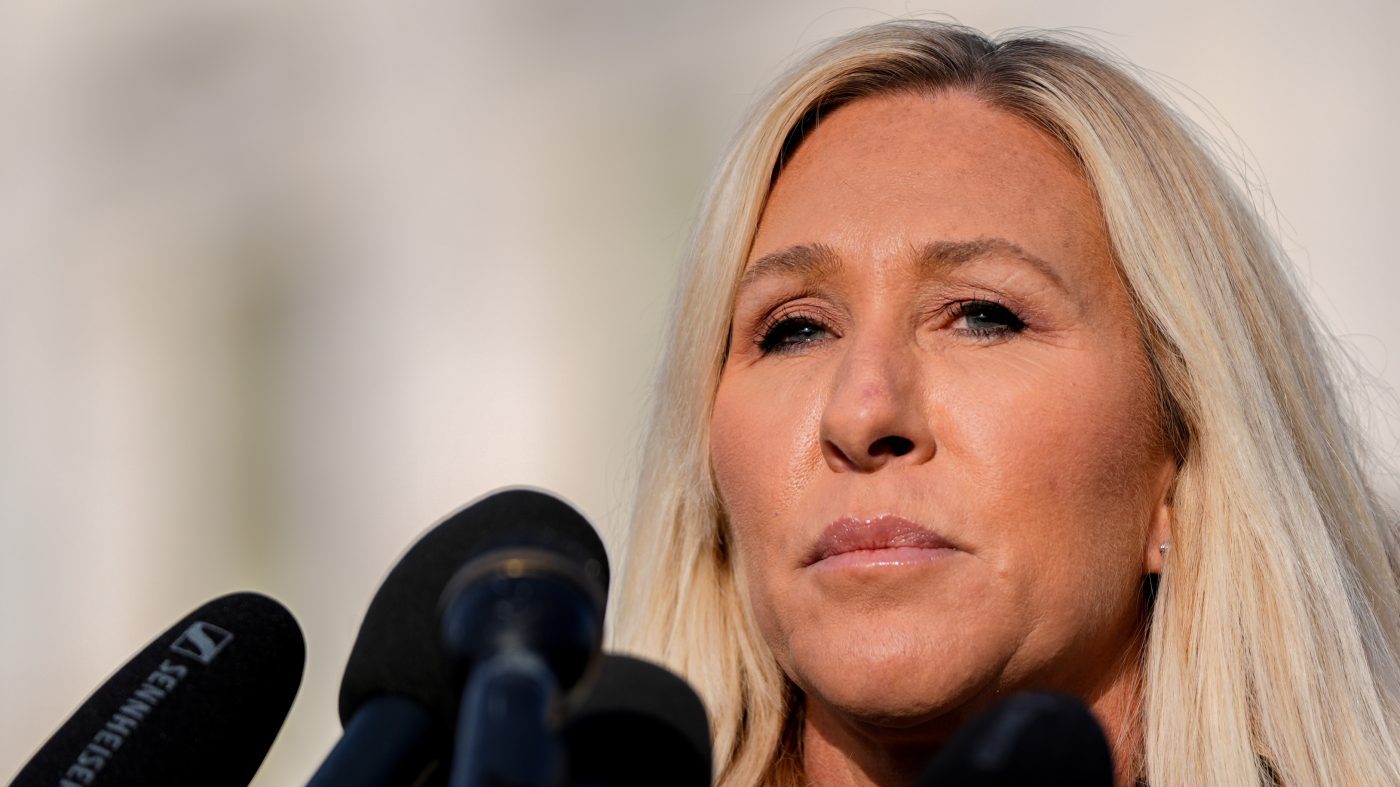
Former Republican Congresswoman Marjorie Taylor Greene delivered a scathing rebuke of President Donald Trump's recent threat against Iran, labeling his statement that the nation's "whole civilization will die" as "absolute madness." In an interview with CNN, Greene characterized the president's rhetoric as dangerously unstable and fundamentally at odds with diplomatic negotiation.
"How can any person that is mentally stable call for an entire civilization of people to be murdered, to be wiped out, to never come back again?" Greene asked during her appearance. "That's what the president called for, and that shows that there's serious instability in his thinking that he would not only say that in a private room, perhaps with his advisers, but actually go to his megaphone, his Truth Social, and post that for the entire country and the entire world?"
The Provocative Post
The controversy stems from a Tuesday post on Trump's Truth Social platform, where he warned Iran that if it did not submit a peace deal proposal and reopen the strategic Strait of Hormuz, a "whole civilization will die tonight, never to be brought back again." Trump added, "I don't want that to happen, but it probably will," before suggesting that "different, smarter, and less radicalized minds" now prevailing in the U.S. administration might enable "something revolutionarily wonderful."
Greene explicitly rejected the notion that such threats contributed to the shaky ceasefire agreement reached between the U.S. and Iran just hours before Trump's deadline. "It's not his 'tough rhetoric' that brought the U.S. and Iran together," she stated. "It's insanity. It's calling for the murder of an entire civilization of men, women, children, of the innocent civilians. That is not what I would call proper or even decent negotiations."
Contrast with Vance's Approach
The Georgia Republican highlighted what she viewed as a stark contrast between Trump's approach and that of Vice President J.D. Vance, who led the negotiations that secured the temporary ceasefire. "Vice President Vance did not go to his social media and threaten to murder every single man, woman and child in Iran," Greene noted, implying that Trump's threat implicitly referenced nuclear weapons as the means for such destruction.
Greene's criticism extends beyond the specific threat to the ceasefire deal itself, which she described as tenuous at best. "It doesn't seem to be much of a ceasefire," she remarked, referencing Iran's decision to re-close the Strait of Hormuz less than 24 hours after the agreement, following continued Israeli military action in Lebanon. This move exposed conflicting interpretations of the deal, with Iranian and Pakistani officials insisting it included a pause in hostilities toward Lebanon—a condition the U.S. and Israel deny.
A Fundamental Break
In a significant personal and political shift, Greene declared that Trump has "gone from being the peace president to the war president, and that I don't support at all." This represents a dramatic turn for a lawmaker who was once among Trump's most vocal defenders. Her comments follow a Wednesday appearance on conspiracy theorist Alex Jones's show where she asserted the president "is not the same man that we supported" for over a decade, urging the American public to "take the blinders off."
The episode underscores deepening fractures within the Republican coalition regarding foreign policy, particularly concerning the use of aggressive rhetoric against adversarial states. It also raises questions about congressional oversight of military authority, a topic that has seen recent legislative action, including when House Republicans blocked a Democratic effort to limit the president's unilateral military powers regarding Iran.
Greene's condemnation adds to a growing chorus of concern from some foreign policy observers. NATO Secretary-General Mark Rutte has previously warned that the Iran standoff risks escalating into a 'North Korea scenario' of prolonged confrontation and proliferation, complicating alliance cohesion. Meanwhile, Greene's complete break with Trump, which she has detailed elsewhere, marks one of the most notable political defections of his presidency.
The fallout from Trump's threat and the fragile ceasefire continues to unfold, testing the administration's diplomatic credibility and exposing internal GOP divisions on national security strategy at a moment of heightened global tension.