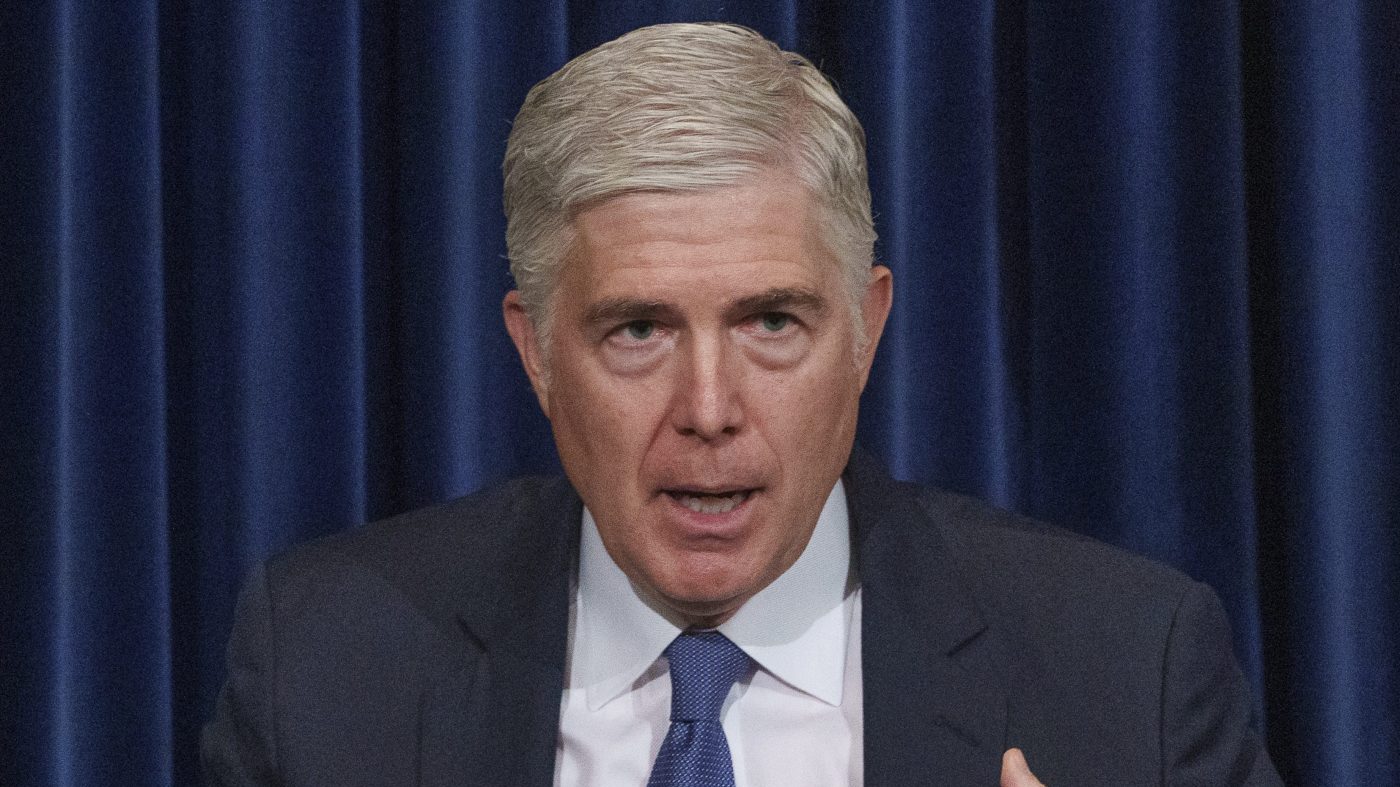
Supreme Court Justice Neil Gorsuch directly challenged Vice President JD Vance's vision of a Christian-founded America, arguing in a recent interview that the United States was never intended to be defined by a single race or religion. The exchange highlights a deepening ideological rift within conservative circles over the nation's identity.
In an episode of PBS's Firing Line released Friday, Gorsuch told host Margaret Hoover that the country's colonial roots were built on religious pluralism, not uniformity. “We were founded, a lot of our colonies, for our religious pluralism, right? And the opportunity to practice your own faith in your own way,” he said. “And we were never supposed to be a nation that was about one race or one religion, it was about those ideas.”
Gorsuch pointed to the founding principles of life, liberty, and the pursuit of happiness as “perfect ideas that speak to every human heart and that unite us all.” His remarks come as Vance has increasingly promoted a Christian nationalist narrative, arguing at Turning Point USA's AmericaFest in December that Christianity serves as “America's creed.”
The vice president, who converted to Catholicism in 2019, said at the event that the Christian faith provided the “shared moral language” from the Revolution through the Civil War and beyond. He claimed the country's major debates have always centered on pleasing God and that religious liberty itself is a “Christian concept.”
Gorsuch, however, offered a historical counterpoint. He noted that Charles Carroll, a Catholic, signed the Declaration of Independence alongside Protestants, and that Amish and Quaker communities settled in the colonies. “We have a First Amendment for crying out loud. No established religion, everybody has a freedom of religion, everybody has the freedom of speech, we are all equal under law,” he said.
The justice's comments resonate amid ongoing legal battles over religious freedom and national identity. The Supreme Court is currently weighing cases on mail-in voting restrictions and other politically charged issues, while the Trump administration has asked the Court to reinstate limits ahead of the midterms. Meanwhile, Justice Elena Kagan recently rejected claims that the Court acts as a rubber stamp for the White House, even with its conservative supermajority.
Gorsuch acknowledged that disagreement with America's founding ideals is permissible, but warned, “Then we have a problem. But those three ideas are something all of us can unite behind.” His stance puts him at odds with a strain of conservative thought that seeks to enshrine Christianity as the nation's moral foundation, a position Vance has championed.
The debate reflects broader tensions within the Republican coalition, as figures like Elon Musk also navigate political labels. Musk recently rejected the “far right” label, saying he backs “normal people.” For now, Gorsuch's intervention injects a judicial voice into a cultural and political argument that shows no signs of resolution.