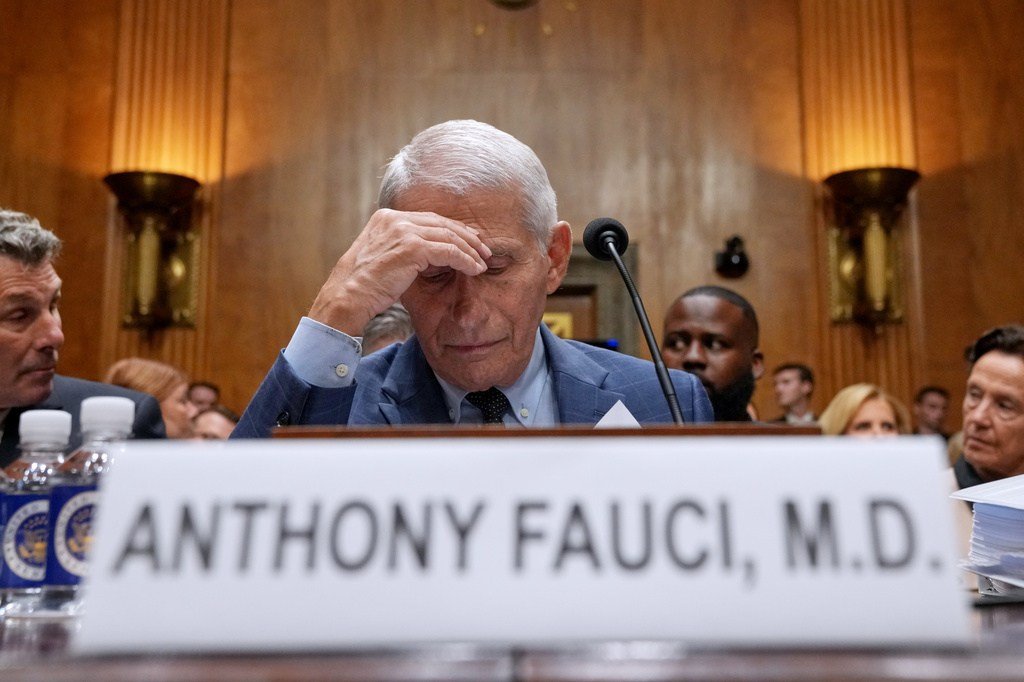
The Senate's decision to hold Dr. Anthony Fauci in contempt of Congress has thrust a rarely used parliamentary tool into the political spotlight, exposing both its historical roots and its modern-day limitations. The move, driven by Senator Rand Paul (R-KY), chairman of the Homeland Security and Governmental Affairs Committee, has sparked a debate over the efficacy of contempt citations in an era of heightened partisanship.
Contempt of Congress is an implied power, not explicitly written into the Constitution, but it has been a cornerstone of legislative oversight since the nation's founding. The power dates back to English parliamentary practice and was adopted by colonial legislatures. It wasn't until 1857 that Congress codified the penalty for refusing to testify or produce documents, making it a misdemeanor punishable by up to $1,000 in fines and 12 months in prison. Before that, Congress held its own trials and even maintained a jail cell in the Capitol to compel cooperation.

The current controversy stems from an August 6 hearing where Fauci, the former chief medical adviser to President Biden and ex-director of the National Institute of Allergy and Infectious Diseases, declined to answer over 100 questions, citing his Fifth Amendment right against self-incrimination. The committee, voting along party lines, found him in contempt. Paul, vowing to bypass the full Senate's 60-vote threshold, sent the matter directly to then-Acting Attorney General Todd Blanche for prosecution.
What complicates the case is that Fauci had already received a preemptive pardon from President Biden covering any federal offenses between January 2014 and January 2025. Paul argued this pardon negated the need for Fauci to invoke the Fifth, while Fauci called the inquiry a "perjury trap." The referral was formally sent to Vice President JD Vance, as Senate president, only on August 25.
According to a Wall Street Journal report, the Trump administration is now in a difficult position. President Trump, while critical of Fauci's COVID-19 decisions, has expressed reluctance to push for prosecution, respecting the presidential pardon as "a powerful thing." This ambivalence gives the Justice Department discretion in whether to pursue the case, likely leaving it to the U.S. Attorney for the District of Columbia.
Historically, contempt citations have yielded mixed results. In the 117th Congress, Steve Bannon and Peter Navarro were convicted and imprisoned for defying Jan. 6 committee subpoenas, while Mark Meadows and Dan Scavino were cited but not indicted. More recently, Bill and Hillary Clinton agreed to testify voluntarily in the Epstein scandal after facing a contempt threat.
The Fauci case underscores the "club behind the door" nature of contempt power—a deterrent more than a frequent prosecutorial tool. As political battles intensify, its use has become more frequent, but its effectiveness remains uncertain. The DOJ's decision on whether to prosecute Fauci will be a test of how this historical power adapts to contemporary political pressures.
For now, the legal minefield surrounding the referral suggests the issue may linger without resolution, leaving Congress's oversight authority in a state of flux. The party-line vote in committee has set the stage for a broader debate on the limits of legislative power.