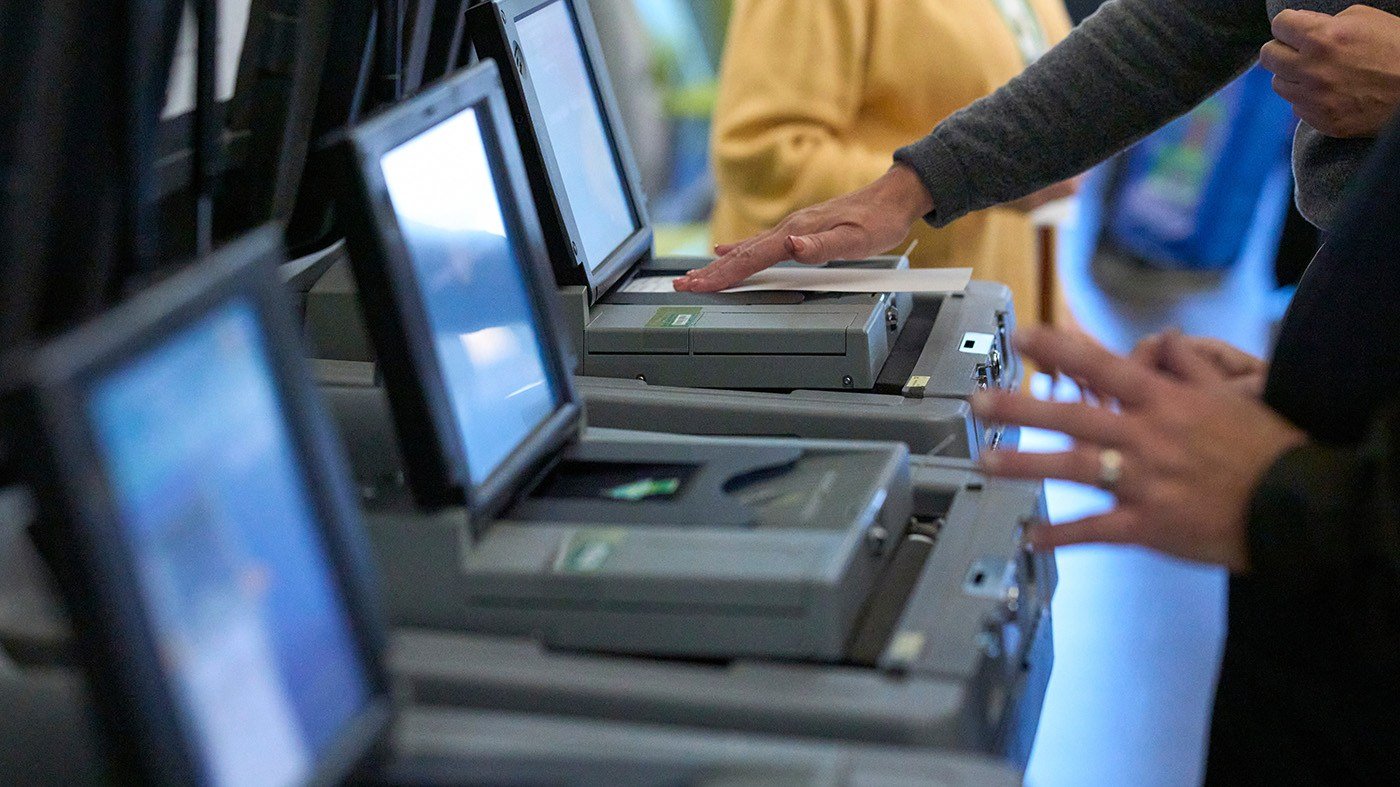
Early voting numbers are climbing across several pivotal states, offering Democrats a glimmer of hope that their polling strength will translate into a decisive turnout advantage on Election Day. In North Carolina, more than 1.2 million ballots have already been accepted, a 37 percent jump compared to the same period in the 2022 midterms, according to an analysis by Catawba College political scientist Michael Bitzer.
That surge, which includes both in-person and mail-in ballots, is being driven by a 47 percent increase among registered Democrats and a 60 percent rise among unaffiliated voters. Republican early voting, meanwhile, is up just 2.6 percent. Similar patterns are emerging in other states, particularly in traditionally Republican-leaning areas with competitive Senate races this cycle.

Nationally, more than 23 million ballots have been accepted, compared with over 15 million at a comparable point in 2022. In Kansas, early voting is up roughly 69 percent, while Maine and Iowa have seen increases of 41 percent and 24 percent, respectively, according to a New York Times analysis of state election records through Thursday.
Michael McDonald, a University of Florida political science professor who tracks early voting, said Democrats and unaffiliated voters are consistently outpacing Republicans in turnout gains across states where party registration data is available, including Kansas, Maine, Iowa, and Nebraska. “It’s the same pattern. Democrats and unaffiliateds are engaged. Republicans are not as engaged,” McDonald told The Hill, adding that this explains why the battleground appears to be shifting into red states.
McDonald cautioned that early voting numbers can be influenced by factors like when mail-in ballots are distributed, and that party registration doesn’t always predict a voter’s choice. Still, he said the data aligns with polling that shows Democrats in a strong position. “The early voting data is just telling me that what we know from the polling data is correct. That yes, the polling is not telling us something wrong. There’s not some big polling miss on the horizon,” he said.
In Texas, Democrats are hoping Senate nominee James Talarico can break the party’s three-decade losing streak in statewide races. But Texas doesn’t register voters by party, making it harder to gauge whether Democratic enthusiasm is translating into early ballots. Decision Desk HQ’s modeling estimates that among the 2.06 million ballots cast so far, 44.3 percent came from Democrats and 43.7 percent from Republicans, with Hispanic voters favoring Democrats by roughly 2.5 to 1.
Democratic strongholds like Travis County, which includes Austin, are showing particularly strong participation. More than 158,000 in-person ballots were cast in the first four days of early voting, up 61 percent from 2022 and 19 percent from 2018, though the county’s electorate has grown since then. Luke Warford, chair of the Travis County Democratic Party, said, “In Travis County, where Democrats really need to run up the score, we’re beating 2022 and 2018 turnout levels—elections when Beto [O’Rourke] was on the ballot—and pacing towards 2024 turnout.”
However, high turnout alone may not secure a win for Talarico, according to University of Houston political science professor Brandon Rottinghaus. “Democrats don’t just need high turnout to win statewide. They need urban margins large enough to overcome rural margins, and Republicans’ rural floor has risen since 2018,” he said. He also noted that the surge isn’t exclusively a Democratic story, with rural areas “slow out of the gate but catching up.”
In Georgia, where Sen. Jon Ossoff (D) is favored to win re-election, voters also don’t register by party, so analysts rely on geographic and demographic clues. Early voting is slightly higher than in 2022, with about 1.5 million ballots cast through Thursday. Andra Gillespie, a political scientist at Emory University, said Democrats likely benefit from elevated turnout among Black voters and those in metro areas like Atlanta, Athens, Savannah, Macon, and Augusta, though participation is also strong in GOP-leaning counties like Cherokee and Forsyth.
In Virginia, where Democrats are targeting several GOP-held House seats, nearly 930,000 early ballots had been cast by Thursday, an 80 percent increase from the same point in 2022, according to the Virginia Public Access Project. The early voting trends are closely watched as a signal of same-day registration options and other factors that could shape turnout. With the midterms approaching, the data suggests a potentially significant shift in the electoral landscape.