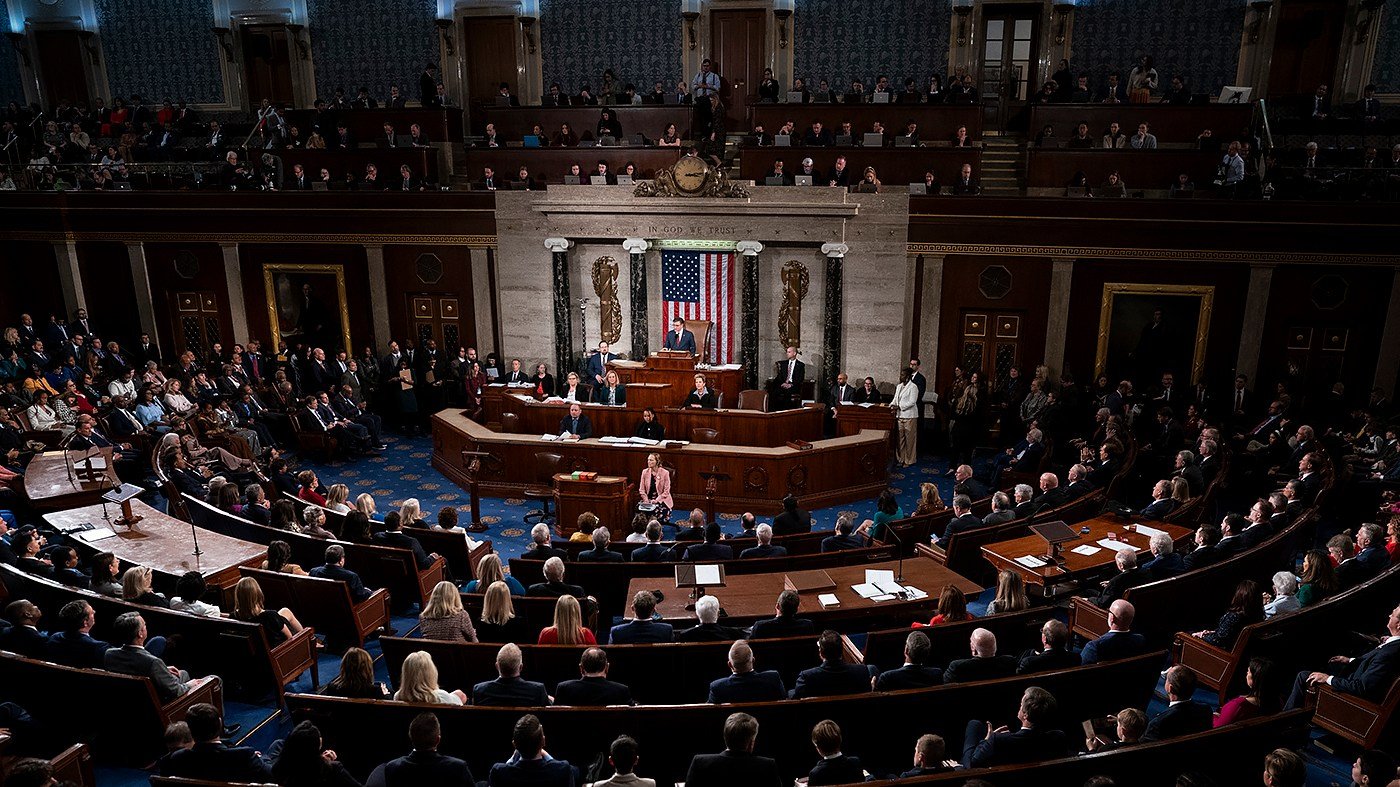
Robert E. Rubin, who served as Treasury secretary under President Bill Clinton, has raised an unsettling prospect: that President Trump and his allies could exploit a procedural loophole involving the House clerk to refuse to seat duly elected Democratic members when the new Congress convenes on Jan. 3. Rubin didn't spell out the details, and he didn't respond to requests for elaboration. But after consulting with experts, it appears he's referring to the fact that the clerk for a new Congress, by long-standing custom, is the carryover clerk from the previous Congress—currently Kevin McCumber, elected by the Republican majority in 2023. McCumber is widely respected on both sides of the aisle.
That has fueled speculation that Speaker Mike Johnson (R-La.) might oust McCumber before noon on Jan. 3 and replace him with a clerk more amenable to manipulating the roll. The fear is that a clerk could omit certain members-elect from the roll call, disenfranchising them and swinging majority control back to the Republicans. But can a clerk actually do that? Historically, yes—but it's not that simple.
In modern practice, the clerk's role is largely ministerial. When a state's top election official—governor or secretary of state—certifies election results, the clerk is expected to recognize those certificates. If a losing candidate or another member contests an election, the House Administration Committee investigates, but the challenged member is provisionally sworn and seated in the meantime. That's been the norm in recent times.
But it wasn't always so. In the 19th century, the clerk's office was highly partisan, and there were instances where clerks simply refused to call certain names. In 1863, Clerk Amerson Etheridge excluded 16 members-elect from five pro-Union states while including three from Louisiana. That effort failed, and a new clerk, Edward McPherson, was elected. Two years later, during Reconstruction, McPherson omitted members from Tennessee, Virginia, and Louisiana, allowing Radical Republicans to take control of the House, elect Thaddeus Stevens as Speaker, and override many of President Andrew Johnson's vetoes.
In 1839, a dispute over the clerk's refusal to include New Jersey members-elect sparked a broader debate about whether a non-elected clerk could unilaterally disqualify members. The House ultimately asserted its authority: when the clerk refused to recognize a motion to seat the five, members moved to elect the oldest member as chairman, and then Rep. John Quincy Adams was chosen to preside until a Speaker was elected.
The idea of a clerk resurrecting such powers is alarming, but it echoes the Jan. 6, 2021, effort to pressure Vice President Mike Pence to invalidate presidential election results. Pence refused, citing his strictly administrative role under the Constitution. Similarly, the House itself is the ultimate arbiter of election contests—not the clerk.
If the Speaker were to fire the current clerk, he couldn't simply appoint a new one. The House must elect its own clerk, and an interim appointment or elevation of the deputy clerk wouldn't suffice. That's a critical safeguard. As Rep. Jim Himes (D-Conn.), ranking member on the House Intelligence Committee, put it, such a move would be a "break the glass scenario for us."
Fortunately, the precedents are clear: the House must proceed immediately to elect a new clerk if the office is vacant. The House—not the clerk—has the final say on who gets seated. That's a fundamental check on any rogue clerk's ambitions.
Don Wolfensberger, a 28-year congressional staff veteran and former chief of staff of the House Rules Committee, analyzed these historical precedents. He notes that while the clerk's power has been abused in the past, the House has always retained the authority to override it. In the end, the ultimate check lies with the members themselves.
As the new Congress prepares to convene, the focus will be on whether Speaker Johnson attempts any procedural maneuvers. But the institutional safeguards, reinforced by history, suggest that a rogue clerk alone cannot decide control of the House. The members, not the clerk, hold the power to seat their colleagues.