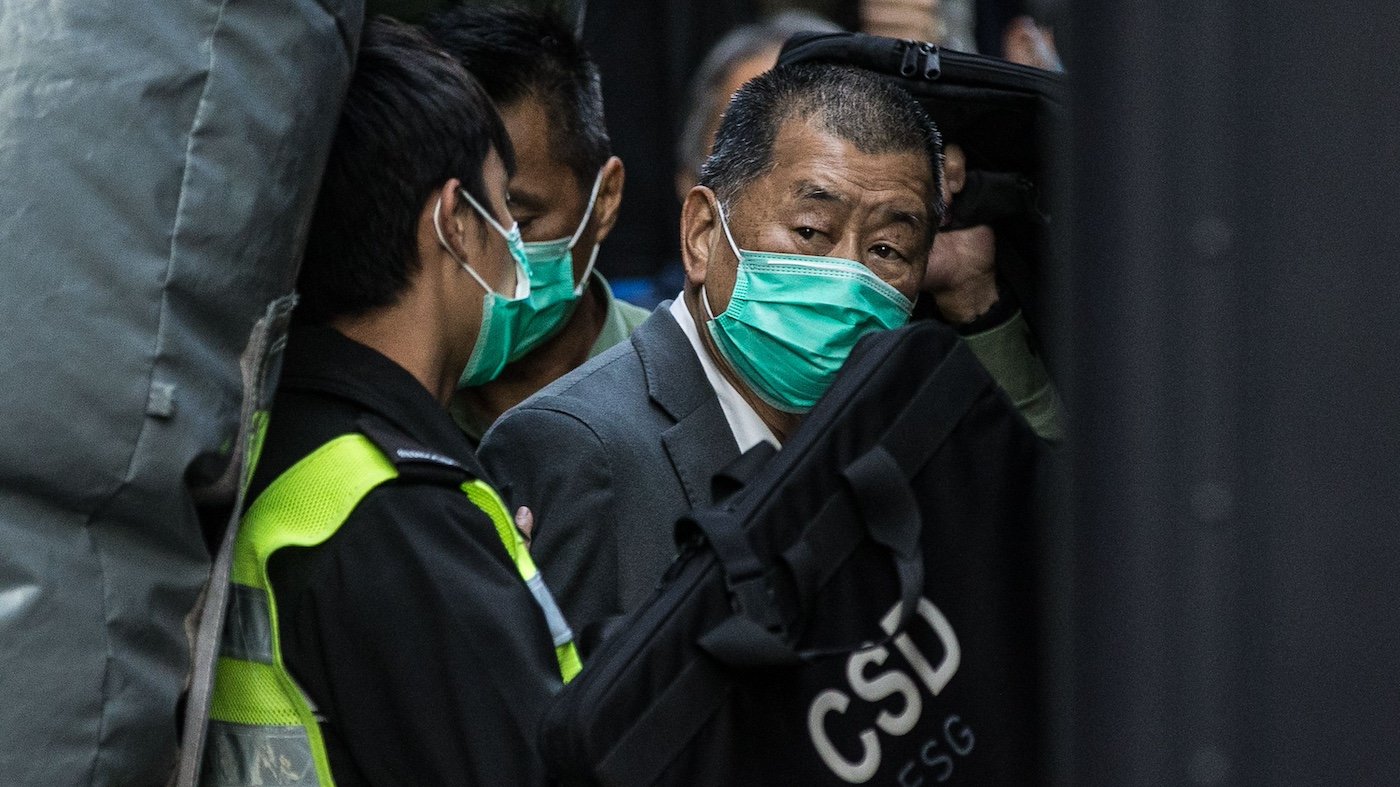
President Trump is heading into a pivotal summit in Beijing this week under mounting bipartisan pressure to demand that Chinese President Xi Jinping release media mogul Jimmy Lai and other political prisoners. Lawmakers from both parties have coalesced in recent months, drafting letters urging Trump to confront Xi over the detentions of Lai—a prominent Hong Kong businessman and democracy advocate—along with Ezra Jin, a Christian pastor at Zion Church, and several others.
Trump has indicated he will raise the cases of Lai and Jin during his meeting with Xi, but questions persist about how much leverage he can exert while also negotiating on contentious issues like the Iran conflict, trade imbalances, and artificial intelligence. “I don’t have any window yet as to whether he will or whether he won’t,” Senator Tim Kaine (D-Va.) told The Hill. “But I think that a bipartisan effort to encourage him to is nothing but a positive. If it was a partisan effort, it probably wouldn’t work.”
Kaine, along with Senator Ted Budd (R-N.C.) and Representatives Tom Suozzi (D-N.Y.) and Riley Moore (R-W.Va.), sent a letter in March pressing Trump to seek Jin’s release. This week, a separate letter from the Congressional-Executive Commission on China (CECC)—signed by both Republicans and Democrats—urged Trump to personally raise the cases of Jin, Uyghur American activist Rushan Abbas, and Uyghur tech entrepreneur Gao Zhen, a U.S. permanent resident. The House is also expected to vote on a resolution calling on Trump to advocate for Jin, Lai, Pastor Gao Quanfu and his wife Pang Yu, and Uyghur doctor Gulshan Abbas.
Sam Brownback, a former U.S. senator and Trump’s ex-ambassador-at-large for international religious freedom, noted the broader context. “President Trump is used to raising these,” Brownback said. “I think you have to look at the longer-term play that takes place here. This is the first meeting after really some period of time. There’s a lot of tension in the air. I think probably the biggest pull or desire for this meeting will just be to try to reduce the global tension more than anything.” The summit marks Trump’s first trip to China since 2017 and is expected to set the tone for U.S.-China relations going forward.
For families of detainees, the stakes are deeply personal. Rayhan Asat, sister of Ekpar Asat—a Uyghur who vanished in 2016 after a State Department program in Washington—said, “This is the most scary part of all. For years we didn’t know. I didn’t even know what happened to him.” She later worked with lawmakers who wrote to the Chinese Embassy in 2019. Asat has since met with White House officials under the second Trump administration and feels “hopeful” due to the administration’s “peace through strength” foreign policy approach. “I trust that this is a matter of great concern for the Trump administration, this case specifically,” she said.
Most attention has focused on Lai and Jin. Lai, a vocal critic of the Chinese Communist Party, was convicted late last year of conspiring to collude with foreign forces and publishing seditious material. Ryan Hass, director of the China Center at the Brookings Institution, observed, “The Trump administration has not shown a fidelity to human rights as an issue. But they have indicated at various points interest in specific cases, Jimmy Lai, and Pastor Jin could be another. My understanding is that he did raise Jimmy Lai in Busan,” referring to their last meeting in South Korea in October 2025.
Trump stirred controversy on Monday by comparing Lai to former FBI Director James Comey, saying Lai had “caused a lot of bedlam” for Xi—though he added he would like to see Lai freed. The Justice Department recently indicted Comey, a political opponent of Trump’s. Trump also said he plans to raise Jin’s case, who was arrested in October for leading the underground Zion Church. Secretary of State Marco Rubio, traveling with Trump to China, called for Jin’s “immediate release” after his arrest last year.
Grace Jin Drexel, Jin’s daughter and an American citizen, acknowledged the difficulty: “I understand it’s a difficult ask. There are definitely so many topics that the two most important countries in the world are going to talk about, but for me, this is the most important thing for me and my family.” Asat echoed that sentiment, noting increased awareness in Congress and the administration. “There is so much better awareness within the Congress, within the State Department, within the Trump administration about what is at play here,” she said. “This is not just about political prisoners; it’s about human lives.”
For more on Trump’s ongoing policy battles, see our coverage of Trump's Gas Tax Holiday Faces GOP Resistance Over Highway Fund Concerns. Meanwhile, the president’s China trip has also drawn attention for its cultural side, as Brett Ratner Joins Trump's China Trip to Scout 'Rush Hour 4' Locations.