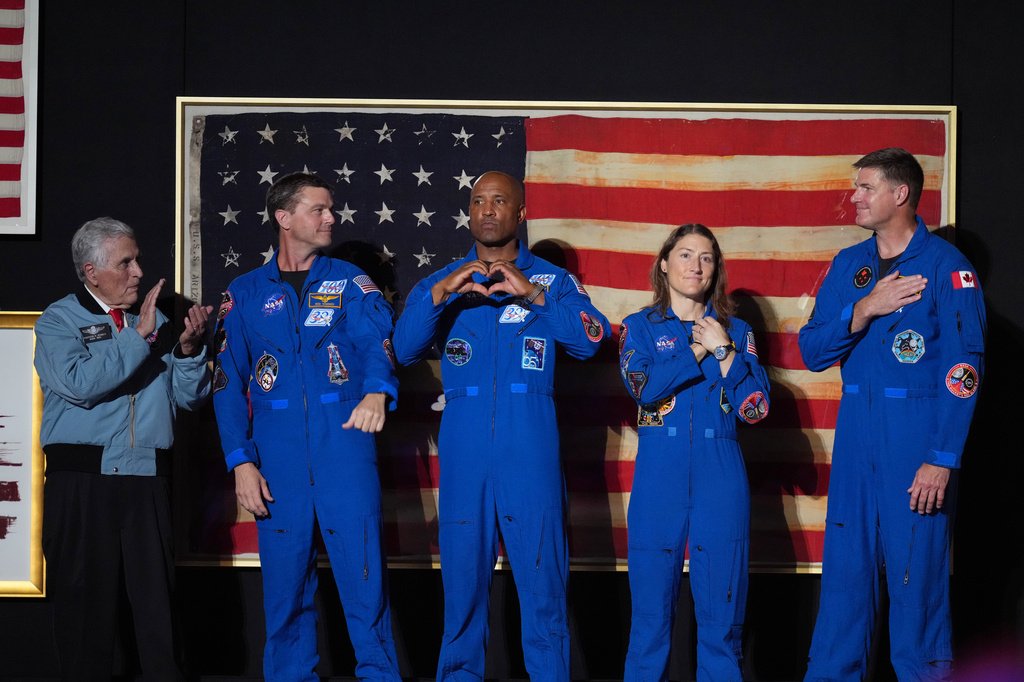
Nearly seven decades after President Dwight D. Eisenhower created NASA, the United States is again pushing the boundaries of human spaceflight. The Artemis II mission, which carried four astronauts around the Moon and back in April, has become a touchstone for American ambition—and now lawmakers want to honor its crew with Congress's highest civilian award.
On April 1, Artemis II launched from Kennedy Space Center, and nine days later splashed down in the Pacific Ocean. Commander Reid Wiseman, Pilot Victor Glover, and Mission Specialists Christina Koch and Jeremy Hansen traveled 252,756 miles from Earth—farther than any humans before them. It was the first crewed flight beyond low Earth orbit and around the Moon in 53 years.

The mission also broke significant barriers. Glover became the first Black astronaut and first person of color to journey beyond low Earth orbit and circle the Moon. Koch became the first woman to achieve that feat. Hansen, representing the Canadian Space Agency, became the first Canadian and first non-American to do so. Wiseman, who commanded the mission, has now logged 175 days in space across two flights.
To recognize these achievements, Rep. Don Bacon (R-Neb.) and Sen. Mark Kelly (D-Ariz.) introduced the bipartisan, bicameral Artemis II Congressional Gold Medal Act. They are joined by co-chairs of the Advancing Humanity in Space Congressional Caucus: Reps. George Whitesides (D-Calif.), Gabe Evans (R-Colo.), and Glenn Ivey (D-Md.). The legislation would award each crew member a Congressional Gold Medal, an honor last given to astronauts in 2009 for the Apollo 11 crew and John Glenn.
“These milestones place Artemis II among the defining achievements in human spaceflight,” Bacon said. “The medals would recognize the crew's achievement and the extraordinary national effort behind it—thousands of scientists, engineers, technicians, manufacturers, and military personnel helped send these astronauts around the Moon and bring them safely home.”
The bipartisan support underscores a rare moment of unity in a polarized Congress. Kelly, a former astronaut who flew four space missions, and Bacon agreed immediately that the crew deserved recognition. “Republicans and Democrats in both chambers have joined us because American achievement in space deserves to be celebrated and sustained,” Bacon noted.
Beyond the symbolic honor, Bacon emphasized the practical dividends of space exploration, from GPS and weather satellites to innovations that boost agricultural productivity and strengthen American industry. He also pointed to Nebraska's stake in the Artemis program, with four state suppliers contributing to ground systems at Kennedy Space Center and the University of Nebraska-Lincoln's Big Red Satellite team sending a CubeSat to the International Space Station in 2024.
Bacon, who chairs the House Armed Services Subcommittee on Cyber, Information Technologies and Innovation, warned of growing threats in space. “China continues to expand its satellite capabilities and counterspace weapons, while Russia develops ways to threaten systems in orbit,” he said. Given America's reliance on satellites for banking, communications, weather forecasting, and power grid operations, he argued that maintaining a strategic edge is essential for both economic and national security.
The legislation arrives as NASA prepares for future Artemis missions, including a planned lunar landing. As the nation approaches its 250th anniversary, Bacon framed the bill as a way to recommit to American leadership in space. “America did not reach 250 years by standing still,” he said. “We should carry Artemis II's momentum into the next era of discovery, innovation, and security in space.”