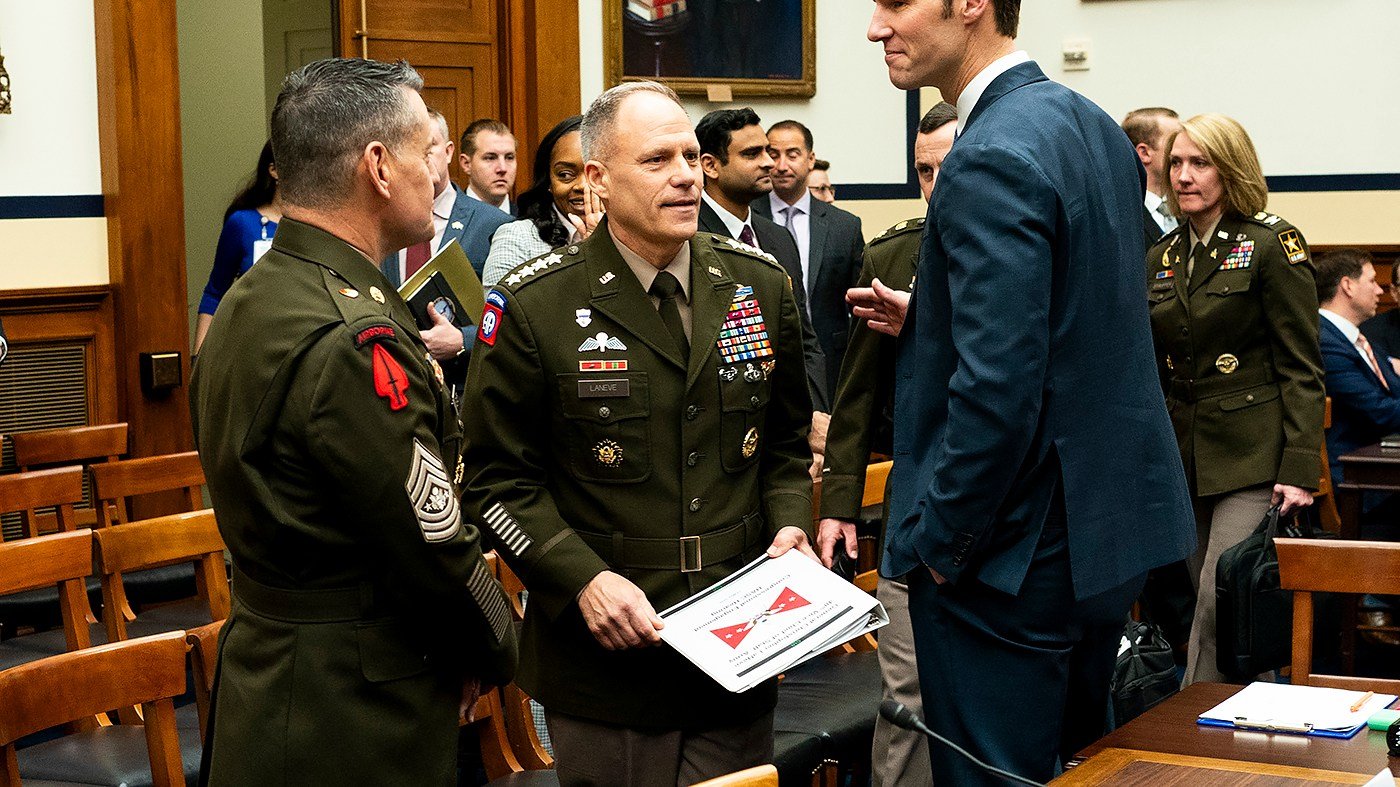
Acting Army Chief of Staff Gen. Christopher LaNeve moved to calm defense industry anxieties on Tuesday, declaring that the service is not retreating from its modernization drive despite the abrupt departures of its top civilian and uniformed leaders earlier this year.
“The secretary and I are not walking away from modernization,” LaNeve told an audience at the Dwight D. Eisenhower luncheon during the Association of the United States Army conference in Washington. “In fact, quite the opposite. We are sprinting towards it.”

His remarks follow a turbulent period for the Army. Defense Secretary Pete Hegseth fired Gen. Randy George as chief of staff, and Army Secretary Dan Driscoll resigned in late August after months of friction with Hegseth. LaNeve, who had been vice chief of staff, was elevated to the acting role.
The leadership turnover raised questions about the future of the Army Transformation Initiative, a sweeping effort launched last April to accelerate technological experimentation, cut bureaucratic red tape, and funnel resources toward high-priority operational needs. But LaNeve insisted the service’s commitment to change remains intact, pointing to a new 46-page framework titled “How the Army Fights,” which he signed and which was published last week.
That document argues for what it calls “focused modernization,” warning that the Army “cannot and should not modernize everything at once.” Instead, it outlines four priority areas: Convergence, Strike, Close Battle, and Endurance.
“Our investments must strengthen the Army as a collective warfighting system rather than attempt to make every platform technologically superior or equip every formation with every capability,” the framework states.
Acting Army Secretary Adam Telle, speaking Monday at the same conference, echoed that theme, arguing the service must adopt the “speed of business” rather than the “speed of government.” He criticized past practices that favored large, entrenched contractors over smaller, innovative firms.
“We were taking too long to find and fund good ideas,” Telle said. “Agile, hungry companies with brilliant ideas were starved while we forced them to wait.”
LaNeve said the Army’s resources are not “endless,” requiring what he called “threat-informed investments.” He described three categories of capabilities: legacy, enduring, and modern. The service plans to divest aging equipment to free units from maintenance burdens, invest in enduring systems to speed delivery of modern gear, and make targeted bets on scalable technologies that fit how the Army fights within the joint force.
The push to bring in nontraditional defense firms aligns with broader Pentagon efforts to expand capital access for smaller companies, an initiative that has gained traction as the U.S. seeks to outpace adversaries like China. Meanwhile, the Army’s message to industry is clear: the door remains open, but the service will be selective about where it places its bets.