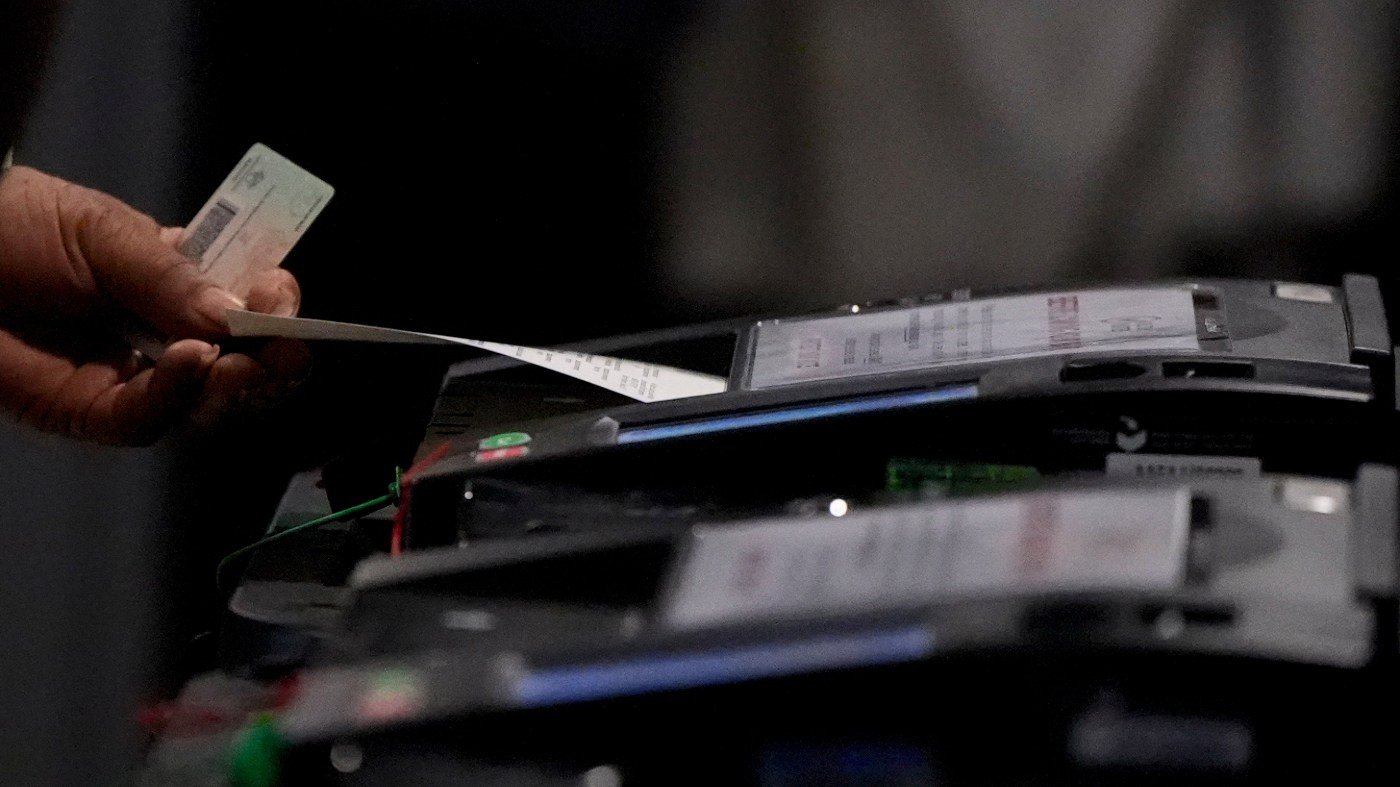
Voters are heading to the polls in two weeks for the first national election in decades without the Voting Rights Act's core protections against racial discrimination. That reality is being met with celebration in some quarters, but for civil rights advocates, it marks a dangerous turning point.
Since the Supreme Court's 2013 Shelby v. Holder decision, a string of rulings—most recently Louisiana v. Callais—has systematically dismantled the law's enforcement mechanisms. Todd A. Cox, associate director-counsel at the Legal Defense Fund, which argued both cases before the Court, warns that Black voters are now exposed to a wave of restrictive measures: strict voter ID laws, polling place closures, cuts to early voting, and redistricting schemes that dilute Black voting strength.

“We are facing the greatest attack on voting rights since Jim Crow,” Cox said in an interview. But he insists that abandoning the racial justice principles that underpinned the original 1965 law would be a grave mistake. “We cannot allow cynical, hyper-partisan maneuvering to upend a foundational tenet of our political system: that ours is a government of, by, and for the people—all of us.”
The consequences are already visible. In Tennessee, Louisiana, and Alabama, fair districts have been erased. Cox argues that without intervention, this year's elections could be the last time many communities see fair representation. “Black voters are not political pawns,” he said. “We are not faceless masses waiting to be packed and cracked into districts that most efficiently benefit either party.”
Reimagining the Ballot
To counter these attacks, Cox urges a bold rethinking of election mechanics. He points to proven reforms like ranked-choice voting, cumulative voting, and limited voting, which have been shown to increase turnout when used in local elections. These systems can give Black voters a real chance to elect candidates of their choice, especially in communities where they cohesively support the same candidates but are consistently shut out.
“There may be no magic wand that works in every locale,” Cox acknowledged, “but we certainly should take hold of every tool in our toolbox.”
Fighting in the Courts and Legislatures
While embracing new voting methods, the Legal Defense Fund continues to challenge discriminatory redistricting in court. Recent victories include defending the sole majority-Black judicial subdistrict in DeSoto County, Mississippi. At the federal level, Cox points to the John R. Lewis Voting Rights Advancement Act, which would restore and strengthen the original law's provisions. But with Congress stalled, he emphasizes the importance of state-level action.
“We must continue to throw our resources behind passing, enacting, and ensuring funding of state Voting Rights Acts,” he said. In 2026, the Legal Defense Fund helped enact such laws in Maryland, Delaware, New Jersey, and California for the first time in history. These measures provide crucial protections against local discrimination.
Community mobilization remains a key part of the strategy. The Legal Defense Fund has partnered with groups for initiatives like “All Roads Lead to the South” in Alabama and this year's March on Washington in D.C.
Rejecting Partisan Manipulation
Cox argues that voting rights should not be a partisan football. “For too long, voting rights and ballot access have been considered under the very partisan conditions that plague our system,” he said. “If we keep letting politicians decide where the power lies, we all lose.”
He calls for reforms rooted in justice, not partisan gain, and warns that history shows fair representation is essential to a functioning democracy. “On our long march for fair representation, we must demand voting reforms rooted in justice and reject attempts to manipulate our electoral systems to promote partisan gains at the expense of Black representation.”