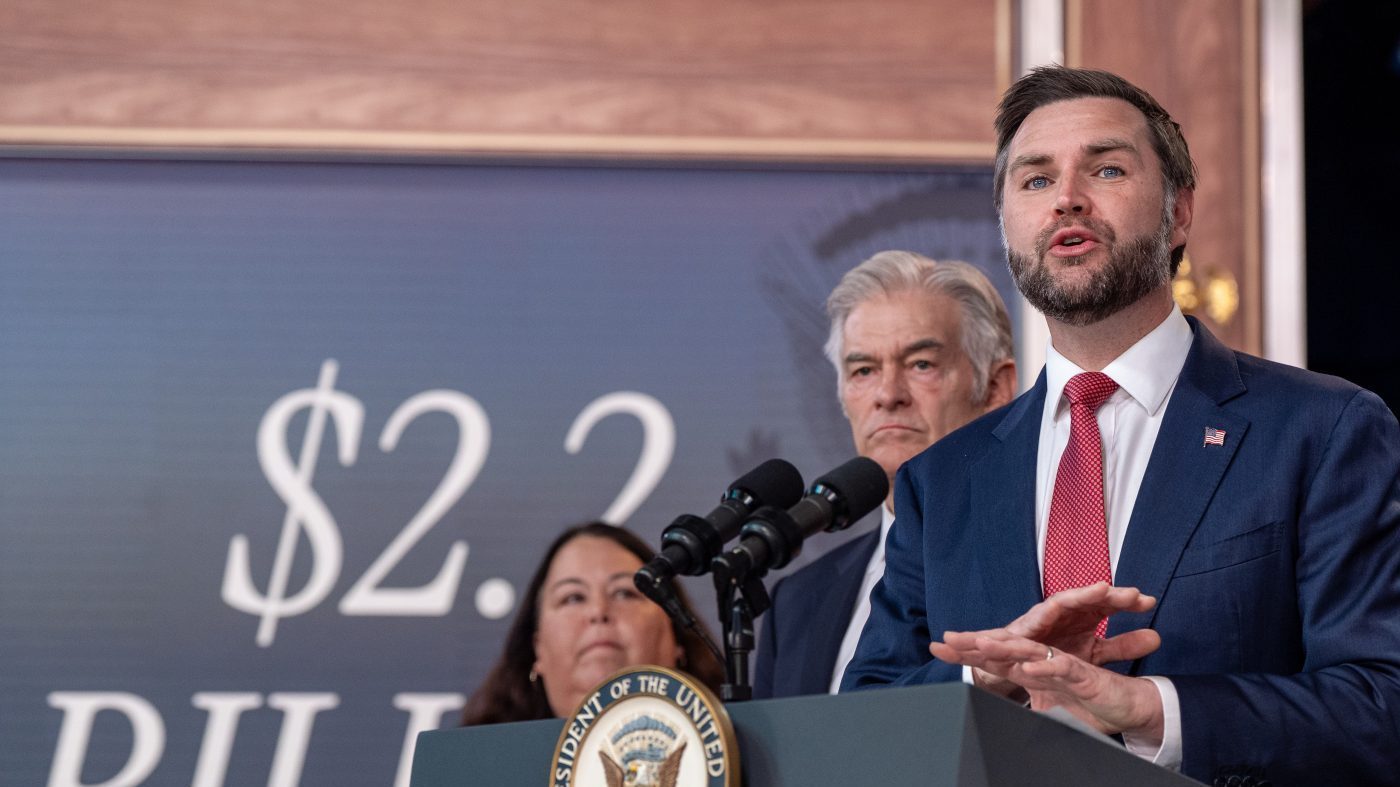
Vice President JD Vance used a Tuesday event for the administration's fraud task force to needle two news organizations that President Trump recently barred from the White House. Appearing alongside Dr. Mehmet Oz, administrator of the Centers for Medicare and Medicaid Services, Vance glanced at his notes and remarked, "I have my notes here that I'm supposed to take questions from CNN and Politico. Anybody from CNN and Politico here? No? OK."
Oz, standing behind the vice president, laughed at the quip, and Vance turned to give him a thumbs-up. The moment underscored the administration's combative posture toward certain outlets, which escalated last Friday when Trump announced on Truth Social that CNN, Politico, and MS NOW would be excluded from the White House press area due to what he called their "constant 'reporting' FAKE NEWS."
Trump did not explain the timing of the ban, telling reporters in the Oval Office that it stemmed from "cumulative stories" over his second term. On Tuesday morning, upon arriving at the UN General Assembly in New York, the president expressed surprise at seeing CNN's chief White House correspondent, Kaitlan Collins, among the press. "You should not be here covering me. You said you weren't going to be covering me," he told her. Collins later said on air that she was credentialed for the UN event and that the network "never said we were not going to cover the president."
The three outlets filed a joint lawsuit against the administration on Monday, arguing the ban constitutes a "direct assault on the First Amendment" and a "blatant violation of our most fundamental constitutional principles." The legal challenge sets up a high-stakes confrontation over press access, reminiscent of other recent disputes such as San Francisco's lawsuit against Trump Media over paid early access to Truth Social posts.
Trump defended the ban in a Monday evening Truth Social post, writing, "The White House is not instituting an assault on the Free Press, something which I cherish. It is instituting an assault on the FAKE NEWS, something that has grown like Cancer in our beloved United States of America."
Secretary of State Marco Rubio echoed that defense Tuesday on NBC News' "TODAY" show, telling host Craig Melvin, "I don't think the White House is saying they're not able to cover the President. What he is arguing is, why should I have these people? What right do they have to be embedded in this building? They can cover the White House; they just can't have a desk there."
Also on Monday evening, the White House unveiled its own 24/7 YouTube streaming channel, branded Trump TV. The administration's official social media account promoted it as a destination for "top past moments, announcements and the latest and greatest from the administration all in one place," adding, "Not every big moment has made it on your tv, now it can." The move signals a further push to bypass traditional media, a strategy that has also played out in international settings like Trump's recent UN address.
The ban and the ensuing lawsuit have drawn sharp reactions from press freedom advocates, who warn of a chilling effect on White House coverage. The administration, however, shows no signs of backing down, with Vance's lighthearted jab serving as the latest example of its defiance. As the legal battle unfolds, the question of whether the president can selectively exclude outlets from the White House grounds will likely test the boundaries of executive power and the First Amendment.